
What does it look like when two women hold each other up for half a century — through career firsts, dead husbands, cancer, and the slow erosion of everything they fought to build?
I started this one on a Saturday afternoon. Frida was asleep on my lap, Diego was doing that thing where he stares at me from across the room like I owe him money, and I had a client's brand kit open on my second monitor that I absolutely was not working on. Nine and a half hours later, I was a wreck.
Two Women Who Refused to Be Footnotes
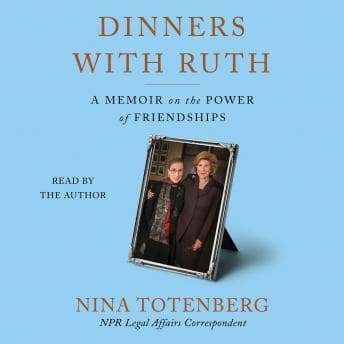
Nina Totenberg and Ruth Bader Ginsburg met because Nina picked up the phone in the early '70s to ask about a legal brief arguing that sex discrimination was unconstitutional. That's it. A phone call. And from that call grew a friendship that outlasted husbands, illness, political shifts, and decades of Washington dinner parties. What got me wasn't the Supreme Court stuff — though there's plenty of that — it was the small, domestic architecture of their bond. Saturdays reserved for Ruth in Nina's home during RBG's final year. Shopping trips where they understood that for women in male-dominated spaces, clothes weren't vanity but armor. The way Nina describes drawing Ruth out of grief after Martin Ginsburg died, mirroring how Ruth had done the same for her twelve years earlier when Nina lost her first husband.
My heart. MY HEART.
This book felt like sitting at your abuela's kitchen table while she tells you about the friend who really knew her — not the public version, not the legend, but the woman who called on a Tuesday just to check in. She would've been clutching her rosary during the illness chapters and then immediately asking me to replay the part about the opera trips.
Nina's Voice Is the Story (For Better and Occasionally Worse)
Here's the thing about author-narrated memoirs: you're getting the real person. Nina Totenberg is a radio journalist who's been telling stories on air for decades, and you can hear that training. Her pacing is deliberate and attentive — she knows when to speed up during a lively anecdote about Scalia arguing with RBG over dinner and when to slow down and let the weight of a moment land. When she talks about Ruth's death, her voice cracks in a way that no hired narrator could replicate. That's not performance. That's grief.
But — and I say this with love — her voice is reedy. It has this particular thinness that, over nine-plus hours, can wear on you. I noticed it most in the middle chapters where the book dips into more standard Washington memoir territory — the NPR colleagues, the various justices, the professional milestones. During those stretches, I found myself adjusting my headphones, shifting in my chair, a little restless. It's not that the content is bad, it's that Nina's voice doesn't have the warm velvet quality that makes you want to sink into long stretches of narration the way, say, Julia Whelan does.
And then there are the violin interludes. Nina's father, Roman Totenberg, was a legendary violinist, and snippets of his playing are woven between sections. The first time it happened I literally stopped mid-design and just... sat there. It's such a tender production choice — this man's music living on inside his daughter's story about the women and friendships that shaped her life. I ugly-cried. Obviously.
The Friendship Chapters Hit Different Than the Career Chapters
I'll be honest: this book is uneven. The sections about Nina's friendship with Ruth — the dinners, the illnesses, the quiet Saturdays — are devastating and beautiful and specific in a way that made me text my best friend at 10 PM just to say "hey, I love you." But the book also tries to be a broader memoir about women breaking into journalism and law, and those parts sometimes feel like they're checking boxes. The chapters about Cokie Roberts and Linda Wertheimer are warm but surface-level. The Supreme Court history is interesting but reads more like a well-written NPR segment than a deeply personal story.
The vibes are immaculate when Nina stays intimate. When she zooms out to chronicle an era, the energy dips. Not enough to stop listening, but enough to notice. Rabbit: The Autobiography of Ms. Pat has that same quality — it's electric when it's personal and a little airless when it tries to be a broader cultural document, which I say as someone who sobbed through the intimate chapters and skimmed exactly zero of them.
Who This Is For (and Who Should Wait)
If you care about female friendship — real, weathered, fifty-year female friendship — this is your book. If you want a window into how women navigated Washington when they were basically told to sit down and be quiet, it's here. If you loved RBG as a public figure and want to see her as a private one — the friend who showed up, who shopped for clothes like it was strategy, who spent her last Saturdays eating dinner at Nina's house — you will cry. I cried at least three times. (Adding to the spreadsheet.)
But if author-narrated books are hard for you, or if you need consistent pacing across nine hours, maybe borrow this one first. Nina's voice is an acquired taste, and the middle sags a bit.
Saturdays Are for the People Who Show Up
This one asks you to slow down. Put your phone down, light a candle, and let a woman in her seventies tell you what it means to really, truly have someone's back for a lifetime. The political stuff fades. The career milestones blur. What stays is two women eating dinner together on a Saturday night, year after year, because that's what love looks like when you strip away everything else.