
I didn't expect to spend twelve hours listening to a book about a bartender on a train and come out the other side thinking about Fitzgerald. But here we are.
I started this during a particularly brutal stack of sophomore essays on The Great Gatsby—ironic, given how much Dining Car channels that same American Dream disillusionment through its unlikely friendship between a washed-up college football player and a legendary food critic who travels the country in a private railroad car. By hour three, I'd stopped grading entirely. (Sorry, second period. Your analysis of the green light will have to wait.)
The Odd Couple on Rails
Eric Peterson clearly knows his trains. The man worked for Amtrak, and it shows—not in tedious technical detail, but in the lived-in authenticity of how his characters move through these spaces. The private railroad car becomes its own character, a rolling monument to a dying form of American elegance. This reminds me of what Hemingway said about writing what you know, except Peterson also knows fine dining, and software apparently, and weaves all of it into something that feels both nostalgic and sharp.
The central dynamic works because it shouldn't. Our narrator—former athlete, current bartender, perpetually out of his depth—serves as the reader's surrogate into a world of high society widows and eccentric food writers. It's a classic mentor-protégé setup, but Peterson doesn't let it calcify into formula. The legendary Horace Button is demanding, ridiculous, and genuinely wise in unpredictable measures.
Graham Hamilton Knows That Silence Is Punctuation
Here's where I need to talk about the narration, because Hamilton does something I rarely hear: he trusts the silences. When the grief sequences hit—and they hit with surprising weight for what bills itself as a quirky travel narrative—he doesn't oversell. He lets the prose breathe.
But the real magic is in his range. His voice drops into this resonant bass for the more serious moments, then pivots to genuine comedy without whiplash. The drinking scenes are particularly impressive—you can actually hear the difference between characters who've had two glasses of wine versus those who've had the whole bottle. It's subtle work. The kind of thing you don't consciously notice until you realize you've been picturing completely distinct people for the past several hours.
And his high society widow? Audio antique gold. There's a particular cadence he gives her—aristocratic but not cartoonish—that made me think about how class difference sounds, not just how it reads. My students would hate this analysis. I love it.
What Peterson Is Really Saying
Beneath the charm—and there's considerable charm—this is a book about reinvention. About what happens when the thing that defined you (football, in our narrator's case) disappears and you have to figure out who you are without it. The railroad car becomes a liminal space, literally between destinations, where transformation becomes possible.
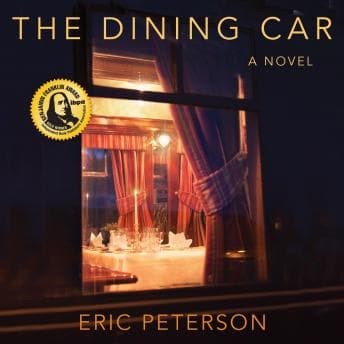
Peterson earned a Benjamin Franklin Gold Award for this, and I understand why. The prose deserves to be savored. He's working in a tradition of American road narratives, but the train setting gives it a different rhythm. Slower. More contemplative. You're not racing through landscape—you're watching it unfold at a pace that lets you actually see it.
The 11-year-old girl character could have been a disaster. Child characters in adult fiction often are. Lost Rider manages a similar feat with its younger characters—giving them agency without making them sound like tiny adults. Hamilton finds a voice for her that's believable without being precious, and Peterson writes her with enough specificity that she becomes essential rather than decorative.
Who This Is For (And Who Should Skip It)
If you loved The Art of Racing in the Rain or A Gentleman in Moscow, this is their spiritual successor—that same blend of unlikely friendship, American setting rendered with European sensibility, and genuine emotional stakes beneath the surface pleasures. Beneath a Scarlet Sky works in that same register—sweeping historical backdrop, intimate human connection, and a narrator who makes you feel every mile of the journey. Skip this if you need fast pacing or can't stand leisurely character studies. But if you want something that rewards patience? This is it.
Last Stop on the Line
I finished this at 11 PM on a Tuesday, Denise already asleep, the lake visible from our window in that particular Chicago darkness that's never quite dark. The ending isn't tidy—Peterson respects his readers too much for that—but it's earned. Every mile of track leads somewhere.
At 12 hours, it's a commitment. But Hamilton's performance makes every minute worthwhile. I listened at 1.0x because the author chose those words—and because Hamilton's delivery rewards patience. Speed this up and you'll miss the texture.
My students would probably call this a "boomer book." They're not entirely wrong. But sometimes the old forms still have something to say.