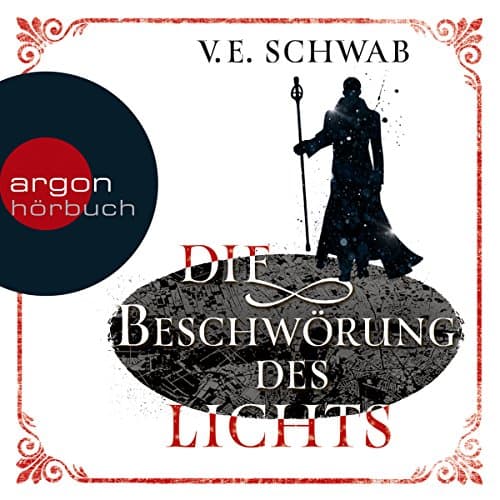

Everyone kept telling me this trilogy sticks the landing. I've been burned by fantasy finales before — enough times that I went in braced for disappointment, honestly. I was shelving returns at the library on a Saturday afternoon, earbuds in, volume low enough that patrons wouldn't notice I was somewhere else entirely. By the time Osaron started spreading through Red London like a spiritual infection, I'd stopped pretending to work and was just standing in the stacks, holding a copy of The Secret Garden and staring at nothing.
Here's the thing about Die Beschwörung des Lichts — this is the German audiobook of A Conjuring of Light, Schwab's finale to the Shades of Magic series, and if you've been following Kell and Lila through these parallel Londons, you know what's at stake. Osaron isn't just a villain. He's a god-shaped absence, the worst thing Black London ever coughed up, and he wants worship. Not destruction. Worship. That distinction matters, because Schwab understands that the scariest antagonists aren't the ones who want to destroy you — they're the ones who want you to love them while they do it.
When Your God Problem Has a God Problem
The question driving this book — "Wie tötet man einen Gott?" (How do you kill a god?) — is genuinely good fantasy scaffolding. Schwab doesn't rush the answer. She sends Kell, Lila, the disgraced pirate-prince Alucard Emery, and the deeply untrustworthy Antari Holland on what amounts to a magical scavenger hunt for an artifact powerful enough to challenge Osaron. The pirate elements are a welcome addition. Schwab's always been good at ensemble dynamics, and watching Holland — a man nobody should trust and everybody kind of has to — navigate forced alliance is one of the book's quiet pleasures.
But that middle section. I felt it. Around hours eight through twelve, the pacing softens into something dangerously close to treading water. There are political machinations and character beats that serve the emotional architecture of the series but don't necessarily earn their runtime in a nearly twenty-hour audiobook. I found myself speeding up to 1.25x during stretches where the intrigue circled without advancing. Not a dealbreaker, but noticeable — especially when the opening and final acts move with such urgency.
Kell's cloak, though — the magic woven into that thing, the way Schwab treats it as almost a character in its own right — that's the kind of detail that rewards trilogy investment. If you've been here since A Darker Shade of Magic, watching what happens to that cloak in the final act hits different.
Peter Lontzek und das Lila-Problem
Peter Lontzek has been the voice of this series in German from the start, and there's real value in that consistency. He reads with conviction. You can tell he's invested in these characters — his Kell carries weight, his Rhy has the right amount of reckless charm. The narration convinced me, which is not something I say lightly about single-narrator fantasy where you're juggling this many POVs across parallel worlds.
But Lila. Look, I love Lila Bard as a character on the page. She's reckless and brilliant and exactly the kind of knife-happy chaos agent fantasy needs more of. But Lontzek's vocal interpretation of her... it grated. There's a quality to how he pitches her dialogue that lands somewhere between "fearless pirate" and "teenager daring you to be annoyed," and over nineteen hours, that line blurs. It's not bad voice acting — it's a choice that doesn't quite land for every listener. And since Lila is essentially co-lead, you're stuck with it for long stretches.
The rest of his work here is solid. He doesn't phone it in. The narrator commits. That's rare, especially in a series finale where voice fatigue would be understandable. But the Lila issue kept pulling me out at moments where I wanted to be fully immersed.
Wer sollte das hier hören — und wer nicht
If you've listened to the first two books with Lontzek, finishing with him is the right call. His consistency across the trilogy means the world sounds the same, the characters feel continuous, and the emotional payoffs land because he's been building toward them for three books. If you're new to the series, don't start here — go back to Die Verzauberung der Schatten and let the world build properly. My own notes on Die Verzauberung der Schatten dig into why that first entry earns the investment — Lontzek already had me then.
Skip this if you need relentless pacing and can't tolerate a saggy middle act. This is a nineteen-and-a-half-hour book that probably should've been sixteen. Schwab's strengths are world-building and character — her plotting occasionally takes the scenic route. Also skip if a male narrator voicing a female co-lead is a hard limit for you; Lontzek's Lila is divisive.
Shelving This One Where It Belongs
I finished the last chapter locking up the library, standing in the dark entryway with my keys in one hand and my phone in the other. Shirley (my cat) was waiting at home, deeply unimpressed as always. But the ending — the actual, real ending — earned itself. Schwab knows how to close a door. Not everyone walks away whole, and the choices characters make in the final hours feel genuinely costly. That's what good fantasy finales owe you: not happiness, but honesty.
My podcast listeners are going to love this — or at least the argument about whether Osaron qualifies as horror. (He does. A god that feeds on devotion is body-horror for the soul.) The German production is clean, Lontzek is reliable if imperfect, and the story wraps a trilogy that deserves wrapping. Not flawless. But earned.