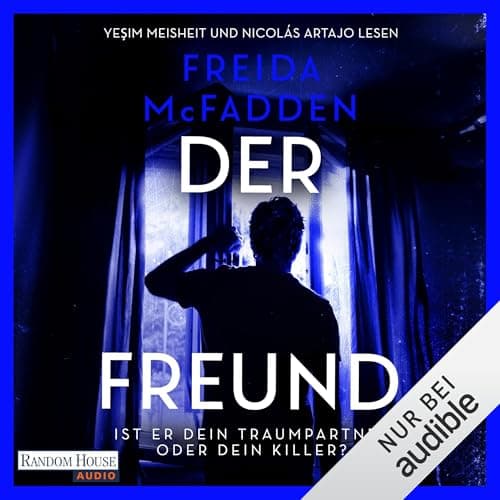

What happens when the person you're sleeping next to might be the reason women in your city keep turning up dead?
I was shelving returns at the library — late shift, mostly alone, fluorescent lights buzzing that specific frequency that makes everything feel like a David Fincher movie — when I hit the halfway mark of Der Freund. And look, I knew going in this was Freida McFadden territory. I've read enough of her work to know the playbook: unreliable narrator, mounting domestic paranoia, a twist that recontextualizes everything. But knowing the playbook doesn't mean you can't still get played.
The Dating App Killer Setup Is Sharper Than It Sounds
The premise reads like a Lifetime movie logline — woman meets perfect man, perfect man might be a serial killer — but McFadden earns it through Sydney's interiority. Domestic paranoia built around an unreliable female narrator is a formula I keep returning to — Hidden Riches runs a similar engine, though it trades the dating-app dread for something slower and more claustrophobic. Sydney isn't just naive. She's someone who's been conditioned by bad dating experiences to distrust her own instincts, which means every red flag Tom throws up gets filtered through her self-doubt. That psychological mechanism is what makes this work as horror-adjacent thriller rather than just another "is he or isn't he" exercise. The serial killer targets women from dating apps, and the investigation creeps closer to Sydney's orbit in ways that feel genuinely suffocating. There's a scene where Sydney finds something in Tom's car — I won't spoil what — that lands with the kind of quiet dread I live for. Not a jump scare. Just the slow realization that the person across the dinner table might be something else entirely.
The twists do come, and they come hard. Listeners who've praised the "Showdown" ending aren't exaggerating — McFadden stacks reveals in the final stretch like she's speedrunning a plot twist competition. Some of them genuinely caught me off guard. At least one felt like it existed purely for shock value. That's the McFadden bargain: you get the dopamine hit, but occasionally at the expense of character logic.
Two Narrators, One Paranoia Engine
This is the German-language edition, narrated by Yeşim Meisheit and Nicolás Artajo, and having two narrators for what is essentially a dual-perspective thriller makes structural sense. The split between Sydney's chapters and — well, the other perspective (no spoilers) — creates a tonal contrast that a single narrator would struggle to maintain. I don't have enough data on Meisheit and Artajo's individual performances to break down specific vocal choices, which is frustrating because narration can make or break McFadden's work. What I can say is that the dual-narrator format serves the paranoia well. When you're hearing Sydney's growing suspicion in one voice and then switching to another perspective entirely, your brain starts doing the detective work on its own. That's smart audio design, even if I can't tell you whether Artajo nails Tom's charm-to-menace shift the way I'd want.
At 8 hours 35 minutes, it's a tight listen. McFadden doesn't pad. The pacing moves like something's chasing it — which, given the subject matter, tracks.
The McFadden Problem (And Why It's Still Fun)
Here's where I get honest. McFadden writes bestsellers because she understands what triggers the "one more chapter" reflex better than almost anyone working in psychological thrillers right now. But understanding mechanics and creating something that lingers are different things. Der Freund is propulsive and clever, but the characters exist primarily as vehicles for plot machinery. Sydney's bad dating history is sketched rather than felt. Tom is charming in the ways the plot needs him to be charming. The supporting cast — the friend, the detective — serve their narrative functions and then exit stage left.
The book understands that horror isn't about gore — it's about dread. And McFadden does generate real dread in the middle act, when Sydney's suspicions are mounting but she can't articulate why. That stretch is the best part of the book. The resolution, while satisfying in a popcorn-thriller way, trades that slow-burn unease for fireworks. I prefer the unease.
Shirley (my cat) was unimpressed. I was entertained — genuinely, solidly entertained — but not haunted. And I want to be haunted.
Who Should Listen (And Who Should Skip)
If you burn through psychological thrillers on your commute and want something that respects your time, this delivers. If you need characters who feel like real people rather than chess pieces in an elaborate twist mechanism, you'll notice the gaps. Skip it if you're after something that crawls under your skin and stays — this is a popcorn thriller, not a slow poison. The German translation by Astrid Gravert reads clean in audio form, and the dual narration adds a layer the English single-narrator version probably doesn't have.
My podcast listeners are going to love this — it's exactly the kind of book that sparks a good "craft vs. entertainment" debate. Is it scary? Sometimes. Is it smart? Structurally, yes. Does it stay with you? Ask me in a week. I suspect the answer is no, but the ride was worth taking.









