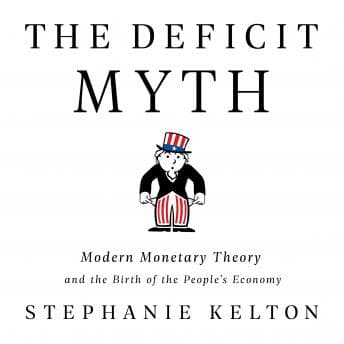

Everyone told me this was the economics book that would "change how I think about government spending." I went in skeptical. I've read enough econ books that promise paradigm shifts and deliver warmed-over Keynesianism with a fresh coat of paint. And honestly? Kelton's core argument did hit different - but not always in the ways I expected.
I started this one during a brutal on-call week where I was basically nocturnal. 3AM, staring at Datadog dashboards waiting for alerts to resolve, and Stephanie Kelton is in my ears explaining why the US federal government is not, in fact, like a household balancing its checkbook. The timing was weirdly appropriate - debugging mental models about how systems actually work is kind of my whole job.
The Federal Government Is a Currency Issuer, Not a Currency User
That's the core thesis, and Kelton hammers it home with the force of someone who has been screaming into the void for two decades. The US government literally creates dollars. It can't "run out" of them the way you or I can run out of money in our checking accounts. The real constraints aren't financial - they're about real resources: labor, materials, productive capacity. Inflation is the actual speed limit, not the deficit number.
She structures the book around six "myths" about deficits and takes them apart one by one. Myth 1 (the government should budget like a household) gets the most thorough treatment, and it's genuinely the strongest section. She walks through the mechanics of how federal spending actually works - the Treasury, the Fed, the way money enters and leaves the economy - and it's clear she's spent years figuring out how to explain this to non-economists. The scoreboard metaphor she uses (the government's deficit is the private sector's surplus, literally by accounting identity) is the kind of thing that sticks in your brain.
But here's where my inner systems engineer started raising flags. She's essentially arguing that a monetary sovereign with its own fiat currency operates fundamentally differently from a household, a state government, or a eurozone country. And she's right about that mechanical distinction. But the leap from "the constraint is inflation, not insolvency" to "therefore we can fund [massive program X]" felt like it skipped some error handling. The inflation constraint is real, and she acknowledges it, but the chapters on how to manage it felt thin compared to the chapters on why deficits aren't inherently scary.
Author-Narrated: The Double-Edged Sword
Kelton narrates this herself, and - look, she's clearly a fantastic lecturer. You can hear the professor energy. She's precise, she doesn't rush, and she genuinely sounds like she cares about making you understand the material. But she's not a professional narrator, and at 10 hours 52 minutes, that matters. There's a certain flatness to the delivery during the more data-heavy sections in the middle chapters (the myths about Social Security and trade deficits) where a narrator like - well, you know who I'm going to say - could've kept the energy up.
I bumped it to 1.75x for the business book sections where she's rehashing examples that felt padded, and 1.5x for the meatier monetary mechanics. That's my standard protocol for books in this genre that could've been tighter at maybe 7-8 hours instead of nearly 11.
Where the Model Breaks (Or Where I Wanted More Stress Testing)
This is basically distributed systems theory but for macroeconomics. And as someone who thinks in distributed systems, I kept wanting her to address the failure modes more rigorously. She spends a lot of time on the happy path - what happens when a currency-issuing government spends wisely, when a federal jobs guarantee absorbs slack labor, when the inflation thermostat works correctly. But the edge cases? Weaker treatment.
What happens when political systems can't actually respond to inflation signals fast enough? Congress isn't exactly known for its sub-millisecond response times. She addresses this briefly but hand-waves toward automatic stabilizers without fully grappling with the political economy problem. And the international comparison sections - why MMT applies to the US and Japan but not, say, Argentina or Turkey - deserved a full chapter, not scattered paragraphs.
Kevin (who majored in econ and loves telling me about it) pointed out that she barely engages with serious MMT critics like Kenneth Rogoff or Larry Summers. That's a fair hit. If you're going to call your book "The Deficit Myth" and position yourself as busting conventional wisdom, you should steelman the opposition harder.
Who Should Queue This Up (And Who Shouldn't)
Perfect for: anyone who has ever sat through a political debate and heard "but how will you pay for it?" and felt like the framing was off but couldn't articulate why. If you're a policy nerd, econ-curious engineer, or just someone who wants a framework for thinking about government spending that goes beyond household budget analogies, this delivers real value.
Skip for: anyone looking for a balanced survey of monetary economics. This is advocacy. Smart, well-argued advocacy, but advocacy. And if you already know MMT basics from Mosler or Wray, chunks of this will feel like a 101 refresher.
The ROI on this audiobook is solid but not spectacular. I finished it in about 5 commutes at 1.5-1.75x, and I came away with a genuinely better mental model for how sovereign currency creation works. That's worth something. But I also came away feeling like the argument was about 70% rigorous and 30% "trust me, the inflation management part will work out." In production, that ratio makes me nervous. I had a similar 70/30 feeling about Choose Your Enemies Wisely — big swinging thesis, implementation hand-waving.
Ship It With Caveats
TL;DR: Worth your commute if you want a clear, accessible breakdown of MMT from its most prominent advocate. Just don't mistake a well-argued case for a complete one. Think of it as a really good RFC - it'll change how you think about the problem space, but the implementation details still need review.









