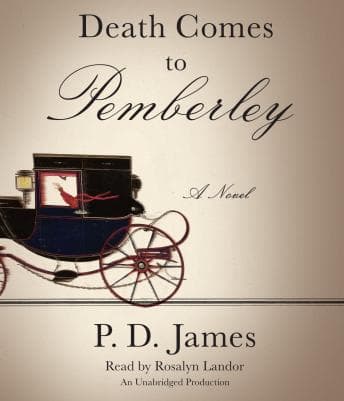

I don't usually pick up literary mashups. My reading life is already split between trauma protocols and whatever thriller I can finish before the kids wake up - I don't have a lot of patience for books that feel like a writing exercise. But my sister-in-law left a copy of Death Comes to Pemberley at my house after Christmas and basically dared me to listen to it. She knows I love a good murder mystery. She also knows I've never finished Pride and Prejudice. (I started it twice. Both times I fell asleep. Don't @ me.)
So I queued it up on a Tuesday morning drive home, post-night-shift, brain running on two cups of bad hospital coffee and the particular exhausted clarity that comes at 7 AM when you've spent the last twelve hours keeping people alive. Which, it turns out, is actually a pretty good headspace for Regency England.
When Jane Austen's World Gets a Body in the Woods
Here's what P. D. James does that I didn't expect: she doesn't just drop a murder into Pemberley like a party trick. She actually earns it. The setup is slow - and I mean slow, like the first hour is basically Elizabeth Darcy managing household logistics and worrying about the ball - but then Lydia comes screaming up the drive in a carriage, convinced Wickham has been murdered in the woods, and suddenly the book shifts into something completely different.
And honestly? The shift works. Because James has spent that first hour reminding you exactly who these people are and exactly how much they have to lose. The Darcys' whole world is reputation and order. A murder - especially one involving Wickham, who has always been the chaos agent in this family - threatens everything. That's not just plot mechanics. That's character stakes, and James understands the difference.
What I genuinely appreciated was that the mystery itself is real. It's not a cozy little puzzle. There's a trial. There's actual procedural weight to it, the kind of attention to consequence that makes you feel like someone is actually going to hang for this. That same unflinching weight in a courtroom is exactly what makes To Kill a Mockingbird so hard to shake - the law as a thing with real human cost, not just a plot mechanism. James doesn't let Regency manners soften the edges of what a murder investigation actually means. That's the crime writer in her refusing to be polite about it, and I respected that.
The Narration: Rosalyn Landor Gets Half of It Right
Okay. Rosalyn Landor. Her accent is genuinely beautiful - that upper-crust British enunciation that makes every sentence sound like it was written to be read aloud in a drawing room. When she's doing Elizabeth, or Georgiana, or Lady Catherine (who doesn't appear but whose presence haunts the whole book anyway), she's excellent. Distinct. Specific. You can hear the class difference between characters in the way she shapes her vowels.
But the men. Oh, the men. Every male character in this book sounds like they've all come down with the same mild throat complaint. Darcy, Wickham, the Colonel, the magistrate - they blur into each other in a way that becomes genuinely confusing during the investigation scenes when multiple men are talking. I found myself rewinding twice during a courtroom exchange because I couldn't track who was speaking. That's not a small problem in a murder mystery where the men are doing most of the legal procedural work.
So: half credit. She's doing something lovely with the women. She's letting the men down. For a book where the central tension runs through both, that's a real limitation.
Prescription for Who Needs This and Who Doesn't
If you love Pride and Prejudice - like, actually love it, have opinions about the 1995 BBC adaptation, have argued about whether Darcy's letter is romantic or manipulative - you will probably adore this. The fan service is real and James clearly did her homework. Listeners who grew up with Colin Firth in that wet shirt will feel right at home.
If you're coming in primarily as a mystery reader, it's worth it, but go in knowing the first third is setup. This is not a fast book. It's a slow-burn procedural wrapped in a bonnet. The payoff is satisfying, but you have to earn it.
If you've never read Austen and don't particularly care about Regency social dynamics? You'll be lost and bored within the first hour. This is not a standalone thriller. It's a sequel to someone else's novel.
For me personally - Austen agnostic, mystery lover, perpetually sleep-deprived - it landed somewhere in the middle. I didn't love it. I didn't regret it. I yelled at my dashboard exactly once, not about medicine but about the fact that the male voices were genuinely indistinguishable during the trial scene. Carlos asked why I seemed annoyed when I got home. I said the book was complicated. He made me coffee and didn't ask follow-up questions. Good man.
Borrow it. Don't buy it. It's a perfectly decent way to spend a commute if you're in the mood for something that takes its time.