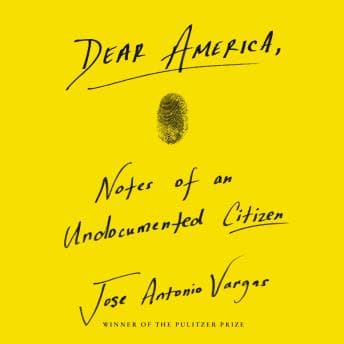

I was walking the lakefront with Denise last Saturday — one of those gray Chicago mornings where the wind off the lake cuts right through your jacket — and I finished this book somewhere between Montrose Harbor and the bird sanctuary. I just stood there for a minute. Denise asked if I was okay. I wasn't sure, honestly.
Jose Antonio Vargas wrote a book that refuses to be what you expect it to be. You pick it up thinking you're getting an immigration polemic, a political argument, a position paper with a spine. And he tells you right at the top: this isn't about immigration. Not really. It's about what happens to a person — psychologically, emotionally, spiritually — when they exist in a country for twenty-five years as a legal ghost. When your name is on a Pulitzer Prize but not on a valid Social Security card.
The Lie That Becomes Your Architecture
Vargas narrates his own story, and this matters enormously. His voice carries the specific weight of a man who has spent decades performing normalcy while internally cataloging every potential exposure. There's a quality to his delivery — his accent, which someone once compared to tropical rain on cement, and that's actually pretty accurate — that sits between confession and defiance. He's not asking for sympathy. He's not really asking for anything. He's just telling you what happened.
What happened is this: he was sent from the Philippines to the United States at age twelve by his mother, delivered to grandparents in California, given forged documents, and told to never tell anyone. And then he built an entire American life on that foundation of enforced silence. Graduated. Became a journalist. Won a Pulitzer. And every single day, the first thought wasn't about deadlines or sources — it was about whether today was the day someone checked his papers.
The book is structured around this sustained psychological tension, and Vargas reads it with the control of someone who has rehearsed this confession in his head ten thousand times before saying it out loud. There are moments where his voice tightens — not dramatically, not performatively, but in the way a person's voice tightens when they're telling you something true and expensive. You can hear the cost.
What Vargas Understands About Homelessness
Here's what got me, standing there by the lake. Vargas makes this distinction between being homeless and being home-less. Not sleeping on the street. Something worse in some ways — having a bed, having a job, having friends who love you, and still feeling fundamentally unmoored because the ground beneath you is borrowed. He talks about constructing a "family" out of colleagues and mentors because his actual family is separated by an ocean and a bureaucracy designed to keep them there.
This is where the book transcends its obvious category. This is memoir doing what the best memoir does — taking a specific, almost impossibly particular experience and finding the universal nerve. Invisible Women does something adjacent — uses data instead of confession, but lands in the same uncomfortable place where you realize an entire category of human experience has been systematically made invisible. I've taught James Baldwin's "Notes of a Native Son" for fifteen years, and Vargas is working in that same tradition. The title isn't accidental. This is a letter to a country that claims him when it's convenient and discards him when it's not.
At five hours and forty-five minutes, it's brief. Vargas doesn't pad. He doesn't repeat himself. He says what he means and he stops. My students would appreciate the efficiency even as the content would gut them. (I'm actually considering assigning this. The ones who complain about reading might actually listen to it. Progress.)
The Narrator Is the Point
I need to say something about author-narrated memoirs, because I'm usually skeptical. Writers aren't performers. But Vargas is a journalist — he knows how to deliver information with weight and clarity. His reading is purposeful without being polished in that overproduced audiobook way. There are breaths you can hear. Tiny pauses before certain words — "undocumented," "illegal," "American" — that function as punctuation. The narrator understands that pause is punctuation. Those hesitations aren't mistakes. They're the whole argument.
No one else could have read this book. A professional narrator would have smoothed out exactly the rough edges that make it land.
Who Needs to Hear This (And Who Will Resist It)
If you loved Baldwin's essays or Ta-Nehisi Coates' "Between the World and Me," this is their spiritual successor — a letter written to a country from inside a wound. If you're looking for policy arguments or statistical analysis, look elsewhere. This is one man's interior life, and it's devastating precisely because it's so contained.
If you think you already know what you think about immigration — regardless of which direction — listen to this. Not because it'll change your mind. Because it'll complicate it. And complicated is where understanding starts.
The Assignment I'm Giving Myself
I walked the rest of the lakefront in silence. No next audiobook. Just the wind and the water and the uncomfortable realization that I've been teaching American literature for twenty years and the question of who gets to be "American" has never felt this raw. The prose deserves to be savored. Five hours and forty-five minutes. Less time than a faculty meeting about parking lot procedures. Worth every second.