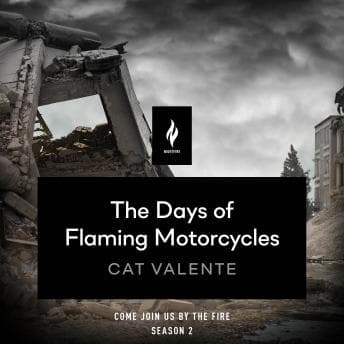

Twenty-five minutes. That's it. I almost skipped this one because - honestly - what can you do with twenty-five minutes? I can barely get through a med reconciliation in twenty-five minutes. But I had exactly that much time between pulling into my driveway and needing to start the rice cooker before the kids woke up, and the title alone was enough. Days of Flaming Motorcycles. You don't scroll past that.
Here's the thing people probably expect from a Catherynne M. Valente zombie story: literary, lyrical, maybe a little too precious for the genre. And yeah, her prose is ornate - she writes like someone who dreams in stained glass. But what caught me off guard is how grounded this story actually feels. This isn't your standard outbreak narrative. The zombies here aren't shambling monsters. They're... creatures of habit. They return to the routines of their lives, riding motorcycles, going to diners, sitting in churches. Death doesn't erase who you were. It just makes you quieter about it. And weirder. And more dangerous. That lingering presence of who someone used to be - I found echoes of that same unsettling persistence in Morning Star, though it plays out on a much grander scale.
As someone who's actually worked a code, who's watched people come back from the edge and not quite be themselves for a while afterward - that concept hit differently than I expected from a 25-minute horror short.
When the Dead Keep Their Routines
Valente takes the zombie apocalypse and strips away the survivalist fantasy stuff - no bunkers, no headshot tallies, no grizzled loner heroes. Instead you get this quiet, eerie portrait of a woman navigating a world where the dead still want to do what the living do. The flaming motorcycles of the title aren't metaphorical. There are actual burning bikes ridden by the dead, and the image is both terrifying and weirdly beautiful in Valente's hands. She treats the apocalypse like grief - something you accommodate, something that reshapes your daily life without fully replacing it.
The pandemic parallels are impossible to ignore, though the story predates COVID. There's this exhausted resignation in the narrator's voice - the protagonist's voice, I mean, though Naudus captures it too - that felt uncomfortably familiar. That sensation of living alongside something catastrophic and still needing to eat breakfast, still needing to figure out water and shelter and whether the person next to you is safe. I've worked through a pandemic. I know what it's like when the extraordinary becomes your Tuesday.
Natalie Naudus in a Sprint
Okay, so I don't have a ton of data on Naudus specifically in this performance, and at 25 minutes you're basically getting a snapshot. But here's what I can say: she doesn't oversell it. With Valente's prose, a narrator who pushed too hard would tip the whole thing into melodrama. Naudus keeps it steady, almost matter-of-fact, which is exactly the right call for a story where horror lives in the mundane. She lets the language do the heavy lifting and stays out of its way. For a short like this, that restraint matters more than range.
I didn't yell at my dashboard during this one. That's high praise.
The 25-Minute Problem (And Why It's Not Really a Problem)
Let me be practical for a second. This is part of Nightfire's Come Join Us by the Fire Season 2 anthology, sold as individual stories. Twenty-five minutes. If you're spending a credit on this, that math doesn't work - you'd be paying fifteen bucks for something shorter than my commute. But if you've got it through a subscription or you're picking up the full anthology, this is one of the standout pieces.
The brevity actually works in the story's favor. Valente doesn't overstay. She drops you into this world, lets you feel the dread and the strange beauty of it, and gets out. No bloat. No unnecessary backstory about how the outbreak started. Just the texture of living through it. I finished it sitting in my car with the engine off, rice cooker forgotten, staring at my steering wheel for a minute. Carlos found me out there and asked if I was okay. I was. I was just... processing.
Who This Is For (And Who Should Keep Scrolling)
If you want traditional horror with jump scares and body counts, this isn't it. If you want a zombie story that plays by Walking Dead rules, keep walking. But if you're the kind of person who finds horror in the quiet moments - in the way grief reshapes normalcy, in the way the world keeps turning even when it shouldn't - this is 25 minutes well spent. Literary horror fans, Valente devotees, anyone who's ever worked through a crisis and recognized themselves in the exhaustion of just... continuing.
My mom would love this (she still thinks I should've been a doctor), mostly because it's short enough that she'd actually finish it.
Chart This One as Stable
Perfect for that post-shift decompression - short enough to fit in the gap between parking and real life, sharp enough to stay with you through breakfast. The medical details aren't really the point here, but the emotional accuracy of surviving something terrible? The medical details are accurate. Finally. Just not the kind you'd find in a textbook.