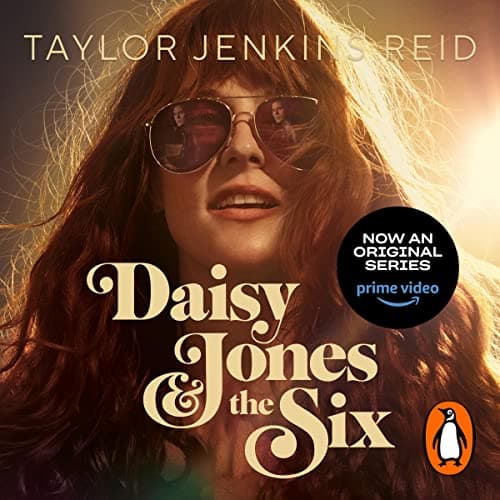

This audiobook is a full-body experience disguised as a novel.
I was three hours deep into a rebrand project for a local brewery — color palettes everywhere, Diego asleep on my keyboard, Frida perched on the monitor judging me — when Daisy Jones started talking about writing "Aurora" with Billy Dunne, and I had to stop working. Just stopped. Sat there with my stylus hovering over the tablet like a fool because the tension between these two was so thick I could feel it in my chest. Two people making something beautiful together while actively destroying each other. That kind of creative intimacy where you can't tell if it's love or war or both.
I didn't move for twenty minutes.
The Rockumentary You Can't Pause
The oral history format — characters giving their version of events in interview snippets, contradicting each other, lying to themselves — this is what makes the audiobook version the only way to experience this story. Fifteen narrators. FIFTEEN. And it works because each voice carries its own damage. Jennifer Beals as Daisy has this raspy, I-don't-give-a-damn quality that cracks open at exactly the right moments, like when she's talking about Billy's eyes during the recording sessions and trying so hard to sound casual about it. Benjamin Bratt as Billy brings this controlled intensity — you can hear the man white-knuckling his sobriety while describing a woman who made him feel like the music was the only safe place to put all that wanting.
Judy Greer as Karen does something subtle that wrecked me — there's this weariness in her voice, like a woman who watched two people burn down everything she helped build and is tired of pretending she doesn't have opinions about it.
But here's the thing nobody warns you about: the format takes about 30 minutes to click. The first few interviews feel choppy, like you're spinning a dial between radio stations. You don't know whose voice belongs to who yet, and there are moments where the character switches blur together. I almost switched to music. Almost. But once you learn the voices — and you will, because these narrators commit — it stops being a book and starts being a documentary you're eavesdropping on.
The Love Story That's Actually About Addiction (To Everything)
Taylor Jenkins Reid did something sneaky. She made you think this was about a band breaking up. It's not. It's about Daisy's addiction to substances and Billy's addiction to control and their shared addiction to each other and how the music was the only place they could be honest about any of it. When Daisy describes walking barefoot onto that Chicago stage for the last time, knowing it was the last time — I ugly-cried. At 2 PM. On a Tuesday. Diego looked concerned.
And the thing that got me? It's not the big dramatic moments. It's the small betrayals. Billy's wife Camila, voiced with such quiet dignity by January LaVoy, talking about hearing "Aurora" for the first time and knowing her husband wrote those lyrics about someone else. Knowing and staying. LaVoy delivers that section with this stillness that hit me harder than any screaming fight scene could have. Abuela would have loved Camila. She would have understood that kind of love — the kind that costs you something every single day and you pay it anyway.
When Fifteen Voices Become One Band
The production here is genuinely impressive — no music, no sound effects, just voices — and somehow it sounds more like the '70s than any soundtrack could. The narrators create the atmosphere entirely through delivery. There's a looseness to how some characters speak, a cocaine-era rambling quality, versus the tight, measured responses of characters being interviewed decades later who've had time to build their stories into something polished and self-protective.
Now — and this is my one real gripe — not every narrator lands with equal force. A couple of the band members blend together in my memory, and I sometimes had to rewind to catch who was speaking. With fifteen narrators, a few inevitably become background characters vocally, even when their words matter. It's a minor issue, but in a format that lives and dies by voice recognition, it's worth mentioning.
This Book Felt Like Finding Your Abuela's Records
You know that feeling of holding a vinyl album that belonged to someone who's gone? The weight of it, the scratch marks that tell you which songs they played most? That's what this audiobook felt like. It's nostalgic for an era I never lived in, but the emotions — the desperate creativity, the impossible love, the way women had to be twice as wild to get half the credit — those are timeless.
I finished it at 1 AM, sat in the dark with both cats asleep on me, and immediately wanted to listen to the whole thing again.
Four crying sessions. Tied my record. Beach Read, you've got competition. I'll say this — Secretly Yours made me feel something too, though nowhere near four sessions worth.
Who Gets a Backstage Pass (And Who Should Skip)
This is for you if you want to feel like you're watching a VH1 Behind the Music that makes you weep. If you listen at 1.0x because you want to catch every loaded pause between what these characters say and what they mean. If you've ever loved someone you shouldn't have and wrote something beautiful because of it.
Skip it if you need a traditional narrative structure, if fifteen narrators sounds overwhelming rather than exciting, or if you're looking for a light background listen — this demands your full attention or it'll lose you in the first hour.