
What happens when your fantasy novel is basically a D&D campaign where someone rolled a nat 1 on their character's backstory complexity but a nat 20 on setting vibes?
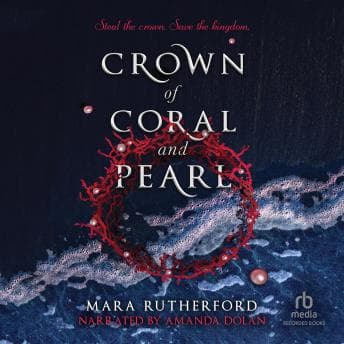
Look, I picked up Crown of Coral and Pearl during one of my thesis-avoidance sessions (Dr. Patel, if you're reading this, I was definitely working on my procedural generation chapter). The premise hooked me immediately—underwater village, twin sisters, one gets scarred so she can't be the pretty one sent to marry the prince. It's giving classic fairy tale energy with a fantasy twist, and I'm always down for that.
Beautiful Map, Shallow Lore
Here's the thing about Rutherford's world-building: it's gorgeous on the surface. Varenia, this ocean village where everyone dives for pearls and beauty is literally currency? Chef's kiss concept. The contrast between the underwater world and the cold mountain kingdom of Ilara? Solid. I was ready for some Sanderson-level exploration of how these cultures developed, what the magic system looked like, why exactly the royal bloodline needed these specific brides.
But—and this is where my D&D brain started twitching—the world feels more like a beautifully painted backdrop than a fully realized setting. It's thin. Like when your DM describes an amazing tavern but then you ask about the local economy and they just... stare at you. The bones are there, the aesthetic is there, but I kept wanting more depth that never quite came.
Nor as a protagonist is fine. She's got the scar, she's got the "I'm not the pretty one" complex, she's got the determination. Standard YA fantasy heroine stuff. The twin dynamic with Zadie had potential, but I never felt that gut-punch sisterhood connection that would've made the stakes feel real. And the love triangle between Prince Ceren (evil, cold, obvious villain) and Prince Talin (kind, warm, obvious love interest)? My group would've called that plot twist from session one.
Amanda Dolan Does the Heavy Lifting
Okay, so here's where the audiobook actually earns its keep. Amanda Dolan's narration is genuinely good—like, she's working overtime to give this story more emotional weight than the text sometimes provides. Her character differentiation is solid. You can tell who's speaking without the dialogue tags, which is baseline competency that not every narrator hits.
Her pacing does drag in spots, which... honestly might not be entirely her fault. Some sections of this book just move slowly, and there's only so much a narrator can do to punch up a chapter where not much happens. But when the tension ramps up—the court intrigue moments, the discovery of the murdered queen subplot—Dolan brings it. She's got good instincts for when to lean into the drama.
I couldn't find a ton of info about Dolan's other work, but based on this performance, she knows her way around YA fantasy. The emotional beats land when they need to, even if the writing doesn't always give her the strongest material to work with.
I Saw Every Plot Twist Coming From Session One
I'm not someone who needs every plot twist to blindside me. Some tropes exist because they work, and I'll defend that position until my dying breath. But Crown of Coral and Pearl leans so hard into familiar territory that I found myself mentally checking off plot points before they happened. Evil prince is evil? Check. Kind prince is secretly the better choice? Check. Village in danger requires heroine to discover her inner strength? Check, check, check.
The court politics had potential. The failing bloodline mystery had potential. The murdered queen subplot—actually pretty interesting! But none of it gets developed enough to feel surprising or fresh. It's like someone took all the ingredients for a great fantasy stew but didn't let it simmer long enough.
Roll for Initiative (Or Don't)
If you're newer to YA fantasy and want something accessible with pretty world-building and a straightforward romance, this might hit exactly right. It's comfort food. There's nothing wrong with comfort food. My D&D group's younger siblings would probably love this—it's got that fairy tale quality that works for readers who aren't yet jaded by having consumed approximately ten thousand fantasy novels.
But if you're looking for complex magic systems, layered political maneuvering, or characters that surprise you? You might want to look elsewhere. A Dance with Dragons delivers on all three fronts, though fair warning—you're committing to a significantly longer runtime and approximately seventeen POV characters. I'd point you toward The Wrath and the Dawn or The Star-Touched Queen for similar vibes with more depth.
The 13-hour runtime felt a bit long for what we got, honestly. I found myself speeding up during the slower middle sections. Dolan's narration kept me from bailing entirely, but I definitely did some thesis work during the less engaging chapters. (See, Dr. Patel? Multitasking.)
It's not bad. It's just... fine. And sometimes fine is exactly what you need. Just maybe not what I needed after promising myself I'd only listen to "really good" audiobooks this month.