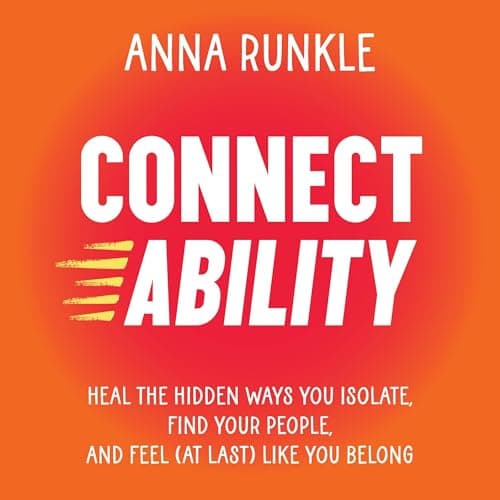

I started this one at 11:40 PM, standing in my kitchen eating leftover dumplings straight from the pan because an on-call page had wrecked dinner and my brain was too fried for anything dense. Bad setup for a self-help audiobook about trauma and connection, honestly. I expected something I'd need to bookmark, outline, and maybe process with a spreadsheet like the emotionally avoidant engineer I apparently am.
Instead, Connectability got me because it stays practical when it could've drifted into vibes.
Bottom Line: Worth your commute — if it's the kind of commute where you can actually pay attention.
Where this actually hits: covert avoidance, not just loneliness
A lot of books in the CPTSD lane are good at naming the wound and less good at explaining the weird daily behaviors the wound creates. Anna Runkle gets more specific than that. Her framing around "covert avoidance" is the sticky idea here — not just obvious isolation, but the subtle habits that make closeness fail even when you think you're trying. That distinction matters. It's the difference between "I'm bad at relationships" and "I keep running a background process that kills connection before it fully loads."
That was the part I kept replaying.
She doesn't stop at theory, either. The book keeps moving from cause to action: self-reflection prompts, daily connection plans, practical advice around small talk, active listening, and reading the room. And yes, on paper that last list sounds like basic social-skills content. But in this context, it lands differently because she ties those skills to dysregulation and trauma responses, not to some generic "be more confident" script. If you've ever wondered why ordinary social situations feel like you're SSH-ing into a server with packet loss, this book explains the lag.
Also important: she talks about trusting your instincts, spotting red flags, and setting boundaries without making every interaction sound dangerous. That balance is hard. Some trauma books accidentally turn listeners hypervigilant. This one is more interested in helping you connect without ignoring your own warning system.
Author narration that helps instead of getting in the way
Anna Runkle narrates it herself, and for this book, that's absolutely the right call.
She has a clear, compassionate delivery, but the real advantage is credibility in the personal sections. When she shares her own trauma and healing stories, the emotional texture in her voice makes those sections feel lived-in rather than imported from a speaking coach. Not polished in a corporate audiobook way. Human. A little raw in the places where it should be.
And because the production is straightforward — no music, no dramatics, no weird sound design trying to manufacture intensity — the focus stays on the material. For a book like this, clean audio is the correct engineering choice. You do not want swelling piano under a discussion of childhood trauma. You want clarity, and that's what you get.
Commute-worthiness check: this is not a "half-asleep on the 6 AM Caltrain while three people are taking calls" kind of listen. You can follow the words, sure, but you'll miss the point if it's just background. I'd put this in the dedicated-listening bucket — maybe a quieter commute home, maybe a walk, maybe that Sunday afternoon when you finally admit you should stop reorganizing your kitchen drawer and deal with your brain instead.
At 5 hours 59 minutes, it's also efficient. I finished this in basically 2 commutes and one insomnia cleanup session. The ROI on this audiobook is pretty solid because it doesn't overstay its welcome. No endless chapter-padding. No "this could've been a podcast series, but somehow became seven hours."
What you get, and what you give up
What you get is a very usable framework for understanding trauma-driven disconnection. Not a grand unified theory of all relationships. Not a super clinical textbook. More like a practical debugging guide for why closeness keeps failing in familiar ways.
(I kept thinking about how differently Power handles a similar promise of practical frameworks — it shoots for actionable and lands somewhere much murkier, which made me appreciate how clean Runkle's throughline actually is.)
What you give up is breadth. If you want deep dives into the neuroscience, heavy research citations in every section, or a more academic map of CPTSD, this may feel lighter than something like Complex PTSD or Healing Developmental Trauma. The science-informed angle is there, but the center of gravity is application. Daily behavior. Pattern interruption. Tiny reps.
And that's why I think it works.
Runkle is very good at translating painful internal states into concrete next actions. Personal stories of trauma and healing keep the book grounded, but the self-reflection prompts and daily connection plans are what make it useful after the download ends. This isn't just "you feel disconnected because of your past." It's "here are the moments where disconnection gets reenacted, and here's what to try instead." Big difference.
If you already liked Re-Regulated, this makes sense as a continuation — less about internal stabilization alone, more about what happens when you try to re-enter actual human relationships without your old defensive codebase running the show.
One caution: if discussions of childhood trauma or CPTSD hit hard for you, don't queue this up casually when you need pure distraction. It's warm, but it's not lightweight.
Who Should Listen (And Who Should Skip)
Listen if you're trauma-informed already and want actionable social repair — the kind of person who gets the theory but keeps stalling on the human-interaction part. Skip if you need a heavily research-cited, neuroscience-deep academic treatment of CPTSD, or if you're looking for pure distraction listening. This one asks you to show up.
My sign-off from the platform edge
This is basically trauma recovery but for the awkward, invisible mechanics of everyday belonging.
Not flashy. Not padded. Not trying to sound wiser than it is. Just useful, compassionate, and specific enough to help. For a lot of self-help, I go 1.75x because it could've been a blog post. This one held up at 1.25x because the pauses and personal delivery are part of the point.
Would I spend a full credit on a sub-6-hour audiobook? Usually no. But if this topic is your topic, this is a very good use of six hours.