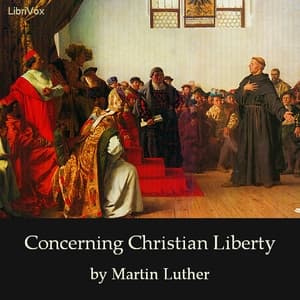

Look, I have a complaint. Martin Luther wrote this in 1520, and it's under two hours long, and it's more coherent than half the faculty emails I get on a weekly basis. Five hundred years ago. The man was facing excommunication, possible execution, the entire institutional weight of the Roman Catholic Church bearing down on him - and he sat down and produced something this tight, this disciplined, this ruthlessly logical. Meanwhile, I can't get a straight answer about whether the copy machine on the third floor is fixed.
I listened to this on a Sunday morning while Denise was still asleep, coffee going cold on the nightstand, and honestly? It felt right. There's something about the quiet of an early weekend morning that suits Luther's prose. He's not shouting here. This isn't the Luther of the 95 Theses, hammer in hand. This is Luther as teacher, working through a paradox with almost pastoral patience. The same patient, pastoral approach shows up in his Large Catechism, though I have to warn you—it’s longer and less tightly argued, more like a series of lectures than a single treatise.
The Paradox That Still Won't Leave Me Alone
Here's the central argument, and it's genuinely brilliant: "A Christian man is the most free lord of all, and subject to none; a Christian man is the most dutiful servant of all, and subject to every one." If you teach literature long enough, you develop an ear for the kind of contradiction that isn't actually a contradiction - the kind that cracks open meaning. This is one of those. Luther spends the entire treatise holding both halves together, insisting that freedom and servitude aren't opposites but consequences of the same faith. Inner freedom produces outward service. Not obligation. Not guilt. Service as the natural overflow of a liberated conscience.
This reminds me of what Hemingway said about prose being architecture, not interior decoration. Luther builds an argument here. He doesn't decorate it. Each section stacks on the previous one, and by the time he's distinguishing between the "inner man" and the "outer man," you realize he's constructed something remarkably sturdy for its size. Under two hours, and it carries the theological weight of volumes three times its length.
My students would hate this. I love it.
Jonathan Lange and the Problem of Reading Luther Aloud
Here's the thing about narrating theological treatises - and I say this as someone who records himself talking about Faulkner for 47 listeners - there's a temptation to either go full dramatic preacher mode or flatten everything into academic monotone. Lange mostly avoids both traps. His reading is steady, clear, and respectful of the source material. He treats it like what it is: a serious piece of writing by a serious thinker.
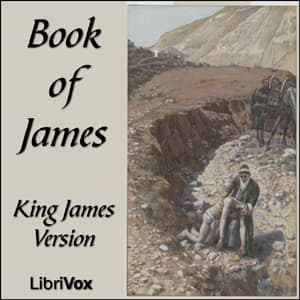
But - and I want to be fair here - there's a limitation built into the format. This is a LibriVox recording, which means volunteer production. The audio quality is functional, not polished. No sound design, no chapter music, just a person reading into a microphone. For a two-hour theological text, that's honestly fine. You're not here for production values. You're here for Luther.
What I will say is that Lange reads at a pace that lets you actually process the arguments. The prose deserves to be savored. Luther's sentences - even filtered through English translation - have a rhythm to them, a kind of argumentative momentum where one clause builds on the next. Lange doesn't rush through that, and I'm grateful. At 1.0x speed, which is the only civilized speed, the pacing felt natural.
Who Should Press Play (And Who Shouldn't)
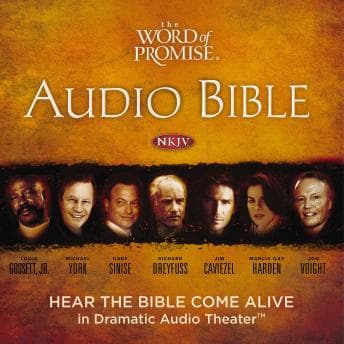
If you're looking for a dramatic audiobook experience with rich character voices and cinematic production - wrong address. Now, if you actually want that full-on theatrical treatment for Scripture, The Bible Experience pulls out all the stops—full cast, music, sound effects. It’s a very different beast from this LibriVox recording. This is a primary source document from the Reformation. It's theology. It's dense in places. Luther assumes his audience has some familiarity with Paul's epistles, and he quotes Scripture extensively without always stopping to contextualize. For a more exhaustive exploration of Luther’s wrestling with Pauline doctrines, I might steer you toward his Commentary on Galatians—it’s where he really unpacks the law-grace dynamic, though at significantly greater length.
But if you've ever wondered what the intellectual engine of the Reformation actually sounded like? If you've read about Luther but never read Luther himself? This is the entry point. It's short enough to finish in a single sitting, and it's the clearest distillation of his core theology on Christian freedom and works. Pair it with his "Address to the Christian Nobility" and "The Babylonian Captivity of the Church" and you've got the trilogy that shook Western civilization.
For my fellow teachers: there's genuine pedagogical value here. Luther is modeling how to construct an argument from a paradox, how to hold tension without resolving it cheaply. I might actually assign this to my AP students. (They'll hate me. That's fine. That's basically my job description.)
Worth Pausing the Faculty Meeting For
At under two hours, this is barely a commitment. It's the length of a movie. But the ideas in it have been rattling around Western thought for half a millennium, and hearing them spoken aloud - hearing Luther's logic unfold in real time rather than scanning it on a page - gives them a weight that surprised me. The prose is workmanlike in the best sense. No flourish for its own sake. Every sentence is load-bearing.
This is why we still read the classics. Not because they're old. Because they're still arguing with us.