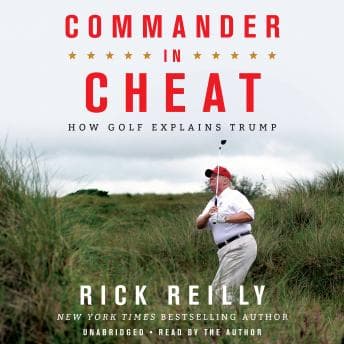

Look, I'm an English teacher. I'm supposed to care about Faulkner and Fitzgerald and the moral architecture of the Western canon. So explain to me why I just spent seven hours listening to a book about a man cheating at golf and couldn't stop grinning like an idiot during a faculty meeting about standardized testing benchmarks.
Rick Reilly, I blame you entirely.
The Longest Sports Column Ever Written (And I Mean That as a Compliment)
Here's my complaint: this book has no business being this entertaining. It's essentially a 7-hour sportswriter's column about one guy's relationship with golf, and yet Reilly structures it like a prosecutor building a case - anecdote by anecdote, witness by witness, until you're sitting there thinking, "Wait, he had his Secret Service detail help him cheat? At GOLF?" The stories pile up with this absurd momentum. Trump declaring himself club champion at courses where he didn't even play in the championship tournament. Trump driving his cart onto greens - something that made me physically wince, and I'm a guy who can barely tell you which end of the club to hold.
What Reilly understands - and what makes this work as more than political red meat - is that golf culture has its own moral code. Its own honor system. You call penalties on yourself. You play it where it lies. And when someone violates that code systematically, obsessively, joyfully, it tells you something. This reminds me of what Hemingway said about how you can learn more about a man in a round of golf than in a hundred meetings. Reilly takes that idea and beats you over the head with it for seven hours, and somehow it never gets old.
The best sections aren't even the cheating stories - though those are genuinely funny. It's the stuff about Trump stiffing contractors who built his courses, or bullying homeowners whose properties border his developments. Reilly interviews over a hundred people, and the picture that emerges isn't just of a bad golfer who lies about his scores. It's of someone for whom the game itself - the rules, the traditions, the other players - simply doesn't matter beyond what it can do for his brand. That's where the book gets its real teeth.
Reilly Reads Reilly (For Better and For Worse)
So here's the thing about author-narrated nonfiction: it's either wonderful or it's a hostage situation. Reilly lands closer to wonderful, but not without some turbulence. His comedic timing is genuinely sharp - he's been writing punch lines for decades and he knows how to land them. There are moments where his delivery had me laughing out loud on the lakefront trail, which earned me concerned looks from joggers.
But - and this is real - when he quotes Trump, his voice takes on this exaggerated, almost sneering quality that tips from impression into mockery. Now, depending on your politics, that's either cathartic or infuriating. I'll say this as someone who teaches kids about rhetorical strategy every day: it undermines his argument. The stories are damning enough on their own. When Reilly leans into the caricature voice, he gives skeptical listeners an easy reason to dismiss the content. And that's a shame, because the content is solid.
The narrator understands that pause is punctuation - Reilly knows when to let a ridiculous detail just sit there and breathe. His timing after revealing that Trump once threw a ball back into the fairway from the rough? Chef's kiss. But the tonal consistency wavers. Some chapters feel like journalism. Others feel like a comedy set. I wish he'd committed more fully to one or the other.
Who Gets the Most Out of This Round
Let me be direct. If you hate Trump, you'll love this. If you love Trump, you'll hate this. If you're somewhere in the middle, it depends on whether you care about golf. Because the book is genuinely good sports writing - Reilly's been doing this for forty years and his craft is obvious. The golf stuff is specific and detailed and often hilarious regardless of your political leanings. But he's not pretending to be neutral, and you shouldn't go in expecting that.
My students would absolutely not read this. It's a 55-year-old sportswriter cataloging etiquette violations at country clubs. But that's fine. My students also think audiobooks at 1.0x is a war crime. They're wrong about that, and they're wrong about this being boring.
At seven hours, it's the right length - any longer and the repetition of "Trump cheated, here's how" would start to drag. As it stands, Reilly keeps it moving. Good for a focused listen, a road trip, or - hypothetically - drowning out a budget presentation you've already heard three versions of.
Worth Keeping in the Bag
This isn't literature. Reilly would be the first to tell you that. The last time I felt this conflicted about enjoying something I couldn't quite defend academically was reading Life of P.T. Barnum — another book about a showman who treated rules as suggestions and somehow made you admire the audacity even while cataloging the damage. But it's smart, funny journalism that uses one very specific lens to examine character, and the prose deserves to be savored even when the subject matter makes you cringe. I listened at 1.0x because Reilly's pacing is already quick and his jokes need room to land. The author chose those punch lines. Let him deliver them.
Is it the definitive political biography of our time? No. Is it the most fun I've had with nonfiction in months? Pretty much, yeah.