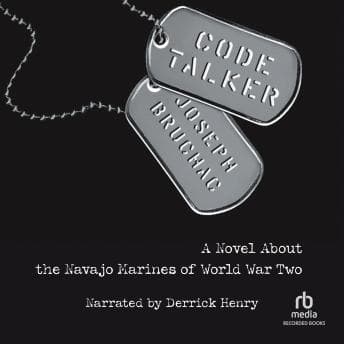

"Your language is no good here. Speak only English."
That's basically what the boarding school teachers told Ned Begay and every other Navajo kid who walked through those doors. And then, a few years later, the U.S. Marines came knocking: "Hey, remember that language we tried to beat out of you? We need it to win a war." The irony is so thick you could choke on it, and Bruchac doesn't let you forget it.
I was up way too late last night rolling dice with my old D&D crew over Discord — we've been running a homebrew Pacific Theater campaign, don't judge me — and after everyone logged off, I just... kept listening to this instead of sleeping. Or working on my thesis. (Dr. Patel, if you're reading this, I was doing "research on procedural narrative structures." Technically not a lie.)
The Boarding School Gut Punch Before the War Even Starts
Here's the thing people don't talk about enough with this book: the war stuff is only half the story, and honestly? It's not even the half that hits hardest. Before Ned Begay ever sets foot on a beach in the Pacific, you spend time watching the systematic destruction of Navajo identity in the boarding schools. Kids punished for speaking their own language. Hair cut. Names changed. Bruchac writes it from this first-person perspective that's simultaneously matter-of-fact and devastating — Ned doesn't melodramatize it because to him, it's just what happened. That restraint is what makes it land.
And then the Marines show up and say "we need your language" and Ned just... goes. Sixteen years old. The book doesn't linger on the irony with a big flashing sign. It trusts you to feel it. My D&D group would love this — the whole narrative has this quiet, understated tension running underneath the action, like a campaign where the real conflict isn't the monster in front of you but the kingdom that sent you to fight it.
Derrick Henry Tells This Like Your Grandfather After Dinner
So Derrick Henry's narration — I need to be honest about this. If you're coming in expecting a military thriller narrator, all gravel and urgency, you're going to be thrown. Henry delivers this in a deliberate, grandfatherly cadence that some listeners bounced off of. I get it. But here's the thing: it works because Ned is telling this story as an elder looking back on his youth. The measured pace, the pauses, the way he handles the Navajo language excerpts with what feels like genuine care rather than performative pronunciation — it turns the whole experience into something that feels like oral tradition rather than audiobook. That same quality — a narrator who makes you feel the weight of history rather than just reciting it — is part of what makes All the Light We Cannot See such a devastating listen; different war, different continent, but the same sense that language and identity are inseparable from survival.
The Navajo language sections are the real standout. Henry doesn't rush through them or treat them as exotic flavor text. They land with weight, which matters enormously given the book's central theme about language being both identity and weapon. Where he's less dynamic is in differentiating character voices — the Marines, the fellow code talkers, the Japanese they encounter — they all kind of blend into the same register. It's not a dealbreaker, but if you're spoiled on someone like Steven Pacey (Steven Pacey walked so other narrators could run, and I will die on this hill), the lack of vocal range is noticeable.
More History Lecture Than Novel — And That's the Trade-Off
Here's where I have to be real with you. Some listeners called this out as reading more like a history book than a novel, and... yeah, there are stretches where Bruchac is clearly in "let me teach you about Guam, Iwo Jima, and Okinawa" mode rather than "let me tell you Ned's story" mode. The battles across the Pacific sometimes feel like they're being catalogued rather than lived. For a young adult audience getting their first exposure to this history, that's probably fine — maybe even ideal. For an adult listener who's read their share of WWII history, the pacing in the middle third can feel like an info-dump. (And look, I'm the guy who will defend info-dumps with my dying breath. If you don't like info-dumps, this isn't for you — but you're wrong. But even I noticed when the fictional wrapper got thin.)
At under six hours, though, it never overstays its welcome. The progression is satisfying — boarding school to basic training to combat to the quiet, bittersweet homecoming. Bruchac earns that ending.
Who Gets the Most Out of This
Parents looking for something to listen to with their kids on a road trip — this is your book. Middle schoolers and up. It's a genuine entry point into a piece of American history that most people know nothing about, wrapped in a story that respects its subjects without sanitizing the ugly parts. If you want a Sanderson-level magic system, obviously look elsewhere. But if you want a story about how language itself becomes a weapon — how the thing they tried to destroy became the thing that saved lives — this is six hours well spent.
Adults flying solo? You'll appreciate it, but temper your expectations. It's YA, and it reads like YA. The characterization beyond Ned is thin, and the emotional beats are painted in broad strokes. That's not a flaw so much as a design choice.
Roll for Respect
I read this instead of writing my thesis, and I don't regret it. Not because it's the best audiobook I've listened to this year — it's not — but because it tells a story that needed telling, in a voice that honors how it should be told. The boarding school scenes alone are worth the listen. And at 5 hours 56 minutes, your thesis can wait one more night. (Sorry, Dr. Patel.)