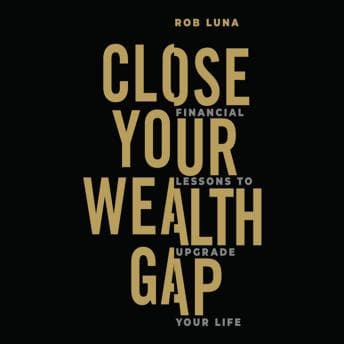

Look, I need to rant about something. Every personal finance book published in the last decade seems contractually obligated to include the phrase "pay yourself first" like they just discovered fire. Rob Luna's Close Your Wealth Gap does this too, and every time I heard it I wanted to yell into the void of my apartment at 11PM on a Tuesday (which is when I finished this, because insomnia after a deploy gone wrong is basically my reading time now).
But here's the thing - I kept listening. And that's worth examining.
The Blog Post That Actually Earned Its Runtime
At 5 hours 30 minutes, this is firmly in "business book" territory, and my default instinct was to crank it to 1.75x and let Eben Fowler speed-talk me through another could've-been-a-blog-post situation. But I actually dropped back to 1.5x about an hour in, because Luna does something most finance bros skip: he walks through the mechanics of reading a personal balance sheet and cash flow statement, step by step, like you're sitting in his office and he's pulling up a spreadsheet. It's not sexy. It's genuinely useful.
The qualified vs. non-qualified accounts section - Chapter 5 or 6ish, I lost track - is where I perked up. Luna actually explains the tax treatment differences between your 401(k), Roth IRA, and taxable brokerage in plain language, including when you'd strategically choose one over another depending on your income bracket and life stage. This is the stuff that I, a software engineer making decent money, had to piece together from Reddit threads and sketchy YouTube videos. Having it laid out linearly in audio form? Genuinely helpful.
The "good debt vs. bad debt" framework isn't new, but Luna's specificity about leverage ratios and when mortgage debt mathematically makes sense even if you could pay cash - that's the kind of practical nuance most books in this genre hand-wave past.
Where The Signal Gets Noisy
Here's where I get critical. Luna is a wealth manager, and you can feel it. There's a persistent undercurrent of "work with a financial advisor" that - look, I get it, that's his business - but it occasionally undercuts the DIY energy the book otherwise builds. The side hustle and passive income section felt like it was written for a different audience than the portfolio construction chapters. One minute he's talking about driving for rideshare apps, the next he's explaining risk-adjusted returns. The tonal whiplash gave me "two books mashed into one" vibes.
And the life-stage action plans? Good idea, middling execution. The advice for young professionals is solid and specific. The advice for families felt more generic - "save for college, have insurance" territory. The children's financial independence section is basically "teach them young," which, okay, but I was hoping for more concrete frameworks.
Eben Fowler's narration is... fine. Professional, clear, steady cadence. He doesn't inject personality the way a narrator like Ray Porter would (Ray Porter narrating a finance book - now THAT I'd buy in a heartbeat), but for a book that's essentially structured information delivery, Fowler doesn't get in the way. No weird pronunciation stumbles, no distracting vocal quirks. He's the adequate API response of narrators - returns exactly what you expect, nothing more.
Who This Actually Helps (And Who Should Skip)
Perfect for: anyone in their 20s-30s making decent money who has never sat down and actually structured their financial life. If you're the person with a 401(k) you set up on day one of your job and haven't touched since - basically me three years ago - this book has concrete ROI. Also great if you want a single audiobook that covers the full spectrum from budgeting basics to portfolio theory without jumping between five different titles.
Skip if: you've already read I Will Teach You to Be Rich, The Simple Path to Wealth, AND A Random Walk Down Wall Street. There's real overlap, and if you've done the finance book gauntlet, you'll spend most of this going "yep, knew that." Also skip if you're looking for advanced strategies - this is 101 to maybe 201 level.
The ROI on this audiobook is actually decent for the right listener. It's not going to change your life if you're already financially literate, but it's a solid single-source primer. I had a similar "useful but not transformative" reaction to Big Potential — solid frameworks, competent delivery, exactly what it promises and nothing more. At 5.5 hours, I burned through it in about 2.5 commutes at 1.5x. Not bad.
Worth A Credit? Probably Not - But Worth Your Time
At under 6 hours, this is a tough sell at full credit price when you could grab a 20-hour sci-fi epic instead. But if your library has it on Libby, or you catch it on a sale? Grab it. It's the kind of practical, no-nonsense financial primer that's genuinely better in audio form - you absorb the frameworks while your body autopilots through the morning commute, and by the time you're at your desk, you're googling how to rebalance your portfolio. That's the best outcome a book like this can hope for.