
I started this at 6:47 AM on a Tuesday, sandwiched between a guy manspreading into my seat and someone's leaky headphones playing what I can only describe as aggressive EDM. Not ideal conditions for a book about how other people make us better. The irony was not lost on me.
But here's the thing—by the time I got to Mountain View, I was genuinely reconsidering how I approach my team's code reviews. And that's basically the highest compliment I can give a business book.
The Thesis That Actually Has Legs
Bottom Line: Individual success has a ceiling. Collective success doesn't. Stop trying to be the lone genius. Top 1% takes the opposite approach—it's all about individual optimization, which makes for an interesting contrast.
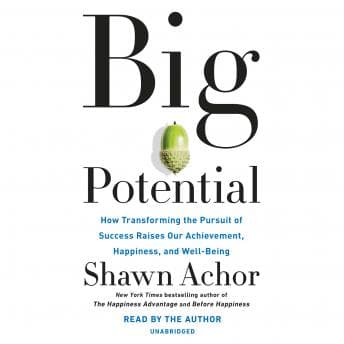
Achor's central argument is that we've been measuring potential wrong—treating it like a solo stat when it's actually a multiplayer game. He calls the lone-wolf approach "Small Potential" and contrasts it with "Big Potential," which is basically what happens when you stop hoarding your wins and start amplifying everyone around you.
The ROI on this audiobook is surprisingly high because Achor doesn't just philosophize—he brings actual research. Studies from NASA, the NFL, Fortune 100 companies. The man has data. When he talks about how praise cascades through networks or how a single high-performer can actually tank team morale if they're not collaborative, he's citing real experiments, not just vibes.
Is some of this intuitive? Sure. But there's something satisfying about having your gut feelings validated by neuroscience.
Author-Narrated: The Double-Edged Sword
Shawn Achor narrates his own work, and honestly? It works. His enthusiasm is genuinely contagious—you can tell this is a guy who's spent years giving TED Talks and corporate keynotes. He knows how to land a point. The personal anecdotes hit different when they're coming from the person who actually lived them.
That said, this isn't Ray Porter territory. Achor's a researcher who reads well, not a professional narrator who disappears into the material. You're always aware you're listening to the author, which is fine for nonfiction but means the delivery is more "engaging professor" than "immersive experience." No complaints about pacing or pronunciation—it's clean, professional, and easy to follow at 1.5x.
Where It Drags (And Could've Been a Blog Post)
Look, I have a rule: if your business book is over 5 hours, you better earn every minute. At 6 hours and 36 minutes, Big Potential occasionally feels padded. Some concepts get repeated with slightly different examples, and there were moments on my commute home where I zoned out and didn't feel like I'd missed much.
The SEEDS framework (Surround, Expand, Enhance, Defend, Sustain) is useful but also the kind of acronym that screams "corporate workshop." It's not bad, just... very on-brand for someone who consults with Fortune 100 companies.
Also—and this is a minor gripe—the book leans heavily on examples from elite environments. NASA astronauts, NBA players, Harvard students. Aspirational, sure, but sometimes I wanted to hear how this plays out for, I don't know, a mid-level engineer trying to survive sprint planning.
Who Should Queue This Up (And Who Should Skip)
Perfect for: Your commute, especially if you're in a leadership role or work on a team that's gotten weirdly competitive. Also solid for gym listening—upbeat enough to keep you moving.
Skip if: You've already read The Happiness Advantage and want something radically different. This is basically The Happiness Advantage but for teams. Same energy, similar research style, just zoomed out to the collective level. Also skip if you need deep tactical advice. This is more "shift your mindset" than "here's a step-by-step playbook."
Pushing to Main
I finished this in 3 commutes and immediately Slacked my team lead about our peer review process. That's the test, right? Did it change how I think about something real? Yeah, actually. It did.
Achor's core insight—that lifting others up doesn't diminish your own success but actually amplifies it—isn't revolutionary, but it's well-argued and backed by enough research to feel credible rather than preachy. The audiobook format works because his natural speaking style carries the material, even if it occasionally feels like a very long keynote.
Worth a credit if you're in a collaborative role and want some science-backed motivation to be less of a lone wolf. Wait for a sale if you're skeptical of positive psychology or already have a shelf full of similar books.
Now if you'll excuse me, I have a code review to approach with slightly more generosity.