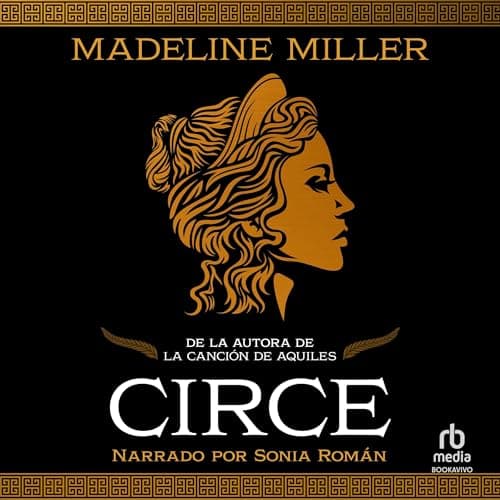

What does power sound like when a woman has to build it from exile instead of inheriting it?
I started this one on the light rail home after an accessibility consult downtown, captions running on my phone, Seattle windows black with rain and my hearing aids doing that weird hyper-detailed thing where every consonant matters more than the room. That turned out to be exactly the right way into Circe. Not because it's loud. Because it isn't. This book lives or dies on controlled intensity - on whether the voice can carry isolation, divine cruelty, and self-invention without pushing too hard. Sonia Román gets very, very close to the center of that.
Cuando el destierro suena más fuerte que la guerra
The big gamble of Circe has always been this: you already know some version of these myths, so the retelling has to make interiority feel new. Here, that means we begin in the palace of Helios with a daughter who is visibly lesser by divine standards - not seductive like her mother, not naturally powerful like the rest of her bloodline, not even particularly wanted. That social texture matters. Madeline Miller doesn't frame Circe as instantly exceptional; she lets her be dismissed first. And in audio, that dismissal has to sting before the later transformations mean anything.
Román understands that the early sections need restraint. She doesn't oversell the Titan court politics, which is smart, because the point is how cold and hierarchical that world feels. When Circe turns toward mortals in search of connection and discovers witchcraft - real, dangerous, handmade power - the emotional layers come through even without sound turned high. As a hard-of-hearing listener this hit different. I need clarity in emotional transitions, not just clean diction, and this performance tracks the shift from wounded curiosity to deliberate agency with real care.
And the island exile works. Really works. Once Zeus sends her away, the book stops being court myth and becomes something stranger: part survival story, part study of craft, part long argument about what kind of life a woman can make when men and gods both want to define it for her. Her learning to command beasts, refine her dark arts, and protect what she loves feels tactile in this format because Román leans into steadiness rather than spectacle. This narrator actually performs, not just reads.
The mythology drop-ins could've been gimmicky. They aren't.
A lot of myth retellings use famous names like little applause signs. Look, the Minotaur. Look, Daedalus. Look, Icarus. Here, those appearances are threaded into Circe's solitude and moral education. That distinction matters.
The Daedalus and Icarus material especially lands because it interrupts the divine scale with human ingenuity and human failure. You can feel the book asking what creation costs - for gods, for craftsmen, for mothers, for anyone trying to leave a mark without becoming monstrous. Then later you get Medea, who functions less like a cameo and more like a dark mirror. Same female power, very different ethical temperature. Good stuff. Specific stuff. Not interchangeable-myth stuff. Artemisa wrestles with the same tension - divine women who refuse the roles assigned to them - though it lands somewhere angrier and more kinetic than Circe ever tries to be.
And of course Odiseo. His section changes the cadence of the novel in a noticeable way. Missed opportunity for tone shift here? Not really in the text, but I did want just a hair more contrast in the narration once he enters Circe's life, because that relationship introduces warmth, wit, and strategic tenderness into a story that has been running on endurance for so long. Román is effective - she keeps the emotional stakes clear - but I occasionally wanted sharper differentiation between contemplative passages and the more intimate verbal sparring. Not a dealbreaker. More like: if you adore maximal vocal contrast, you may feel the performance stays in one elegant register a little too often.
Spanish audio, accessibility, and why pacing matters here
This is a single-narrator production with no reported music, no sound design flourishes, no full-cast scaffolding. Honestly? Good. Circe needs space. The prose has enough weight already, and the mythology can get crowded if production starts decorating every entrance and exit.
Accessibility done right often looks invisible. Clean audio. Consistent volume. Thoughtful pacing. Clarity over speed - always. Román's style holds attention without racing, which matters in a 16-hour, 44-minute listen where you're moving through family rivalries, palace intrigues, violence, love, grief, motherhood, and long stretches of self-examination. If she had pushed the tempo, the introspective sections would've flattened. If she had slowed too much, the exile sections would've felt stranded instead of purposeful. She mostly finds the lane.
Now, research on this Spanish edition is frustratingly thin on accent notes and character differentiation specifics, so I'm not going to fake granular pronunciation analysis I don't have. What I can say is this: I never felt locked out of the performance. The articulation stayed clean enough for text-sync listening, and I wasn't fighting the audio to track emotional stakes. Caption sync was perfect on my setup, which for me is not a bonus feature; it's the difference between access and approximation.
If you're coming in expecting a plot machine, fair warning - this is character-driven mythic literary fiction. The suspense is real, but it's not built from constant external action. It's built from waiting to see who Circe becomes when every role offered to her is too small. That means the book asks for attention. Dedicated listening helps. A distracted grocery run? Probably not. A late train, insomnia, a quiet room where the language can settle into your body? Much better.
Who Should Listen (And Who Should Skip)
Listen if you want a Greek myth retelling built on interiority, craft, and slow-burn character work - especially if you value clean, accessible audio with strong caption sync. Skip if you need battle-heavy momentum or maximal vocal fireworks from your narrator; this performance stays in a controlled, elegant register that rewards patience more than adrenaline.
My sign-off, before the spell breaks
If what you want from a Greek myth retelling is battle-heavy momentum, pick something else. If what you want is a woman forging identity from humiliation, craft, desire, and threat - with Helios, Zeus, Medea, Daedalus, Icarus, the Minotaur, and Odiseo orbiting that process - this Spanish edition is worth your credit.
Not flashy. Not gimmicky. Just layered enough to feel.
And for a book about a voice dismissed by gods? That feels exactly right.