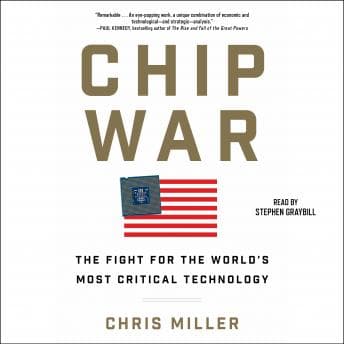

Look, I've sat through a lot of business books that promise to explain "the most important thing you've never heard of." Most of them are garbage. Chip War is not garbage.
Here's the thing—I went into this expecting another tech history that would put me to sleep somewhere around hour three. The semiconductor industry? Come on. My parents ran a dry cleaning business, not a fab plant. But Chris Miller does something I genuinely didn't expect: he turns silicon wafers into a geopolitical thriller. And I mean that. This is basically a spy novel where the spies are engineers and the weapons are nanometers.
Why This Actually Matters to Your Business
Bottom line: if you run a company—any company—you need to understand supply chains. COVID taught us that. But most people still don't get why a single factory in Taiwan can bring the entire global economy to its knees. Miller explains it without making you feel like you're back in an engineering lecture you never signed up for.
The key takeaway is worth the listen. The other 7 hours? Actually also worth it, which is rare for me to say. Miller traces how we got here—from the invention of the transistor to the current standoff between the US and China—and he does it through people. Real people making bets, taking risks, sometimes getting lucky. This is what my parents did instinctively. Now it has a TED talk. Except Miller actually respects the complexity.
I've seen supply chain disruptions kill three different consulting engagements. Companies that thought they understood their exposure to chip shortages. They didn't. This book would've saved them a lot of pain. (And me a lot of awkward phone calls.)
Graybill at 2.0x? No Problem
I listened at 2.0x because—you know me—time is money. And Graybill's narration held up perfectly at that speed. Clear, professional, no weird pauses or pronunciation stumbles on the technical terms. For a 12-hour book about semiconductors, that's not nothing.
He's not doing character voices or anything dramatic. This isn't that kind of book. But his pacing is excellent—he knows when to slow down for the important parts and when to push through the background context. I knocked this out over a week of commutes and a couple of late-night sessions, and I never had to rewind because I'd zoned out. That's high praise from me.
When Miller Loses You in the Fab
Okay, so here's my one criticism—and it's not minor. Sometimes Miller gets so deep into the weeds of who invented what and which company acquired which other company that you lose the thread. There were moments where I thought, "Wait, why do I care about this particular engineer in 1970s Texas?" And then thirty minutes later it clicks. But thirty minutes is a long time to trust an author.
Some listeners have compared it to reading a series of really good blog posts rather than one cohesive narrative. I get that. There's a bit of a formulaic feel to how each section is structured. But honestly? For a topic this complex, I'll take clarity over literary elegance. Jenny would say I'm being harsh. Jenny is right. But also, I finished the whole thing, which is more than I can say for most business books in my library.
Who Needs This (And Who Doesn't)
If you're in tech, manufacturing, defense, or really any industry that depends on electronics (so... all of them), this is required listening. If you're trying to understand why everyone's suddenly talking about Taiwan like it's the most important place on Earth, start here. Skip it if you want a quick beach read. This is dense. It rewards attention. I wouldn't recommend it for background listening while you're doing something else—you'll miss too much.
The ROI on 12 Hours
Finally, a business book that respects your time. Miller did the research, organized it well, and didn't pad it with motivational fluff. That kind of substance is rare—Networking for People tried for practical clarity but ended up feeling thin by comparison. Obama put it on his favorites list, which—fine, whatever—but the Financial Times Business Book of the Year actually means something. This is serious work about serious stakes.
My 2.0x speed couldn't save the slower chapters, but it didn't need to. I wanted to hear what came next. That's the highest compliment I can give a business book about microchips.








![Steve Jobs [unabridged audiobook] audiobook cover](/_next/image?url=https%3A%2F%2Fcovers.audiobooks.com%2Fimages%2Fcovers%2Ffull%2F9788499923406.jpg&w=1920&q=75)