
What happens when a world-builder writes a world that's dying instead of growing?
That's the question I kept turning over at 2 AM in the Georgia Tech CS lab, staring at a terminal that had nothing to do with my thesis. (Dr. Patel, if you're reading this — I was absolutely working on procedural generation and not listening to dystopian British fiction. Absolutely.)
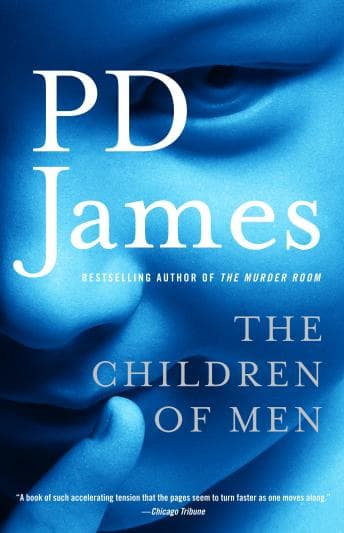
P.D. James — basically the queen of British detective novels — wrote a sci-fi book in 1992, set in 2021. And here's the thing: it's not really sci-fi. Not the way I think about sci-fi. There are no magic systems to reverse-engineer, no progression mechanics, no Sanderson-level explanations of why humanity can't reproduce. James just presents the fact. No babies for 25 years. Humanity is done. And then she writes about how people feel about it.
The Quietest Apocalypse You'll Ever Hear
If you came to this expecting the movie — Clive Owen sprinting through warzones, that legendary single-take battle sequence, visceral urgency from frame one — you're going to be confused for the first three hours. This is a completely different animal. The movie took James's premise and made an action film. The book takes that same premise and makes... a meditation. On power. On despair. On what people worship when there's nothing left to hope for.
Theo Faron isn't an action hero. He's an Oxford history professor and cousin to the dictator running England, and he spends a LOT of time just... observing. Journaling. Thinking about empty playgrounds, about forced euthanasia ceremonies called Quietus, about the way society organizes its cruelty when there's no future generation to be embarrassed in front of. James's background in criminal justice shows — she's obsessed with how institutions rot, how power consolidates, how people become compliant. It's the world-building of decay rather than creation, and honestly? It's effective. Bleak as all hell, but effective.
The thing is, if you're wired like me — if you want systems, rules, explanations for why the world works the way it does — this book will frustrate you. James never explains the infertility. It's not a puzzle to solve. It's a condition to endure. I had the exact same frustration with I Who Have Never Known Men — another novel that leaves its central mystery completely unexplained and forces you to live in the aftermath. That's a very literary-fiction move, and I respect it even though my brain kept screaming "BUT WHY THOUGH" every forty minutes.
David Case: Solo Cello Where You Want an Orchestra
So. David Case. Here's where I have to be honest. He's a decorated narrator — Grammy nomination, AudioFile Earphones Awards, serious pedigree. And his voice fits this material. It's measured, it's grave, it carries this weight that matches a world just... winding down. When he's reading Theo's journal entries, there's a quality to the delivery that feels appropriately exhausted. Like he's narrating the death certificate of the human race and he knows it.
But — and this is a real but — the pacing nearly killed me. There were stretches where I genuinely couldn't tell if I'd zoned out or if nothing had happened. I rewound at least three times because the steady, monotone-ish delivery blended scenes together in my half-asleep lab brain. He doesn't do much vocal differentiation between characters, which in a Sanderson book would be an absolute dealbreaker. Here it almost works? Everyone in this world is flattened by the same despair, so the sameness feels... thematic? I might be too generous. I also caught myself nodding off during one of the mid-book sections, and I can't entirely blame the time slot.
If you're a Steven Pacey person — Steven Pacey walked so other narrators could run — this is going to feel like switching from a full orchestra to a solo cello. Intentional, serves the material, but you will notice the difference. Hard.
The D&D Session That's All Roleplay, Zero Combat
Here's my best analogy: this is the session where your DM describes the political intrigue of a dying kingdom for three straight hours and there's exactly one combat encounter at the very end. Some of my D&D group would love it — the ones who write four-page backstories and argue about alignment over pizza. The rest would be on their phones by hour two.
The back third picks up. There's a woman, a secret pregnancy — the first in 25 years — a chase, actual stakes and real tension. And when James finally lets the plot accelerate, you feel the contrast viscerally. All that slow buildup pays dividends because you understand exactly how impossible and dangerous this situation is within the power structures she's spent hours constructing. But you have to earn it. Six-plus hours of earning it.
At 9 hours and 35 minutes, it's not a huge commitment by my standards. (I just finished a 55-hour LitRPG, so everything feels short now.) But it's a dense 9.5 hours. This is not background listening. You cannot code to this. You cannot game to this. You sit down and pay attention, or the whole thing dissolves into sophisticated white noise.
Who Gets an Invite to This Particular Apocalypse
If you love literary dystopia — Atwood, Ishiguro's Never Let Me Go, that brand of quiet dread — this is your thing. I'd add This Is How You Lose The Time War to that list — it's quieter still, a love story told across a ravaged timeline, and it lingers in the same way. If you watched the Children of Men movie and wanted the deeper philosophical bones underneath the action, James delivers that. If you're a world-building nerd who wants to see how a mystery writer constructs a dying civilization from the inside, there's genuinely fascinating stuff here.
If you need plot momentum, magic systems, or a narrator who voices characters like a one-man theater troupe? Skip it. Or at minimum, bump the speed to 1.25x. I'm not being harsh — P.D. James just wasn't writing for people like us, and that's fine.
I Read This Instead of Writing My Thesis and I Have Feelings
James makes you sit with the idea of extinction in a way the movie never does. It's uncomfortable and slow and occasionally genuinely beautiful. But I'm not gonna pretend this cracked my top twenty listens. It's a well-constructed, quietly devastating book that I'm glad I experienced and will probably never revisit. Like visiting a really well-curated museum about sadness. While your thesis advisor sends you concerned emails you haven't opened.