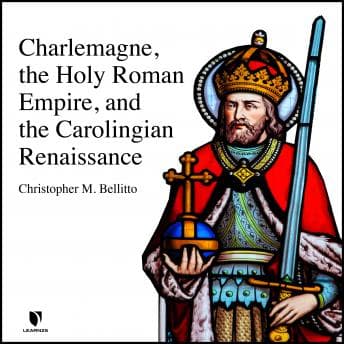

Six hours. That's less time than a standard military briefing package on a new theater of operations - and Bellitto covers roughly 1,200 years of Western civilization's foundational power struggle in that window. That should tell you something about the man's efficiency.
I picked this one up on a drive back from San Antonio after a client meeting ran long. Somewhere around Buda, Charlemagne got crowned Holy Roman Emperor for the second time in the same lecture and I found myself talking back to the speakers. Ranger was in the back seat. He didn't weigh in. That drive reminded me of the one I took through the Hill Country with Sam Houston and the Alamo Avengers in the speakers — Texas roads and big history have a way of going together.
The Command Structure Nobody Taught You in Civics Class
Here's what grabbed me: Bellitto doesn't open with Charlemagne. He backs up to Constantine, then traces how Christianity went from persecuted sect to imperial management tool in roughly three centuries. That context is the whole ballgame. Without it, the 800 AD coronation in Rome is just a ceremony. With it, you understand that when Pope Leo III put that crown on Charlemagne's head, both men were playing a game neither fully controlled - and both knew it.
Bellitto's framing of Charlemagne's self-conception is sharp. The man genuinely believed he was Constantine's heir - not just politically, but spiritually. Defender of the faith, partner to the papacy, maybe superior to it. That's not arrogance for its own sake. That's a coherent theology of power, and Bellitto explains exactly how Charlemagne built that framework through the missi dominici - his traveling royal inspectors who functioned essentially like my old battalion XOs, making sure policy actually got executed at the local level. I've seen that scenario play out in real life. Works until it doesn't.
The author clearly did their homework on the Carolingian Renaissance specifically. Most people - including people who consider themselves history readers - have no idea that Charlemagne couldn't write himself but ran a court that standardized Latin script, established palace schools, and dragged European literacy out of the post-Roman ditch. Bellitto makes the connection between administrative legibility and imperial control explicit. You can't run an empire if your regional commanders are all writing in different scripts. That's not culture. That's logistics.
Where the Lecture Format Shows Its Limits
This is a Learn25 course, not a traditional audiobook - and that distinction matters. Bellitto is narrating his own lectures, which means the pacing is classroom-structured. He signposts heavily: "We'll return to this point," "As I mentioned earlier," "In our next section." For focused listening, that's genuinely useful. If you're trying to half-follow this while doing something else, you'll lose the thread fast.
The research on complaints came back essentially empty, and honestly, I don't have major ones. The delivery is clean and confident - this is a man who has given these lectures hundreds of times and knows exactly where he's going. No stumbles, no awkward pacing, no narrator-versus-material disconnect because he IS the material. At 1.25x he stays completely intelligible, which is my baseline requirement.
The one honest limitation: six hours is enough to make you want more, not enough to make you an expert. The Investiture Controversy - the century-long cage match between popes and emperors over who gets to appoint bishops - gets covered, but you'll want a follow-on listen if that thread hooks you. Which it probably will.
Field Assessment
Who should grab this: Anyone doing business in Europe who wants to understand why church-state friction still shows up in German, French, and Italian politics. History readers who think the medieval period is just plague and castles. Anyone who's ever wondered why the Pope has any political standing at all.
Who should skip it: Thriller readers who wandered in looking for something with momentum. This is a structured academic lecture series, not narrative history. No dramatic reconstructions, no character drama. Pure analytical framework delivery.
Mission accomplished for what it set out to do. Bellitto gets in, makes his argument, connects the medieval to the modern, and gets out in six hours without wasting your time. That's a harder brief to execute than it sounds.
Ranger approved this one. He was very still for the entire drive, which either means he was engaged or asleep. I choose to believe engaged.