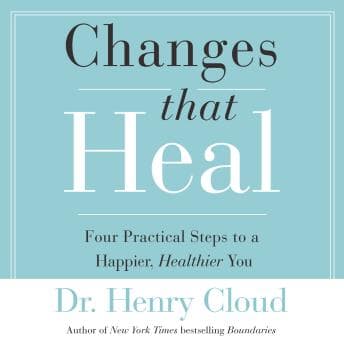

Ten hours of Christian psychology on my commute sounds like a lot. It is a lot. But here's the thing—I actually finished this faster than expected because Cloud's framework is genuinely useful, even if you're not particularly religious.
Look, I'm not the target demographic here. I grew up vaguely Buddhist, married a lapsed Catholic, and my spiritual practice mostly involves debugging code until I achieve a flow state. But my therapist recommended this book after I mentioned struggling with boundaries at work (shocker: engineers at FAANG companies have boundary issues), and honestly? The psychological framework holds up regardless of the theology wrapper.
The Four-Step Framework That Actually Makes Sense
Cloud breaks everything down into four developmental tasks: bonding, boundaries, good-and-bad integration, and authority/adulthood. It's basically attachment theory meets object relations meets Christianity. If you've read any pop psychology, some of this will feel familiar—but Cloud connects the dots in a way that clicked for me.
The bonding section hit harder than I expected. There's this whole piece about how some of us learned early that connection = vulnerability = danger, and we've been running that code ever since. (Yes, I'm making it a tech metaphor. Sue me.) He talks about people who are "functionally isolated"—successful on paper, surrounded by people, but emotionally alone. I may have texted Kevin a screenshot of my notes at that point.
The boundaries material is where Cloud really shines. He distinguishes between people who can't say no and people who can't hear no—and traces both patterns back to developmental gaps. It's not groundbreaking if you've done therapy, but the audiobook format made it easier to absorb during my 6AM zombie commute than reading would've been.
Dick Fredricks Does the Heavy Lifting
I couldn't find much about Dick Fredricks online, but based on this performance, he's exactly what you want for dense self-help content. Clear, warm, steady. No dramatic flourishes, no weird pauses. He sounds like a reasonable person explaining something important—not a motivational speaker trying to pump you up.
The pacing works for commuting. I listened at 1.25x (my usual for business-adjacent content) and it flowed fine. There were a few sections where I zoned out—mostly when Cloud goes deep on specific Bible passages—but I could pick up the thread easily enough. Fredricks doesn't get in the way of the content. For a book this long, that's exactly what you need.
The God Parts (And Whether They Matter)
Okay, so this is explicitly Christian. Cloud frames everything through a theological lens—we're made in God's image, healing comes through relationship with God, etc. If that's your worldview, this will feel deeply affirming. If it's not... you can still extract value, but you'll be doing mental translation work.
I found myself treating the religious elements like I treat legacy code at work: I don't have to love it, but I can work around it to get to the functionality I need. The psychological insights are solid. The case studies are helpful. The practical exercises are actually practical.
But some listeners will bounce off the theology hard. And that's fair. Cloud doesn't separate the psychology from the faith—they're woven together throughout. If you want purely secular attachment theory, go read "Attached" instead. Science the Mind takes a more research-heavy approach to similar psychological territory, though honestly I found Cloud's framework easier to apply in real life.
The Length Problem
Ten and a half hours is... a lot. Some sections could've been trimmed. Cloud has a tendency to make a point, illustrate it with a case study, then make the point again. Good for retention, annoying if you're impatient.
I finished this in about 8 commutes, which is longer than I'd normally give a self-help book. But the framework stuck with me in a way that shorter books often don't. The ROI calculation depends on how much you need this specific content.
Who This Is (And Isn't) For
Perfect for: Christians working through relational or boundary issues. Also surprisingly useful for therapy-curious folks who don't mind the religious framing.
Skip if: You want a quick fix. Or you'll get annoyed every time Cloud references Scripture (which is often).
The science-adjacent parts hold up reasonably well—Cloud's drawing on established psychological theory, not making stuff up. But this isn't a research-heavy book. It's pastoral, practical, and personal.
Worth the Commit?
I'm probably not going to become a Henry Cloud superfan. But I did take notes, and I've already applied some of the boundary frameworks at work. For a book I picked up on a therapist's recommendation, that's a win.