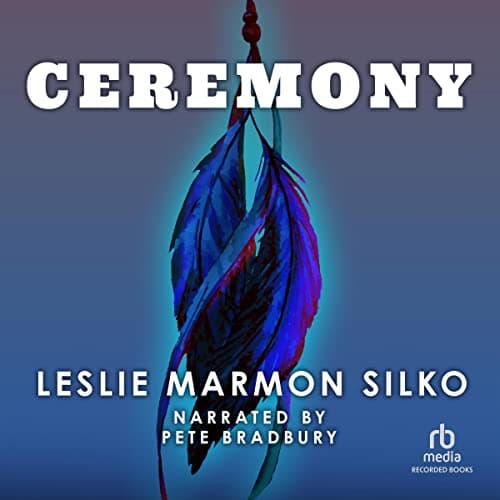

I was driving through central New Mexico last fall — red mesas off to the west, scrubby piñon rolling past — when Pete Bradbury's voice started carrying Tayo's story through my car speakers. I didn't plan it that way, but the landscape and the novel synced up so completely that I pulled over twice just to sit with what I was hearing. Ceremony is one of those books that finds you at the right moment, and in audio form, it found me in exactly the right place.
Leslie Marmon Silko wrote Ceremony in 1977, and it remains one of the most important works of Native American literature. The story follows Tayo, a mixed-blood Laguna Pueblo veteran returning from the Pacific theater of World War II. That same weight of systemic harm pressing down on a young person trying to find their footing is something Angie Thomas carries into The Hate U Give — different world, same refusal to look away from what a community has survived. He's hollowed out by shell shock, grief over his cousin Rocky's death, and the slow violence of reservation poverty. He drinks. He dissociates. The narrative fractures right alongside him — jumping between jungle combat, childhood memories, and the arid present without signaling the shift. Threaded through all of it are sections of Laguna verse, creation stories and witchery tales that exist on their own plane but gradually reveal themselves as the scaffolding holding everything together.
This structure is the book's greatest strength and its biggest barrier to entry. Silko doesn't hold your hand. The prose sections blur into verse, timelines collapse, and you're asked to trust the pattern before you can see it. Several listeners have flagged this as a problem, saying they couldn't follow the flashbacks or that the pacing felt aimless. I get it. If you're used to linear storytelling, the first few hours can feel disorienting. But that disorientation is the point — you're experiencing Tayo's fractured consciousness, and as his ceremony of healing progresses, the narrative itself begins to cohere. It's a book that teaches you how to read it, but it demands patience.
Pete Bradbury's narration is mostly excellent. He approaches the material with real care, shifting his delivery between the earthbound prose passages and the elevated, almost incantatory verse sections. When the Laguna stories surface — Thought-Woman sitting in her room, spinning the world into being — Bradbury finds a register that feels appropriately ritual without tipping into melodrama. His character work is solid if understated: different voices for the various men Tayo encounters, a gentle modulation for Ts'eh, the mysterious woman who becomes central to his recovery. One listener described his voice as carrying Silko's words "like smoke from a sacred fire," and that's not far off.
But there are moments where the narration stumbles. A few passages felt mumbled to me, particularly during some of the more internal, stream-of-consciousness stretches where Tayo is deep in memory. I had to rewind a couple of times when dialogue blended into narration without a clear shift. At normal speed, some quieter sections nearly disappeared under road noise. These aren't dealbreakers — they're the kind of thing you notice on an attentive listen and might miss entirely if you're absorbed — but they're worth mentioning.
What makes Ceremony extraordinary as an audiobook is how much it gains from being heard rather than read silently. Silko drew from Laguna oral tradition, and these stories were meant to live in the voice. The rhythm of the verse sections, the repetition of key images — drought, rain, cattle, the color white — all of it hits differently when spoken aloud. There's a cumulative, almost hypnotic effect that builds over the nine hours. By the time Tayo reaches the climactic ceremony near the uranium mine at the novel's end, you feel like you've been through something physical.
The book's emotional core is deceptively simple: a broken man tries to get well. But Silko layers that personal story with the trauma of colonialism, uranium mining on Pueblo land, the way witchery (in the Laguna sense — forces of destruction and separation) operates through history. Tayo's healing isn't just psychological; it's cosmological. The ceremony he undergoes reconnects him to land, story, and community in ways that feel earned rather than sentimental.
Who Should Listen (And Who Should Skip)
I should be honest about what this audiobook asks of you. It's not background listening. It's not a casual commute companion unless you're willing to rewind. The fractured timeline and the blending of mythic and realistic registers require your full attention, especially in the first third. If you come to it expecting a conventional war novel or a straightforward redemption arc, you'll be frustrated. Skip it — or at least shelve it until you're in a patient headspace. But if you're drawn to literature that works on you slowly, that asks you to listen the way oral stories were always meant to be listened to, this is the audiobook to reach for.
Meet it on its own terms — preferably on a long drive through open country, though a quiet room works too — and Ceremony delivers something rare. It's a novel that functions like the thing it describes: a ceremony of restoration, assembling scattered pieces into wholeness. Bradbury's narration honors that process. Not flawlessly, but with enough skill and reverence that the story's power comes through intact.









