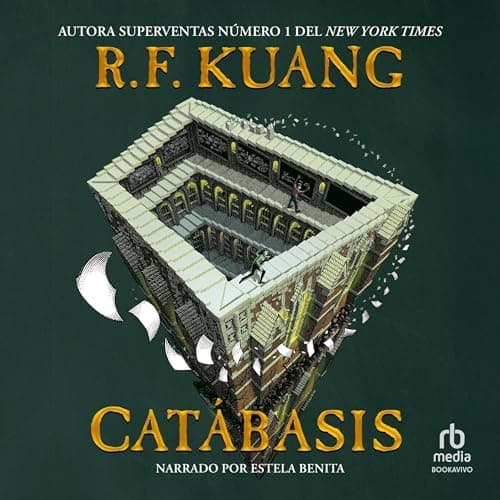

I was deep into a late-night cleaning session — the kind where you're scrubbing grout at 1 AM because your brain won't shut off — when I first started Catábasis. And honestly, that slightly unhinged energy turned out to be the perfect headspace for a book about two grad students so obsessed with academic success that they literally march into hell for a letter of recommendation.
Let me set the scene: Alice Law and Peter Murdoch are Cambridge students studying magic under Professor Jacob Grimes, the most brilliant mage alive. When Grimes dies in a magical accident that might be Alice's fault, both students independently arrive at the same bonkers conclusion — they need to descend into the actual underworld to retrieve his soul. Not because they loved the man. Not because they're heroic. Because they need that recommendation letter. If that premise doesn't make you laugh darkly while also feeling a little too seen, you probably never spent years in a toxic academic environment.
R.F. Kuang has built her career on skewering academia, and Catábasis might be her most personal dissection yet. The dark academia trappings aren't just set dressing — they're the entire point. Alice and Peter's rivalry, their self-destructive devotion to intellectual prestige, the way they've sacrificed health, relationships, and sanity on the altar of scholarly achievement — it's painfully recognizable. Kuang writes academic obsession the way only someone who has lived it can.
The Dante parallels are obvious and intentional, and Kuang plays with them cleverly. Alice and Peter's journey through an underworld that refuses to behave like the literary versions they studied is both funny and unsettling. The hell they encounter doesn't follow the rules from their textbooks, which creates genuine tension — their academic knowledge, the thing they've staked everything on, keeps failing them. It's a sharp metaphor, and when it works, it really works. That feeling of a world gleefully dismantling every rule you thought you understood reminded me of the chaos Darkdawn: Book Three of the Nevernight Chronicle weaponizes in its final act — though Kuang's version is more dissertation defense than bloodsport.
But here's where I have to be honest: Catábasis tested my patience. Around the middle third, I found myself zoning out during long stretches of exposition and academic jargon that, while thematically justified, felt like wading through a particularly dense dissertation. The pacing drags. There's a quote from a Spanish reader that nails it perfectly — they liked it and it tired them at the same time. That's exactly my experience. The book asks a lot of its listener, and it doesn't always reward that investment with enough forward momentum.
The character work is a mixed bag. Alice is fascinating in concept — a protagonist whose defining trait is her willingness to sacrifice everything for academic validation — but her lack of urgency sometimes makes the stakes feel abstract. Peter is more engaging as a foil, though their dynamic takes a while to develop real chemistry. When they finally start functioning as reluctant allies, the book finds its groove, but it takes longer than it should.
Estela Benita handles the Spanish narration with clarity and professionalism. Her voice suits the dark, cerebral tone of the material, and the pacing of her delivery matches the book's contemplative energy. I didn't notice any production issues — no weird volume shifts, no background noise. It's a clean, straightforward single-narrator performance. She doesn't do wildly distinct character voices, but the narration never confused me about who was speaking. For a book this dense with academic language and magical terminology, clear delivery matters, and Benita provides it.
The narration can't solve the book's structural issues, though. At nearly eighteen hours, this is a long listen, and the slow pacing means you need to be in the right mindset. This isn't a background audiobook — you'll lose the thread if you're not paying attention. I'd recommend bumping the speed to 1.25x during the exposition-heavy middle sections; it helped me stay engaged without missing the subtleties.
Compared to Kuang's other work, this feels like a step sideways rather than forward. Babel had a sharper political edge and more emotional urgency. Catábasis is more introspective, more literary in its ambitions, but that comes at the cost of some narrative drive. It's the kind of book that's easier to admire than to love.
What saves it is the ending and the emotional truths buried underneath all that academic satire. There's something genuinely affecting about watching two people realize that the thing they've been pursuing might not be worth the cost — and that the person standing next to them in hell might actually understand them better than anyone above ground. When Kuang lands those emotional beats, she lands them hard.
Who Should Listen (And Who Should Skip)
If you've lived the grad school experience and want to see it reflected back through a dark fantasy lens, this is your book — with caveats. Come for the premise, stay for the character dynamics, and be prepared to push through some slow stretches to get to the payoff. Skip it if you need propulsive pacing or if eighteen hours of academic satire in Spanish sounds more like a final exam than a good time.