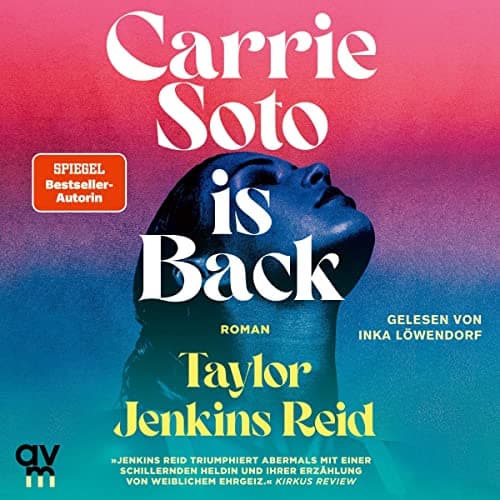

Carrie Soto is the kind of protagonist who makes you want to throw your headphones across the room — and then immediately put them back on because you need to know what happens next.
I started this one on a Tuesday evening walk and ended up sitting in my parked car forty minutes later because Carrie was mid-match at the Australian Open and I physically could not press pause. That's the hold this book has. Taylor Jenkins Reid builds the comeback season of a thirty-seven-year-old tennis legend who'd rather destroy every relationship in her life than watch someone else hold her records. It's abrasive, it's suffocating, and it works.
The real story isn't tennis. It's Carrie and her father Javier. He coached her from childhood, he sacrificed his own career trajectory, and now he's aging in ways Carrie refuses to look at directly. Löwendorf does something specific with Javier's dialogue that caught me — his lines come through slower, warmer, with a kind of measured calm that contrasts sharply with how she voices Carrie's clipped, almost hostile internal monologue. When Javier talks about the sport he still loves, there's a gentleness in Löwendorf's delivery that makes the father-daughter scenes land like a gut punch. You hear the gap between what Carrie says to him and what she actually feels, and Löwendorf holds that tension without overselling it.
The match scenes are where the narration shifts gears most noticeably. Löwendorf picks up speed during rallies and key points — not in a breathless sportscaster way, but with a tightening of rhythm that mirrors the physical intensity. During press conferences, she goes flat and controlled, almost robotic, which is exactly how Carrie would handle reporters she considers beneath her. It's a smart performance choice that separates this from a generic read-through. The quieter hotel-room scenes after losses, where Carrie sits with the reality of her body failing her — those are where Löwendorf is most restrained and most effective. She doesn't reach for drama. She lets the silence around the words do the work.
The Bowe Huntley romance is there but it's not the engine. If you're expecting a swoony love story with the ex who broke her heart, you'll get pieces of that, but Reid keeps Carrie's obsession with legacy front and center. Bowe functions more as a mirror — someone who chose a life outside tennis and forces Carrie to confront what she gave up. Their scenes together have a bruised quality that Löwendorf handles with the right amount of edge. You feel the history between them without needing flashbacks spelled out.
The Evelyn Hugo comparison is inevitable and fair. Both books feature famous women peeling back their public image to show the damage underneath. My full thoughts on that one are in my review of The Seven Husbands of Evelyn Hugo, which I still think about more than I expected to. But where Evelyn Hugo sprawls across decades and trades in Hollywood bombshells, Carrie Soto compresses everything into one season. The result is tighter, more physically urgent. You feel the aching knees, the ice baths, the humiliation of getting broken in the first set by a twenty-two-year-old. If Hugo's appeal was glamour with a dark underbelly, Carrie's appeal is pure stubborn will colliding with a body that won't cooperate anymore.
So — who should listen, and who should skip? If you loved Evelyn Hugo and want something leaner with real athletic grit, this is your next pick. If you need your protagonist to be even slightly likable before the final act, Carrie will exhaust you. She's rude to journalists, dismissive of younger players, and treats vulnerability like a disease. Reid is clearly fascinated by women who refuse to make themselves easy to like, and Carrie is the most extreme version of that impulse. If you bounced off Evelyn Hugo for feeling formulaic or self-involved, this won't convert you — Carrie is less charming and more relentless. Worth noting: the Spanish-language edition, El regreso de Carrie Soto, is also out there if you're weighing which translated version to go with, and I've spent some time with that one too.
The German translation flows naturally in audio. No awkward constructions or moments where the prose felt like it was straining against the original English. At just under ten hours, the pacing is right — no bloated middle section, and the final act delivers an emotional payoff that justifies every frustrating moment Carrie puts you through. I listened at normal speed because Löwendorf's pacing already has the right momentum; speeding up would flatten the contrast between match intensity and the quieter emotional beats.
This is a book about what greatness costs when you're the only one willing to pay that price, and whether the trophy means anything if there's nobody left to share it with. The German edition with Löwendorf is a strong way to experience it — she understands Carrie well enough to let her be terrible without making her a caricature.









