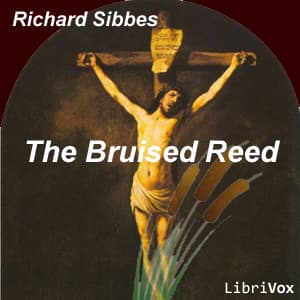

I'm going to be honest with you: I almost didn't listen to this. A 17th-century Puritan devotional text? Narrated by a volunteer reader? At 4 hours and 21 minutes? I teach English literature for a living and even I felt my inner skeptic flare up. There's a particular kind of old theological prose that reads like someone trying to bore you into holiness, and I've sat through enough of it in grad school to be wary.
I was wrong. Pretty much completely wrong.
The Gentlest Sermon You'll Ever Hear
Richard Sibbes writes the way a good doctor talks to a frightened patient. The entire book hangs on a single verse from Matthew 12:20 — "A bruised reed shall he not break, and smoking flax shall he not quench" — and Sibbes turns that image over and over like a stone in his palm, examining every facet. He's not building an argument so much as he's sitting beside you, saying the same comforting thing in forty different ways until one of them finally gets through.
And here's what surprised me: the repetition works. In print, I might've skimmed. But in audio, walking the lakefront with Denise on a cold Saturday morning, the fog sitting on the water like something out of a Brontë novel — the circling back felt intentional. Sibbes keeps returning to the idea that Christ doesn't demand spiritual strength before offering mercy. He meets you in the weakness. If you've ever felt like your faith was a pilot light about to go out, this book says: that's enough. That flicker is enough. That same tenderness toward spiritual brokenness — the idea that love meets you where you are rather than where you should be — is what drew me to Redeeming Love, though Sibbes gets there in forty fewer pages of plot.
This reminds me of what Hemingway said about prose being architecture, not interior decoration. Sibbes isn't decorating. He's building something load-bearing.
RoseA and the Art of Not Getting in the Way
Let's talk about RoseA's narration, because it's — well, it's a LibriVox recording, which means we're in volunteer territory. No studio production. No celebrity voice. And honestly? That's appropriate here. RoseA reads with a warm, steady cadence that doesn't try to dramatize Sibbes' prose. There's no breathless intensity, no theatrical pauses. She reads like someone who believes what she's reading, and that sincerity carries the performance.
The narrator understands that pause is punctuation. When Sibbes shifts from doctrinal explanation to direct comfort — and he does this constantly, pivoting from theology to pastoral care mid-paragraph — RoseA lets the text breathe. She doesn't rush the tender parts to get to the next argument. The pacing is deliberate, almost meditative.
Now, is this a polished Audible-grade production? No. The audio quality is clean but simple. No music, no chapter breaks with sound design, no production flourishes. If you need that stuff, you'll notice its absence. But I'd argue that stripping everything away is exactly right for a book that's essentially a long, quiet conversation about spiritual exhaustion.
One small thing: Sibbes uses a lot of 17th-century syntax — subordinate clauses stacked like Russian nesting dolls — and RoseA handles the sentence architecture well enough that I rarely got lost. That's harder than it sounds. I've listened to narrators with professional credits stumble over Dickens. Managing Puritan prose without turning it into word soup is a genuine skill.
Who This Is Actually For (And Who Should Probably Skip)
Let me be direct. If you're not a person of faith, or at least deeply curious about Christian devotional writing, this won't land for you. Sibbes isn't trying to convince skeptics. He's talking to believers who are already in the room but feel like they don't belong there. The whole book is aimed at people who think they're too broken, too inconsistent, too spiritually tired to matter. If that's not a category you recognize, this will feel like four hours of someone else's therapy.
But if you do recognize it — if you've ever sat in a pew or a quiet room and thought, "I'm not enough" — this is four centuries old and it will feel like it was written last Tuesday. Martyn Lloyd-Jones, one of the great 20th-century preachers, said Sibbes was "balm to my soul" during a period of spiritual and physical exhaustion. That's not hyperbole. The prose deserves to be savored.
My students would hate this. I love it. Not because it's obscure or difficult, but because it's so relentlessly kind. We don't read enough kind books.
The Assignment I'd Give Myself
Listen to this at 1.0x. (You knew I was going to say that.) Listen to it on a walk, or late at night when the house is quiet and the grading can wait. Don't binge it — take it in sections, the way you'd take medicine. Because that's what Sibbes intended. This isn't a book. It's a treatment. And RoseA delivers it with exactly the right bedside manner.
Also, it's free. LibriVox. No credit required. For what you're getting — a 400-year-old classic read by someone who clearly cares — that's a gift.