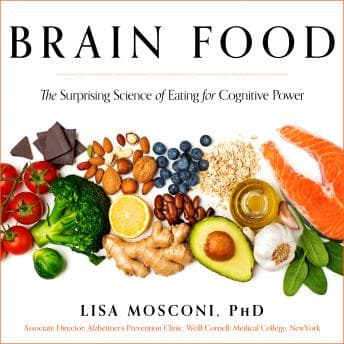

I was fully prepared to hate this book.
Hear me out. I've been burned by so many nutrition books that promise to optimize your brain/body/soul/whatever that I've developed an immune response. The pattern is always the same: cherry-picked studies, breathless claims about superfoods, and advice that could've been a Medium article. I had similar skepticism going into Bad Blood, though that was about medical fraud rather than nutritional overselling. So when I downloaded Brain Food for a particularly brutal week of 5:30 AM trains, I had my skeptic shields up.
Then Dr. Mosconi started talking about how the brain has its own nutritional requirements completely separate from the rest of your body, and I actually paused my audiobook to look this up. She's right. The blood-brain barrier means your brain is basically running its own supply chain, and most of us are feeding it like it's just another organ.
Okay, Lisa. You have my attention.
The Science Actually Holds Up (Mostly)
This is where I got genuinely interested. Mosconi isn't some wellness influencer who took a weekend course—she's associate director of Weill Cornell's Alzheimer's Prevention Clinic, and it shows. She walks through the actual mechanisms: how glucose metabolism in the brain differs from muscle tissue, why certain fats can cross the blood-brain barrier while others can't, how your gut microbiome is basically texting your neurons 24/7.
The paleo diet takedown is particularly satisfying. She doesn't just say "paleo bad"—she explains why eliminating entire food groups that your brain specifically evolved to use might be... suboptimal for cognitive function. Same with the gluten section. Her point isn't "eat all the gluten" but rather "unless you have celiac disease, you might be eliminating fiber sources your gut bacteria desperately need."
Now, is every claim bulletproof? No. Some of the nutritional genomics stuff feels like emerging science being presented as settled fact. But compared to the average health book, the research density here is impressive.
12 Hours Is A Lot For A Diet Book
Here's my main complaint: this could've been 6 hours. Maybe 7. The recipes section at the end—while I'm sure they're lovely—is basically useless in audio format. I'm not going to remember that the Mediterranean fish stew needs three tablespoons of olive oil while I'm half-asleep on the Caltrain. Just give me the PDF, Lisa.
Norah Tocci's narration is... fine? She's clear, professional, doesn't mispronounce the medical terminology (which is actually harder than it sounds for nutrition books). But there's nothing distinctive about the performance. No personality that makes the drier sections more engaging. When Mosconi goes deep on mitochondrial function for twenty minutes, you're going to need coffee regardless of how it's read.
I bumped this up to 1.5x around hour 4 and never looked back. The information density doesn't require the slower pace.
What Actually Stuck With Me
Three weeks later, here's what I actually changed:
I drink way more water now. The section on how even mild dehydration tanks cognitive performance hit different when you're debugging distributed systems at 2 PM and realize you've had nothing but coffee since 6 AM.
I stopped feeling guilty about carbs. The brain runs on glucose. That's just... how it works. The low-carb brain fog I thought was "detox" was probably just my neurons screaming for fuel.
I added more fish. The omega-3 stuff isn't new, but Mosconi's explanation of why DHA specifically matters for brain cell membranes actually made it stick.
Is my memory better? Hard to say—I'm still forgetting where I put my AirPods. But the framework for thinking about brain nutrition is genuinely useful.
Who Gets Value Here (And Who Doesn't)
Queue it up if: You've never read a serious book on nutrition and cognitive health, you want science over wellness woo, or you're looking for long-commute/gym-session listening where you want to feel productive.
Skip it if: You've already read Grain Brain, The Bulletproof Diet, and every other brain-optimization book (you'll find some new material but also a lot of overlap). Also not great for bedtime—too much information to process—or anything requiring deep focus where you'll miss chunks.
The quiz she mentions early on is apparently more useful in the print version where you can actually... take it. The audio version just describes what the quiz would tell you, which is mildly frustrating.
The Debug Summary
I finished this in about 5 commutes at 1.5x speed. Would I recommend it to Kevin? Actually, yeah—he's been complaining about afternoon brain fog, and this book would probably help more than his fourth cold brew.
Just skip to the PDF for the recipes. Trust me.