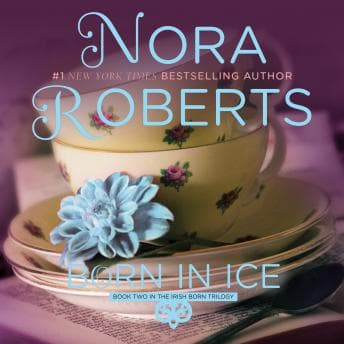

"Sometimes, fire can be born in ice."
That line hit me somewhere around hour eight, and I had to set down my stylus because my hands were shaking. Not from the cold - my apartment in Austin doesn't know cold - but because Grayson Thane had just done the thing where he finally stops running, and Fiacre Douglas delivered it in this low, steady voice that felt like a confession whispered across a pillow. Frida was sitting on my keyboard. Diego was asleep on a stack of client proofs. And I was just... wrecked.
Let me back up.
Brianna Concannon Deserved Better Than Everyone Around Her (And She Knew It)
I picked this up on a Sunday when I had a logo redesign due Monday and needed something to keep my hands busy and my heart occupied. Nora Roberts wrote Brianna as this quiet, stubborn innkeeper in County Clare who bakes brown bread and keeps fresh flowers in every room and holds her entire fractured family together through sheer force of will - and I recognized her immediately. She's the eldest daughter who never gets to fall apart. The one who makes everyone's tea and swallows her own grief. That specific kind of quiet, accumulated grief — the kind that lives in the body of whoever holds everyone else together — is something Notes on an Execution excavates from a completely different angle, and I was wrecked by that one too. If you grew up in a family where one person was the emotional load-bearer, you know this woman. You maybe ARE this woman.
And then Grayson shows up - this American writer, charming and warm and allergic to permanence - and the slow burn between them is so quiet it almost sneaks past you. There's no big dramatic collision. It's her leaving scones outside his door. It's him watching her garden through his window when he should be writing. It's the way Douglas voices Grayson's internal resistance - you can hear him trying not to fall, and failing, and being terrified about it. The chemistry is chef's kiss.
But here's what got me: the secondary storyline about Brianna's mother, Maeve, and the family secrets around their father. Maeve is cold and bitter and says genuinely cruel things, and Douglas doesn't soften her. She sounds like disappointment wrapped in a rosary. She sounds like every mother who loved conditionally. That subplot cuts deep, and Roberts doesn't tie it up with a neat bow, which I respect.
The Brogue That Carries You Home
Okay, let's talk about Fiacre Douglas. His Irish accent is the real deal - not a performance, not an affectation, just the sound of someone who knows the rhythm of that landscape in their bones. When he reads Brianna, there's this gentle lilt, a softness that never tips into fragile. She sounds strong even when she's hurting. His Grayson is trickier - the American accent works about 80% of the time, but occasionally it slides into this slightly nasal register that pulled me out for a second. Not a dealbreaker, but I noticed.
The bigger issue: the female side characters. There were a couple of conversations between Brianna and her sister Maggie where I had to rewind because I genuinely couldn't tell who was speaking. Douglas differentiates them by attitude more than voice, and in fast dialogue exchanges, it muddies. I lost about three minutes of a key argument between them because I was sorting out who said what.
But when he's in the emotional moments? When Brianna finally tells Grayson what she actually wants instead of what she thinks she's allowed to want? The narrator's voice is velvet and honey. I ugly-cried at that scene. Put it on my spreadsheet. (Entry #12 for this year, if you're keeping track.)
This Is a Rainy Sunday Book (And I Mean That as the Highest Compliment)
The pacing is slow. Deliberately, beautifully slow. This isn't a book that rushes to the spicy parts or manufactures conflict every chapter. It breathes. It lets you sit in Brianna's kitchen and smell the bread and hear the rain on the windows. At 10 hours and 41 minutes, it asks for your patience, and it rewards it. I listened at 1.0x because speeding this up would be a crime against the atmosphere Roberts built.
Is it the most innovative romance I've ever heard? No. The bones of it - guarded man, patient woman, inevitable surrender - are classic Nora Roberts. But sometimes you don't need reinvention. Sometimes you need a book that feels like being wrapped in a wool blanket by someone who loves you quietly. Abuela would have loved this one. She would've said "esa Brianna tiene dignidad" and she would've been right.
Who Gets the Scones and Who Gets the Cold
Grab this if you love slow-burn romance where the emotional stakes matter more than the plot twists. If you're a sucker for Ireland settings and don't mind a strong brogue. If you've ever been the person who holds everything together and wanted to see that person get chosen.
Skip it if you need fast pacing or if inconsistent character voice differentiation drives you up the wall. And if thick Irish accents aren't your thing, this will be ten hours of struggle.
My heart. MY HEART. This book felt like standing in a cold garden and finally being asked to come inside.