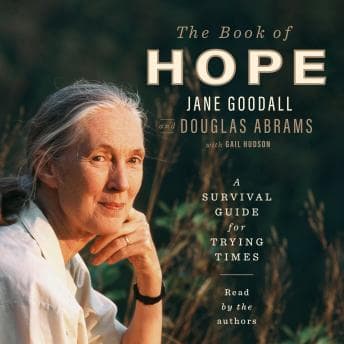

I finished this one at 4 AM in the break room, eating cold rice from a tupperware while a patient down the hall coded. And somehow Jane Goodall's voice in my earbuds—talking about a tree that survived 9/11, about two blind and armless men in China who planted ten thousand trees together—made me cry into my arroz caldo. Not because I'm sentimental. Because after fifteen years of watching people die and fight to live, I know what hope actually costs. Jane Goodall knows too.
This isn't a self-help book. Let me be clear about that. If you want actionable steps and bullet points, go read something with "habits" in the title. This is a conversation—Douglas Abrams asking questions, Jane answering with stories from Gombe, from World War II, from decades of watching humans destroy and rebuild. The format threw me at first. It's not a memoir, not a lecture, just... two people talking. Like sitting at your tita's kitchen table while she tells you about the war.
When the Devil's Advocate Actually Works
Abrams does something smart here. He doesn't just lob softballs. He pushes back. He asks the hard questions—how can you have hope when species are going extinct, when the Amazon is burning, when politicians are useless? And Jane doesn't give him platitudes. She gives him the Survivor tree. She gives him young activists who refuse to accept the world their parents ruined. She gives him her "Four Reasons for Hope"—human intellect, nature's resilience, young people's power, and what she calls the indomitable human spirit. Caste gave me a similar framework that actually stuck—not because it was clever, but because Isabel Wilkerson earned every word of it.
I'm not usually one for frameworks. Too many years watching hospital administrators make acronyms for everything. But Jane's four reasons? They're not corporate nonsense. They're earned. Every single one comes with a story that proves it.
The Voice That Made Me Trust Her
Here's the thing about author-narrated audiobooks—they can go wrong fast. Authors aren't always good readers. But Jane Goodall at 87 sounds exactly like you'd want her to sound. Warm. Unhurried. Like she has all the time in the world to tell you why you shouldn't give up. Abrams has this steady, grounding voice that anchors her wandering stories. Together they sound like the conversation you wish you could have with your wisest grandmother.
Does it get repetitive? A little. Some listeners found the interview format cloying, and I get it. There are moments where the back-and-forth feels circular. But honestly? At 3 AM when you've just watched a family lose their dad to a drunk driver, circular feels okay. Gentle feels okay. I didn't need a page-turner. I needed someone to tell me the world isn't ending.
Not for Background Listening
Fair warning—this is not a workout audiobook. This is not a "half-listening while you fold laundry" audiobook. You need to actually pay attention. The stories are quiet. The wisdom sneaks up on you. I tried listening while charting once and missed an entire section about chimpanzees because I was too focused on documenting wound measurements.
Best listening context? That drive home from work when you're too tired to think but too wired to sleep. The 45 minutes where you need something that isn't news, isn't drama, isn't demanding. Just someone wise reminding you that humans have survived worse and will survive this too.
Who Needs This at 3 AM (And Who Doesn't)
If you're burned out, bone-tired, and need gentle wisdom without being preached at—this is your book. Healthcare workers, teachers, anyone in the trenches of caring for others. Skip it if you want concrete action plans or can't stand interview-format books. This one requires patience and a willingness to sit with stories instead of solutions.
What My Mom Would Say
My mom, who still thinks I should've been a doctor, would love this. She'd call it "inspirational" and try to buy copies for all my siblings. She'd probably cry at the part about the trees. She'd tell me Jane Goodall is proof that women can change the world if men just get out of the way. (She's not wrong.)
Carlos asked why I was crying in the car. I blamed allergies. But really it was Jane talking about leaving Gombe—leaving the forest she loved—because she realized advocacy mattered more than research. That's the kind of sacrifice I understand. That's the kind of hope that costs something.
Six hours and forty-nine minutes. Not long. But dense with meaning. Night shift approved.