
I'm going to be honest with you - I almost didn't finish this one. Not because it wasn't good. Because it was too good. Too close.
Somewhere around hour three, walking the lakefront at sunrise while Denise was still asleep, Mpho Tutu started talking about the stories we tell ourselves about our wounds. How we rehearse our grievances like actors preparing for a role we never audition out of. And I had to stop walking. Just stood there by the water, pretending to watch the joggers, actually trying not to cry in public at 6 AM like some middle-aged cliché.
This is why we still read the classics. Because sometimes a book finds you exactly when you need finding.
The Fourfold Path Is Deceptively Simple (And That's The Point)
Admit the wrong. Tell the story. Ask for - and grant - forgiveness. Renew or release the relationship. Four steps. Sounds almost too tidy, right? The kind of framework you'd dismiss in a faculty meeting PowerPoint.
But Archbishop Tutu earned this simplicity. The man chaired South Africa's Truth and Reconciliation Commission. He sat with perpetrators of apartheid violence and their victims - in the same room. He watched people choose confession over revenge when the whole world expected a bloodbath. So when he tells you forgiveness has a structure, you listen.
What I appreciated is that the Tutus never pretend this is easy. They're not selling spiritual shortcuts. The prose acknowledges the full weight of what forgiveness asks of us - it deserves to be sat with, not rushed through. They talk about how holding onto anger feels like drinking poison and expecting the other person to die - which isn't original, but the way they frame it within actual atrocities? That's different. That's earned.
Father and Daughter, Two Voices, One Message
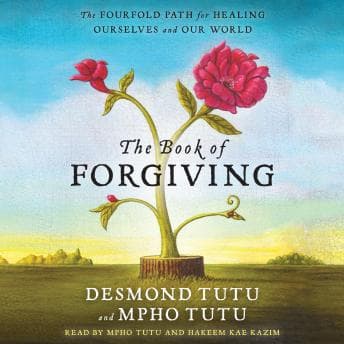
Here's where the audiobook format becomes essential. Hakeem Kae Kazim narrates Archbishop Tutu's portions with this warm, measured authority - the kind of voice that makes you sit up straighter even when you're walking. But it's Mpho Tutu reading her own sections that got me. She's not performing. She's witnessing. There's a difference.
When she reads the meditations and exercises at the end of each chapter, you can hear that she's lived this work. The pauses aren't dramatic - they're invitational. Like she's waiting for you to catch up emotionally before moving on. My students would hate this. I love it.
The dual-narrator approach works because forgiveness is both theological and deeply personal. You need the Archbishop's moral authority AND the daughter's intimate application. One without the other would feel incomplete.
Worth Pausing The Faculty Meeting For
I should mention: this isn't light listening. At 6 hours and 38 minutes, it's not a massive commitment, but the density requires attention. I tried listening while grading papers at 11 PM and realized I was absorbing nothing. The fourfold path demands focus - which makes sense. You can't half-forgive someone.
The exercises at the end of each section are meant to be practiced, not just heard. I found myself pausing to actually do the visualization work, which I never do with audiobooks. (I'm usually too impatient. Ask Denise.) But something about Mpho's voice made me want to try.
If I have a criticism - and I do - it's that some sections feel repetitive. The core message gets restated in slightly different language, which might be intentional for emphasis but occasionally made me check how much time was left. Not a dealbreaker, but noticeable.
Who Needs This (And Who Doesn't)
You need this if you're carrying something. You know what I mean. That grudge you've nursed so long it's practically a roommate. That wound you've told yourself you're "over" but still brings heat to your face at 2 AM.
Skip this if you want theoretical theology or academic analysis. This is practical. Almost uncomfortably so. The Tutus aren't interested in whether you understand forgiveness conceptually - they want you to do it.
This reminds me of what Hemingway said about writing - that the dignity of movement of an iceberg is due to only one-eighth of it being above water. The Book of Forgiving shows you the one-eighth, then hands you diving gear.
The Text I Haven't Sent Yet
I started this review complaining, and I'll end it confessing: I texted someone I haven't spoken to in three years. Haven't hit send yet. But the message is typed.
That's what this book does. It doesn't just explain forgiveness - it creates conditions where you might actually attempt it. Both Kazim and Mpho Tutu use silence like a tool, understanding that pause is its own kind of punctuation.
If you loved Man's Search for Meaning, this is its spiritual successor for the healing side of trauma. Tattooist of Auschwitz bridges that same territory—witnessing atrocity while somehow holding onto humanity. Frankl taught us how to survive suffering. The Tutus teach us how to release it.
Now if you'll excuse me, I have a text to send.