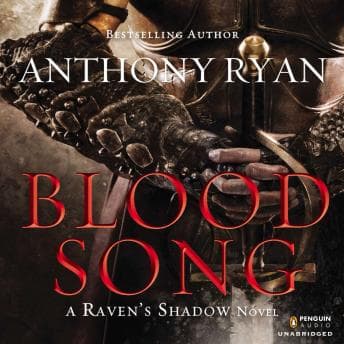

Twenty-three hours is a commitment. That's roughly the time it takes to grade a full set of junior essays, or to walk the lakefront with Denise about forty times. So when I tell you I burned through Blood Song in a week and a half - mostly during late-night grading sessions and one very long Saturday when I was supposed to be doing laundry - you understand I'm not saying that lightly.
Anthony Ryan does something here that I try to teach my students about but rarely see executed this well: he builds a world through absence. Vaelin Al Sorna gets dumped at the gates of a warrior order at ten years old, and we learn about the Unified Realm not through exposition dumps but through what he doesn't know, what he's forbidden to ask, what he pieces together from training and violence and the gaps in his own memory. It's the literary equivalent of negative space. My AP Lit kids would appreciate that. (They wouldn't. But they should.)
Steven Brand's Measured Delivery
Here's where I have to be honest about the narration, because the reviews I've seen are all over the place. Some folks call it exceptional. Others say monotonous. And look - they're both right? Brand has this clear, slightly raspy delivery that's consistent as a metronome. He's not doing theatrical voices or dramatic crescendos. He reads the text like he trusts it to do the work.
For a book like this, that works. Vaelin's story is told in retrospect - he's recounting his life to a chronicler, and there's a weight to that framing device. Brand's measured pacing matches the gravity of what's being remembered. War. Loss. The slow erosion of certainty about everything you believed. You don't need vocal fireworks for that. You need someone who understands that pause is punctuation.
But I'll admit there were moments - particularly in some of the battle sequences - where I wished for a bit more variation. The action scenes blur together when the vocal energy stays flat. I found myself rewinding once or twice during a particularly chaotic fight because I'd lost track of who was where. That's a fair criticism.
The Philosophy Underneath the Swordplay
What kept me listening wasn't the combat anyway. It was the philosophy underneath it.
Ryan is doing something sneaky here. On the surface, this is a coming-of-age military fantasy - boy becomes warrior, warrior becomes legend. But underneath, it's a meditation on faith and doubt and the way institutions shape us into instruments. Vaelin joins the Sixth Order as a child with no choice in the matter. He becomes exceptional at violence. And then he starts asking questions that the Order doesn't want answered.
This reminds me of what Hemingway said about writing - that the dignity of movement of an iceberg is due to only one-eighth of it being above water. Ryan gives you the adventure story on top, but there's so much more going on beneath. The relationship between Vaelin and his brothers in the Order. The slow revelation of what happened to his mother. The way he comes to understand that his father's abandonment might have been something else entirely.
My students would probably call this a "slow burn." They'd be right. The Alchemist has that same deliberate pacing, though it trades swordplay for symbolism. The first several hours are training montages and brotherhood-building. If you need immediate plot hooks, you might get restless. But if you loved Name of the Wind or the early Fitz books - that patient character work that pays off later - this is its spiritual successor.
The Siege That Stopped My Grading
I won't spoil specifics, but there's a section in the back half involving a siege that genuinely made me stop grading and just... sit there. Brand's understated delivery actually amplified it. No melodrama. Just the facts of what happened, and the weight of Vaelin carrying it forward.
The final chapter does get a bit monologue-heavy - Ryan is clearly setting up the next books, and you can feel the machinery clicking into place. But by then I was invested enough that I didn't mind. (I've already downloaded the sequel. Don't tell Denise how much I spent on Audible credits this month.)
Who Gets the Assignment
Not my sophomores. Too long, too much violence, and honestly too much patience required. But for adult listeners who want fantasy that takes itself seriously without being pretentious? Who appreciate world-building that respects your intelligence? Who don't need a narrator doing cartoon voices to stay engaged? This is worth pausing the faculty meeting for.
Skip it if you need fast-paced action or can't commit to a slow build - the first several hours are training and brotherhood before the larger plot kicks in.
Class Dismissed
The prose deserves to be savored. I listened at 1.0x because Ryan chose those words carefully, and Brand delivers them with the respect they deserve. Twenty-three hours is a commitment. This one earned it.