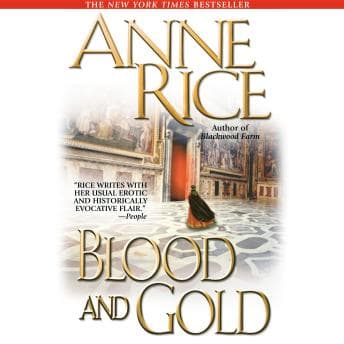

What happens when the most ancient, most powerful vampire in Anne Rice's universe finally gets to tell his own story — and he won't shut up?
I mean that with love. Mostly.
Two Thousand Years of Loneliness and Gilt-Framed Paintings
I was shelving returns at the branch on a grey Wednesday — Oregon grey, the kind that seeps into your bones — when I hit hour three of Blood and Gold and had to stop what I was doing. Just stood there between the 800s and 900s, cart half-loaded, because Marius was describing the fall of Rome and Roger Rees was narrating it like a man eulogizing something he personally loved. There's this quality to his Marius that's less "immortal predator" and more "exhausted art history professor who has seen too much and can't stop teaching." And honestly? That's the exact energy this book needed.
This is book eight of The Vampire Chronicles, and it's the one where Rice hands the mic to Marius de Romanus — Roman senator turned vampire turned eternal guardian of Those Who Must Be Kept (the catatonic king and queen of all vampires, stored like cursed furniture in various underground vaults across millennia). If that premise sounds wild, welcome to Rice. She's been building to this for seven books.
The thing is, Marius's story spans from Imperial Rome through the Visigoths' sack of the city, through the Black Death, into the Renaissance where he's painting alongside Botticelli and falling for a Venetian courtesan named Bianca. The scope is enormous. And Rice — true to form — treats every century like she's being paid by the historical detail. You will learn about Byzantine politics. You will hear about paint pigments. You will sit through Marius philosophizing about the nature of evil while standing in a villa he built with vampire money.
Some people find the early sections heavy with exposition. They're not wrong. Rice has never met a paragraph she couldn't triple in length with sensory description and internal monologue. But here's where I land on it: this understands that horror isn't about gore — it's about dread. I Am Watching You works the same nerve — that particular horror of inevitability, of something terrible moving toward you just out of sight. And the dread in Blood and Gold is the slow, creeping kind. It's the horror of watching someone live long enough to lose everything they love — repeatedly — and still choosing to love again. Marius keeps building beautiful lives and watching them burn. That's not a monster story. That's a tragedy wearing fangs.
Roger Rees Understood the Assignment
The narrator commits. That's rare. Rees — and I should note, the late Roger Rees, because we lost him in 2015 — brought something genuinely tender to Marius. Not soft. Tender. There's a difference. His voice carries this worn aristocratic quality, like a man who learned manners in the Roman Senate and never unlearned them, even after two millennia of bloodshed.
Where he really shines is the female characters. His Eudoxia — the ancient vampire who becomes Marius's rival in Constantinople — has this cold, imperious edge that's distinctly different from his Bianca, who comes through warmer, more reckless. And his Pandora (Marius's great lost love) carries this weight of unresolved history every time she appears. Four AudioFile Earphones Awards for a reason. The man treated audiobook narration like stage acting, and at eighteen and a half hours, that level of commitment is no small feat.
My one caveat: at 18 hours 37 minutes, this is a marathon. And Rice's pacing in the first quarter is — let's be honest — indulgent. If you're coming from Interview with the Vampire expecting that tight, claustrophobic intensity, you're going to need to recalibrate. This is panoramic. This is Rice in full historical epic mode. It requires patience, and it rewards patience, but only if you came here wanting to live inside Marius's head.
Who Needs This (And Who Should Run)
If you've been following The Vampire Chronicles and skipped Marius's book? You're missing context that pays off later. If you love historical fiction with a dark supernatural thread — if you'd read a novel about a vampire watching the Renaissance happen in real time and thinking, "yes, give me more Botticelli scenes" — this is your book.
If you scare easily, skip. Not because the horror is relentless — it's not — but because when it hits, it hits with the weight of centuries behind it. The violence in this book feels ancient and purposeful, not gratuitous.
If you need fast pacing and tight plotting? This will test you. I won't lie about that.
I listened to the last three hours in the dark, after the library closed, sitting in my apartment with Shirley curled up on the radiator. The jungle sequences at the end — where Marius confronts the oldest vampires — finally tighten everything down into something urgent and dangerous. Shirley (my cat) was unimpressed. I was riveted.
Shelve It Under: Gothic Patience Rewarded
Anne Rice wrote Marius like she was channeling two thousand years of longing through a single voice, and Roger Rees delivered it like the Shakespearean actor he was. It's too long. It's too indulgent in places. And I still came out the other side feeling like I'd lived through something real. My podcast listeners are going to love this — or at least, the ones who understand that sometimes the scariest thing isn't a monster. It's time itself.