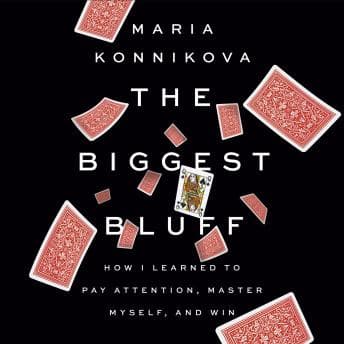

What happens when a psychologist with zero poker experience walks up to one of the greatest players alive and says "teach me"? Normally, embarrassment. In Maria Konnikova's case, hundreds of thousands of dollars in tournament winnings and a book that made me rethink how I advise founders on decision-making under uncertainty.
I listened to this one over a long weekend while Jenny was visiting her sister. Just me, a half-empty apartment, and 11 hours of a former academic explaining how Texas Hold'em rewired her brain. At 2.0x speed, it was still a commitment. Worth it? Mostly.
The Framework My Parents Already Knew
Here's what got me. Konnikova's central insight - that you can't control outcomes, only the quality of your decisions - is something my parents lived every day running their dry cleaning business. A customer doesn't come back? Supplier raises prices? You don't spiral. You focus on what you can control. Konnikova needed a Poker Hall of Famer named Erik Seidel and a deep dive into game theory to arrive at what Korean immigrant small business owners figured out by necessity.
But - and this is important - she does something my parents never could. She articulates the psychology behind it. The sections on tilt (poker's term for when emotions hijack your decision-making) are genuinely useful. I've watched founders blow fundraising rounds because they were tilted by a competitor's press release. Konnikova breaks down exactly how that emotional contamination works, drawing from her own brutal losses at the table. She talks about a specific moment where she's playing well, gets a bad beat, and then watches herself make three increasingly terrible decisions in the next hour. Not because the cards changed. Because she did.
This is what my parents did instinctively. Now it has a TED talk. But Konnikova earns it because she's not just theorizing - she sat down at real tables with real money against people who do this for a living.
The 11-Hour Question
Let's talk about the elephant in the room. This book is 11 hours and 13 minutes. The key takeaway is worth the listen. The other 7 hours? Not so much. There are stretches - particularly when Konnikova gets into the granular tournament recaps - where I felt like I was watching someone else play a video game. Hand by hand breakdowns that matter to her journey but don't translate well to audio. You can't see the cards. You can't feel the stakes the way she felt them.
The psychology and game theory sections? Excellent. Her breakdown of how we confuse luck with skill (and vice versa) is the most practical framework I've encountered for thinking about business outcomes. I've seen this fail at three different companies - founders who had one successful product launch and assumed they'd cracked the code, when really they'd just caught a wave. Konnikova nails why that happens.
The memoir sections about her personal struggles - a family health crisis that partly motivated the whole experiment - add genuine emotional weight. She's not performing vulnerability. She's processing it. The closest I've come to that kind of earned emotional honesty in audiobook form is Joan Rivers in I Hate Everyone...Starting with Me — a completely different register, obviously, but the same quality of someone actually reckoning with themselves rather than curating an image.
Konnikova Behind the Mic
She narrates it herself, and look - she's a writer and psychologist, not a voice actor. Her delivery is steady, clear, and honest. It's also a little flat. During the poker tournament scenes that should have your pulse up, she maintains the same measured tone she uses to explain Bayesian reasoning. It works for the intellectual content. It undercuts the drama.
I bumped down to 1.5x for the first time in months because at 2.0x she started to sound like a GPS giving directions through a casino. At 1.5x, the delivery feels natural, almost like a really smart friend telling you a long story over dinner. The production is clean - no weird audio artifacts, no jarring transitions.
Jenny would say I'm being harsh. Jenny is right. Konnikova's authenticity behind the mic matters more than polish. When she talks about the moment she realized she was actually good at poker - not just surviving but competing - there's a quiet disbelief in her voice that a professional narrator couldn't fake.
Who Should Sit at This Table
If you're a founder, PM, or anyone who makes decisions with incomplete information (so, everyone), chapters on tilt management and distinguishing signal from noise are worth the credit alone. Skip to chapter 5 if the early setup drags for you. Thank me later.
If you want a poker strategy guide, this isn't it. If you want high-energy narration, look elsewhere. If you're expecting a tight 4-hour business book, you'll get frustrated by the memoir pacing.
But if you want to understand why smart people make dumb decisions under pressure - and you want that lesson delivered by someone who put real money on the line to learn it - this is one of the better business-adjacent books I've listened to this year.
The ROI Calculation
Bottom line: Konnikova turned a book advance into a poker career and a poker career into genuine insight about human decision-making. That's a better return than most McKinsey engagements I've staffed. The book runs long and the narration won't win any Audies, but the framework for thinking about luck, skill, and emotional discipline is something I've already started referencing with clients. Not everything that's valuable is efficient. My parents could've told you that too.









