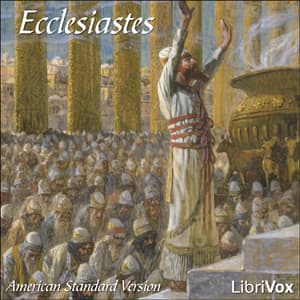

Forty-one minutes. That's all it takes to listen to the most brutally honest book in the entire Bible, and I'm genuinely annoyed that I waited twenty years of teaching literature to finally sit with it properly.
I put this on during a late-night grading session—sophomore essays on The Great Gatsby, if you're curious—and by the time Robert Garrison got to "Vanity of vanities, all is vanity," I'd stopped marking papers entirely. Just sat there with my red pen hovering over some kid's thesis about the American Dream while an ancient text systematically dismantled every achievement I've ever cared about. Thanks for that, Solomon. Or whoever you are.
The Original Nihilist (Who Somehow Isn't Depressing)
Here's what kills me about Ecclesiastes: it reads like existentialist philosophy written three thousand years before Camus was born. The Preacher—and yes, I love that we don't actually know who wrote this—cycles through every human pursuit with the energy of someone who's tried it all and found it wanting. Wisdom? "In much wisdom is much grief." Pleasure? "This also was vanity." Labor? "What profit hath a man of all his labor?"
And yet. And yet it doesn't feel hopeless. There's this strange warmth underneath the bleakness, this insistence that you should eat your bread with joy and drink your wine with a merry heart. The author isn't saying life is meaningless—he's saying our obsession with permanent legacy is the problem. The generations to come won't remember us, so stop killing yourself trying to be remembered.
My students would absolutely hate this. They're seventeen and convinced they're going to change the world. I'm forty-seven and just trying to get through fifth period without losing my voice. Ecclesiastes speaks to me now in ways it couldn't have at their age.
On the American Standard Version (A Brief Tangent)
I should note—because I'm a literature teacher and I can't help myself—that the ASV sits in an interesting place translation-wise. It's more literal than the King James, less poetic in some ways, but there's a clarity to it that serves Ecclesiastes well. When the text says "grasping for the wind," you feel the futility without ornamentation. The KJV's "vexation of spirit" is beautiful, but the ASV's directness cuts differently.
This is why we still read the classics. Different translations reveal different facets of the same truth.
Robert Garrison's Quiet Authority
The narrator understands that pause is punctuation. Garrison doesn't perform Ecclesiastes—he presents it. His pacing is measured, almost meditative, which works for a text that's essentially one long philosophical meditation. There's no dramatic flourish when the Preacher declares that "the dead which are already dead" are happier than the living. Garrison trusts the words to land.
Is it the most dynamic reading I've ever heard? No. But dynamic would be wrong here. This isn't a novel with character arcs and plot twists. It's wisdom literature, and Garrison treats it with appropriate gravity. His voice has a steady, unpretentious quality—like a professor reading aloud in a small seminar, not performing for a lecture hall.
At 41 minutes, there's no room for the narrator to establish range across multiple moods. What you get is consistency, and for a single sitting with ancient wisdom, that's exactly right.
Worth Pausing the Faculty Meeting For
Look, this is a LibriVox recording. It's free. The production is clean, Garrison is competent, and the text itself is one of the most profound pieces of literature in Western civilization. If you've never actually listened to Ecclesiastes straight through—just sat with it, without a pastor interpreting it for you, without study notes in the margins—this is your chance.
The prose deserves to be savored. At 1.0x speed (because I'm ancient and the author chose those words), it's a single lunch break or evening walk. Denise and I listened to it again on the lakefront last weekend, and she—who has heard me ramble about Hemingway's iceberg theory approximately four hundred times—actually said it was beautiful.
If you loved Marcus Aurelius's Meditations, this is its spiritual ancestor. Same energy of a powerful person confronting mortality with clear eyes. I found that same unflinching honesty about human suffering in Tattooist of Auschwitz, though it comes from a very different kind of witness. Same insistence that most of what we chase doesn't matter.
Who Should Listen (And Who Should Walk Away)
This is for anyone who's ever felt the weight of their own ambition and wondered if it was worth it. For readers who appreciate philosophy delivered without academic jargon. For people who want to understand why this strange, almost cynical book ended up in the Bible at all.
Skip it if you're looking for comfort or easy answers. The Preacher offers neither. He offers honesty, which is harder and more valuable.
The Bell's About to Ring
I've assigned excerpts from Ecclesiastes to seniors before, paired with Hamlet's "To be or not to be" and Camus's "The Myth of Sisyphus." They always think I'm being morbid. But there's something freeing about a text that tells you straight: you will be forgotten, your work will crumble, and that's okay. Eat your bread. Drink your wine. Do your labor under the sun with whatever joy you can muster.
Forty-one minutes. The most honest book ever written. And it's free.
Principal Martinez, if you're reading this, I promise I'll pay attention at the next budget meeting. (I won't. I'll be listening to Job.)