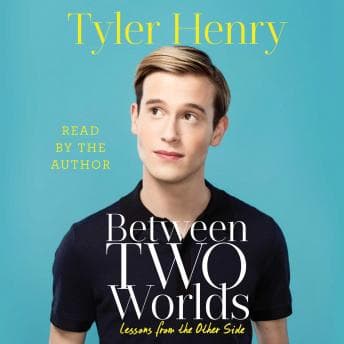
I'm going to be upfront: I'm a science-based, evidence-driven healthcare worker. I believe in what I can see on a monitor, measure in a lab, and confirm with imaging. So when I say I listened to Tyler Henry's memoir with genuine interest and came away mostly... respecting the guy? That should tell you something.
Let me back up. I was home on a day off, folding laundry while Carlos had the kids at soccer practice, and I needed something short and light - not another thriller where someone misuses an AED. At four and a half hours, Between Two Worlds fit the bill. I expected to spend most of it rolling my eyes. And honestly? Parts of it, yeah. But not the parts I expected.
The Kid From Hanford, Not the Celebrity From E!
What surprised me most is that this isn't really a book about celebrity readings or name-dropping Kardashians. I mean, that stuff's in there, but the heart of this book is a small-town kid from Hanford, California - agricultural Central Valley, not exactly Beverly Hills - trying to figure out why he's different. Tyler talks about growing up in a family that didn't have much, about his relationship with his mom, about being a gay kid in a conservative area, and about the isolation that comes with being the weird one. That part? That part I get.
Being the eldest Filipina daughter who chose nursing over med school, being the first in your family to navigate college without a roadmap - the specifics are different but the feeling of being caught between who your family expects you to be and who you actually are? That's universal. And Tyler writes about it with a plainness that feels honest rather than performed.
His description of his grandmother's death - the moment he says he "knew" before anyone told him - is the emotional center of the book. He was ten. He describes this sensation he calls "knowingness," which, look, I can't validate as a medical professional. But I can tell you that in fifteen years of night shifts, I've watched enough patients describe things that don't fit neatly into clinical explanations to keep my mouth shut about what other people experience.
Author-Narrated, and It Actually Works
Tyler reads his own book, and this is one of those cases where that's the right call. He's not a trained narrator - there's no vocal fireworks, no character acting, no dramatic pacing shifts. It's just a young guy talking about his life in a conversational, slightly earnest way. Sometimes he sounds a little rehearsed, like he's reading from a script he practiced a few times (because he is), but the emotional moments land because you can hear that they're his emotional moments. When he talks about the strain his abilities put on his family, there's a weight in his voice that a professional narrator might've over-dramatized.
At 4 hours 31 minutes, it doesn't overstay its welcome. I finished folding laundry, started prepping dinner, and was done before Carlos got back. Perfect length for what it is.
Where My Skepticism Kicks In
Here's where I have to be real. Tyler doesn't spend a lot of time addressing skepticism head-on, and that bothered me. He mentions critics briefly but mostly frames his gift as something he had to accept rather than something he needs to prove. For someone like me - someone who charts vitals and cross-references symptoms for a living - I wanted more engagement with doubt. Not defensiveness, just acknowledgment that healthy skepticism isn't the same as hostility.
The celebrity reading sections are the weakest parts. They feel like extended episodes of the show rather than memoir material. When he's talking about reading for regular people dealing with grief, the emotional stakes are clear. Grief as the real subject matter - not celebrity, not spectacle - is something Anxious for Nothing also gets right, grounding its emotional weight in ordinary human experience rather than performance. When it shifts to Hollywood, it starts feeling like a press kit.
And the spiritual framework he presents is pretty broad - afterlife communication, signs and symbols, the idea that the dead want to help the living heal. He's sincere about it, but if you're looking for a rigorous philosophical or spiritual argument, this isn't it. It's a personal account, not a thesis.
Who Gets Something Out of This
If you've lost someone and you're the type of person who finds comfort in the possibility - not the proof, the possibility - of continued connection, Tyler's sincerity will probably move you. If you're a skeptic who can appreciate a decent coming-of-age memoir wrapped in supernatural packaging, you might be surprised like I was. If you need evidence-based approaches to grief, this will frustrate you.
My mom would love this. She still lights candles for Lola and talks to her like she's in the next room. (She still thinks I should've been a doctor, but she also talks to dead relatives, so her judgment is questionable.)
Night Shift Prescription
Carlos asked why I was being so quiet during dinner. I told him I'd spent the afternoon listening to a psychic medium and didn't hate it. He checked me for a fever. But here's the thing - I didn't love it either. It's a sincere, short, surprisingly grounded memoir from a kid who found fame through something most of us can't explain. The humanity in it is real, even if you question everything else.