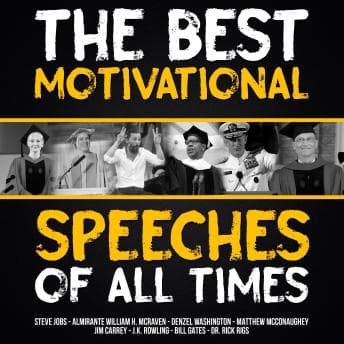

Can we talk about the title for a second? "Best Motivational Speeches of All Times." Of ALL times. Not "all time" — all TIMES. Plural. As if there are multiple timelines and someone surveyed each one. My inner academic twitched. And then I found myself asking: who curated this list and by what criteria? Because "best" is doing a LOT of heavy lifting here for a collection that includes exactly one woman.
I was chopping onions for a chana masala on a Sunday evening — the kind of elaborate cooking project I do alone because I genuinely enjoy it, don't @ me — when I hit play on this. Nearly four hours of speeches from nine speakers. The pitch is simple: greatest leaders, greatest words, maximum inspiration. And look, some of it lands. But as someone who studies why certain narratives stick in people's heads and others don't, I have thoughts.
The Speeches That Actually Rewire Something
Admiral McRaven's "Make Your Bed" commencement speech is the standout, and it's not close. Here's why it works psychologically: he takes a stupidly simple behavior — making your bed — and reframes it as a keystone habit that cascades into identity formation. The research actually shows that small ritual behaviors DO anchor self-efficacy. So when McRaven connects bedmaking to surviving Hell Week, your brain processes it not as a metaphor but as a causal chain. That's good persuasion. That's understanding how humans construct meaning.
Jim Carrey's speech is the other one that genuinely surprised me. The man built a career on physical comedy and then stands up at a commencement and talks about his father choosing the safe path, failing anyway, and the lesson that fear-based decisions don't actually protect you from failure. The protagonist of his own story exhibits classic avoidant attachment patterns that he then consciously rejected. It's raw and specific and funny in the way only someone who's processed real grief can be.
Rick Rigsby — and I'll be honest, I didn't know his work before this — hits differently than the bigger names. His speech about his father, a third-grade dropout who became the wisest man he knew, is a fascinating case study in how we construct authority figures in our personal mythologies. The emotional texture in his voice is unmistakable. You can hear the catch. These are original recordings, not re-reads, and that matters.
The Ones Where My Attention Wandered Back to the Onions
Bill Gates and Steve Jobs — both brilliant people, both gave speeches that feel like they're operating in a different register than the rest. More cerebral, less visceral. Gates in particular has a delivery style that's measured and careful, which is fine for a TED talk but sits a little flat sandwiched between Denzel Washington's baritone conviction and McConaughey doing... whatever McConaughey does. (My therapist would have thoughts about McConaughey's relationship with his own mythology, but that's a different review.)
A couple of the speeches are genuinely dry. Not bad — just the kind of thing where you realize you've been stirring the same pot for three minutes and absorbed nothing. The collection doesn't build; it just... lines up speeches sequentially. No connective tissue, no thematic arc. Jason Fung runs into a similar structural problem in Cancer Code — genuinely compelling ideas that never quite cohere into the through-line the material deserves. As someone who studies narrative structure, this bothers me more than it probably should.
And the gender thing. J.K. Rowling is the only woman here. One. Out of nine. In a collection claiming to represent the "best of all times." Maya Angelou existed. Oprah Winfrey exists. Chimamanda Ngozi Adichie's TED talks have been viewed hundreds of millions of times. The curation choices tell their own story about whose voices get labeled "motivational" and whose get filed under something else. Psychologically, this doesn't track if we're actually trying to represent human inspiration rather than a very specific demographic's idea of it.
The Audio Reality
These are original recordings, which is both the strength and the limitation. You get authenticity — Carrey's comedic timing, Rigsby's emotional breaks, McRaven's military precision. You also get variable audio quality, ambient audience noise, and the occasional acoustics of whatever auditorium they were in. It's not polished studio work. Think of it as documentary footage versus a produced film. Both valid, but manage your expectations.
At under four hours, it's a short listen. Good for a workout playlist approach — queue up a speech or two when you need a psychological nudge, skip around based on mood. It's not really built for a straight-through experience.
Who This Is For (and Who Should Keep Scrolling)
If you've never encountered these speeches before and want a sampler platter, this works. If you're the kind of person who puts on motivational content during a morning run and lets the energy carry you through — sure, grab it on a sale. But if you've already seen these speeches on YouTube (most are freely available), or if you're looking for a curated, contextualized exploration of what makes great rhetoric great, this isn't that. It's a playlist, not an analysis.
My Prescription
Three speeches here are genuinely worth your time — McRaven, Carrey, Rigsby. The rest range from solid to forgettable. The collection's curation is lazy in ways that matter, and the title oversells what's inside. But those three speeches? They understand something true about how humans talk themselves into courage. And sometimes that's enough to justify the listen while your chana masala simmers.