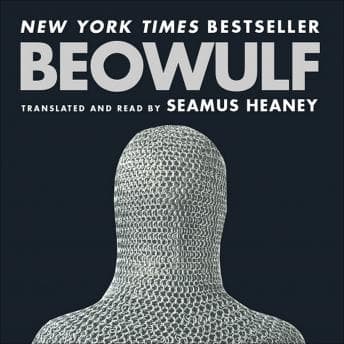

What happens when the poet who translated a thousand-year-old poem is also the one reading it into your ears?
I'll tell you what happens. You stop grading papers. You put the red pen down. You sit there at your kitchen table at 11:47 PM with a stack of sophomore essays on The Great Gatsby and you just... listen. Because Seamus Heaney reading his own translation of Beowulf is the closest thing we have to a time machine. Not back to Anglo-Saxon mead halls, exactly, but to the oral tradition itself — the idea that poetry was never meant to sit quietly on a page. I've chased that same feeling of ancient wisdom demanding to be absorbed slowly — Siddhartha gave me a quieter version of it, the kind where you realize the text was always meant to move through you rather than past you. It was meant to be performed. Spoken. Heard.
The Voice That Knows Every Syllable's Weight
Heaney's Irish lilt does something extraordinary here. It softens the violence just enough to let the elegy underneath breathe. When he reaches Beowulf's final battle with the dragon — an old king choosing to fight one last time — his voice carries this weight that isn't theatrical. It's just... tired. In the right way. The way a man sounds when he knows the ending. This reminds me of what Hemingway said about writing — "All you do is sit down at a typewriter and bleed." Heaney doesn't bleed here. He just speaks, and the blood is already in the words.
Here's the thing my students would never understand: this isn't a "performance" in the way we usually mean for audiobooks. There are no distinct character voices. Heaney doesn't drop into a growl for Grendel or affect some booming hero-voice for Beowulf. He reads the poem as a poem. His pacing follows the alliterative rhythms of his own translation — the stressed syllables land like hammer strikes, and the pauses between them are deliberate. The narrator understands that pause is punctuation. You can hear him breathing between lines, and even that feels like part of the architecture.
I slowed my usual pace. And I already listen at 1.0x, which my students think makes me a fossil. But this demanded even more patience. Two hours and fourteen minutes. You could listen to it twice in the time it takes to sit through a faculty meeting about standardized testing.
The Abridgment Problem (And Why I'm Still Recommending This)
Let's talk about what the author is really saying — or rather, what he chose NOT to say. This is an abridged version. Heaney prepared it himself for a BBC recording, which means the cuts are intentional, not some publisher's hack job. But they still sting. Unferth's challenge to Beowulf — one of the great verbal sparring matches in English literature, a scene I teach every year — is gone. Just... absent. If you're coming to this as your first encounter with the poem, you're getting an incomplete picture. And nowhere on the listing does it scream "ABRIDGED" loudly enough.
So why am I not angrier? Because what remains is so pure. Heaney chose the bones of the story: the three great battles, the elegiac passages about the passing of kings, the funeral at the end. He stripped it to its mythic architecture. It's like hearing a jazz musician play a standard — you know the full arrangement exists, but the stripped version reveals the melody's skeleton. My students would hate this analogy. I love it.
But I'd be lying if I said the cuts don't matter. They do. If you're a teacher, a student, or someone who wants the full text, you need the unabridged version (George Guidall's narration is solid, but it's not the poet himself). This recording is an artifact — beautiful, essential, incomplete.
Who This Is For (And Who Should Walk Away)
If you loved the experience of hearing Derek Walcott read Omeros or Langston Hughes on those old recordings — a poet inhabiting their own language — this is its spiritual successor. It's for people who believe poetry is an auditory art first. It's for the English teacher who's taught this poem fifteen times and forgotten why it matters. (That was me, three semesters ago.)
But if you want a full dramatic production? If you need distinct voices and sound effects and the complete narrative arc? Skip this version. Seriously. You'll be frustrated by what's missing, and Heaney's measured, almost meditative delivery will feel slow rather than deliberate.
Denise fell asleep during the dragon fight. I can't blame her — it was almost midnight and Heaney's voice is genuinely hypnotic. Some listeners call it soporific. I call it the sound of someone who trusts their words enough not to shout them.
Worth Pausing the Faculty Meeting For
This is why we still read the classics. Not because they're assigned. Not because they're on some list. Because a Nobel laureate sat in front of a BBC microphone and read a poem about monsters and mortality, and a thousand years collapsed into two hours. The prose deserves to be savored. Even when it's technically verse. Even when it's technically incomplete.
Principal Martinez, if you're reading this: I listened to it during your email about hall pass procedures. And I regret nothing.