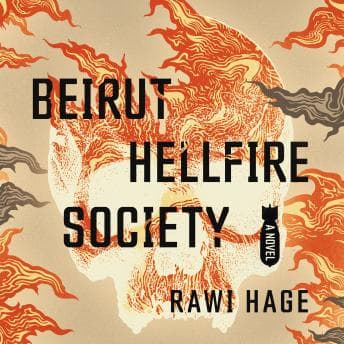

Look, I have a complaint. Rawi Hage has no business making death this funny. I've spent twenty years teaching teenagers about war literature — A Farewell to Arms, The Things They Carried, Slaughterhouse-Five — and I thought I understood how dark comedy operates in the shadow of violence. Then I'm walking the lakefront with Denise on a Saturday morning, sun on the water, joggers passing us with their perfect weekend energy, and Neil Shah is in my ears describing yet another funeral procession through Beirut's bombed-out streets while Pavlov — our undertaker protagonist, named after the dog guy, because of course he is — treats the whole affair with the kind of weary absurdity that made me laugh out loud. Denise asked what was so funny. I said, "A secret society is burying people the church won't touch." She gave me that look. You know the look.
Death as the Only Honest Profession
Here's what Hage is really saying, and it took me a few hours to fully catch it: in a city where every faction claims moral authority — religious, political, sectarian — the only person doing genuinely moral work is the guy handling corpses nobody else wants. Pavlov inherits his father's role with the Hellfire Society, this anti-religious underground that arranges burials for people denied last rites because of who they loved or which god they prayed to (or didn't). And the genius of it is that Hage never lets you settle into a comfortable reading of this as noble or heroic. Pavlov isn't a saint. He's eccentric, detached in that way survivors get detached, and the novel treats his work with the same matter-of-fact absurdity that war imposes on everything.
The scenes with the mourner processions hit differently when you've taught The Stranger as many times as I have. Camus would've recognized Pavlov — that same alienated clarity about death — but where Meursault is cold, Pavlov is warm in a way that sneaks up on you. His interactions with his niece carry this quiet tenderness that Shah delivers without overselling. No trembling voice, no dramatic pauses held too long. Just a slight softening. The narrator understands that pause is punctuation, and Shah uses restraint exactly where a lesser performer would've gone big.
Shah Plays the Rubble Like an Instrument
Neil Shah doesn't try to be everything here, and that's the right call. This is a 7-hour listen — tight, economical, the novel equivalent of a sharp novella that doesn't waste your time. Shah's emotional delivery in the death scenes is genuinely good, but what impressed me more was his handling of Hage's tonal shifts. One moment you're in gritty, visceral war — bombing, displacement, a mysterious woman who appears on Pavlov's staircase after an explosion like some ghost of the city itself — and the next you're with El-Marquis, the flamboyant head of the Hellfire Society, who brings this theatrical energy that borders on the surreal. Shah navigates those shifts without making them feel like different books. The dark humor crackles through his reading, and he lets Hage's prose do the heavy lifting rather than performing over it.
I listened at 1.0x. Obviously. The prose deserves to be savored. Hage writes with this rhythmic intensity — short declarative sentences punctured by longer, almost lyrical passages about the city — and speeding that up would be like fast-forwarding through a jazz solo. My students would hate this. I love it.
The War Novel Your Syllabus Is Missing
This reminds me of what Hemingway said about writing — that the dignity of movement of an iceberg is due to only one-eighth of it being above water. Hage lived through the Lebanese civil war. He's not imagining this. And you can feel the difference between a writer researching trauma and a writer remembering it. The novel doesn't explain the conflict to you with helpful context paragraphs. You're dropped into the sectarian mess the same way Pavlov lives in it — as background noise that occasionally kills people you know.
If you loved Cockroach or De Niro's Game, this is Hage returning to Beirut with twenty more years of craft behind him. If you haven't read Hage at all, this might actually be the place to start — it's his most accessible and his most strange, somehow simultaneously.
Who should listen: Anyone who reads Vonnegut for the sadness underneath the jokes. Anyone who's tired of war novels that treat conflict as plot machinery rather than lived experience. Billy Summers scratches a similar itch — that same sense of a genre novel doing something quieter and more literary underneath the surface action. Anyone who wants a short, fierce listen that doesn't pad its runtime. Skip it if you need clean narrative arcs and resolution — this is a fable, not a thriller, and it ends the way wars end for the people living through them. Which is to say, it doesn't really end. It just continues.
Worth Pausing the Faculty Meeting For
I finished this during a Sunday grading session, red pen in hand, junior essays about The Great Gatsby spread across the kitchen table. And I sat there for a minute afterward thinking about how I teach my students that great literature makes the unfamiliar feel urgent and personal. Hage does that. A secret burial society in 1970s Beirut shouldn't feel this close to home, but it does — because the questions are universal. What do we owe the dead? What do we owe the living who've been cast out? Pavlov never answers these directly. He just keeps carrying bodies. Sometimes that's enough.