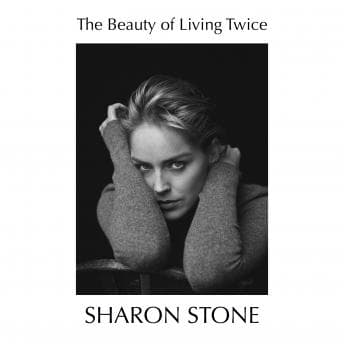

Everyone told me this audiobook would make me cry. The reviews warned of Sharon Stone's emotional delivery, her vulnerable narration, the raw honesty that apparently had listeners reaching for tissues within the first hour. So I queued it up expecting a carefully orchestrated tearjerker, another celebrity memoir designed to rehabilitate an image and sell redemption by the chapter.
What I got was something stranger and more interesting—and honestly, way harder to listen to while folding laundry at 10 PM.
Sharon Stone narrates her own story in a voice that's plainspoken and throaty, occasionally dipping into monotone territory that might lose you if you're multitasking. But here's the thing—that unevenness feels real. This isn't a polished performance designed to hit emotional beats on cue. It's a woman sitting across from you at the kitchen table, sometimes losing herself in memory, sometimes pulling back when things get too heavy. The crying that punctuates certain passages isn't theatrical; it catches her off guard as much as it catches you.
The structure will either work for you or drive you absolutely mad. Stone doesn't tell her story chronologically. She jumps between memories linked by feeling rather than timeline, circling back to traumas, leaping forward to triumphs, then dropping you into a completely different decade without warning. I listened to chunks of this during early morning coffee before the kids woke up, and there were moments when I had to mentally reorganize what era we were even in. If you need your memoirs to march forward in orderly fashion, this will feel scattered and frustrating.
But I've come to think that messy approach is actually the point. Trauma doesn't organize itself neatly on a timeline—ask any mom who's been through something hard and tried to explain it later. I've seen that same fragmented approach work beautifully in Hello, Summer: A Novel, where the narrator weaves between past and present in a way that mirrors how memory actually functions. The brain stores difficult stuff in fragments, and when Stone talks about her childhood violence, her stroke, her career implosions, and her rebuilding, it all swirls together because that's how lived experience actually works. The disorientation mirrors the disorientation of surviving the things she's survived.
Fair warning: the content itself is brutal in places. Stone doesn't soften the edges of her childhood trauma or the sexual abuse she experienced. She discusses her stroke with clinical detail that made me wince, and her miscarriages are handled with a grief that feels unprocessed even now. This isn't light listening, and if you're sensitive to discussions of illness, abuse, or emotional distress, approach with care. I had to pause more than once just to take a breath.
What surprised me most was how little this feels like a typical Hollywood autobiography. Stone mentions her famous roles, sure, but this isn't a behind-the-scenes tour of movie sets or a name-dropping exercise. She's more interested in the internal stuff—the spiritual seeking, the humanitarian work, the slow reconstruction of family relationships after everything fell apart. If you're looking for juicy industry gossip or detailed career insights, you'll be disappointed. This is a book about what happens after the spotlight dims and you're left figuring out who you actually are.
The audio production is clean, no technical issues to report. Stone's voice carries well at standard speed, though I found myself slowing down during the more emotionally dense passages just to let them land properly. The seven-hour runtime feels appropriate—long enough to be substantial, short enough that the non-linear structure doesn't become exhausting.
Who This Is (and Isn't) For
This isn't for casual celebrity fans who want entertainment. It's for people who've had to rebuild themselves after catastrophic loss—survivors of various kinds who might recognize their own fragmented healing in Stone's scattered narrative. If you value authenticity over polish, don't mind sitting with discomfort, and understand that sometimes the most honest stories are the messiest ones, you'll find something here. But if you want linear storytelling or Hollywood gossip, skip it.
Stone earned a New York Times bestseller with this book, and Oprah Magazine called it "brutally honest, restless and questing." That description holds up. There's a restlessness to the narration that matches the restlessness of the content—a woman still searching, still making sense of things, still figuring out what her second life means.
The audiobook format serves this material well specifically because Stone narrates it herself. A professional voice actor might have smoothed out the rough edges, made the emotional beats more predictable. Instead, you get the real thing—uneven, sometimes frustrating, occasionally transcendent.
Worth the Interrupted Listening Sessions
I didn't cry, for what it's worth. But I did find myself thinking about resilience differently by the end, about how the stories we tell ourselves about our own lives don't have to be linear to be true. For a busy week of interrupted listening sessions, that's worth something.