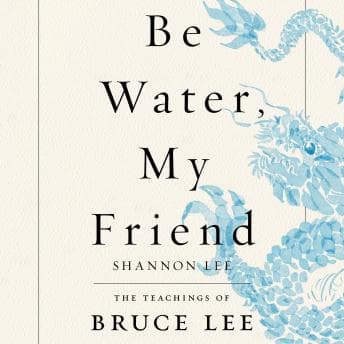

What happens when philosophy gets stripped of its academic pretension and handed to you by someone who watched it lived out at the dinner table?
I was walking the lakefront with Denise last Saturday morning — one of those rare October days in Chicago where the lake looks like hammered silver and you can almost forget winter is coming — and Shannon Lee was in my ears talking about her father's concept of "having no limitation as limitation." And I stopped walking. Just stood there on the path like an idiot while joggers swerved around me. Because I teach Emerson. I teach Thoreau. I've spent twenty years trying to get seventeen-year-olds to understand transcendentalism, and here was Bruce Lee — a martial artist, an actor, a guy most of my students only know from memes — articulating the same ideas with more clarity than half my syllabus.
This reminds me of what Hemingway said about prose being architecture, not interior decoration. Bruce Lee's philosophy works the same way. And Shannon Lee understands that.
A Daughter's Voice Carries Weight the Page Can't
Let me be direct about something: this book lives or dies on the audiobook format. Shannon Lee narrating her father's teachings isn't just convenient — it's essential. There's a moment early on where she's recounting how Bruce Lee would talk about emptying your cup, making yourself available to new learning, and her voice drops into this quiet register that carries real memory in it. Not performance. Memory. You can hear the difference. She's not reading philosophy. She's remembering her father.
The narration blends this steady, grounded strength with moments of genuine tenderness — particularly when she shifts from Bruce Lee's teachings to her own struggles applying them. When she talks about her own grief, her own journey to understand a father she lost when she was four years old, there's a rawness there that no hired narrator could fake. Shannon uses her perspective with real care, and you can tell she's thought about every word. She's intelligent and passionate without tipping into sentimentality.
At 1.0x — because the author chose those words and I choose to hear them properly — the pacing feels right. Meditative, even. The prose deserves to be savored.
The Self-Help Problem (And Why I Don't Entirely Mind)
Here's where I have to be honest with you. There are stretches of this book that read like self-help. Capital-S, capital-H Self-Help. The kind of thing where you're told to "be present" and "embrace the process" and you start hearing it in the same tone as every corporate wellness seminar you've been forced to attend. I get why some listeners hit fast-forward. If you came for a Bruce Lee biography — fight choreography stories, Hollywood anecdotes, behind-the-scenes drama — you're going to be frustrated. That's maybe 30% of this book. The rest is philosophical framework dressed in accessible language.
But here's the thing. I teach literature. I've read Marcus Aurelius and the Tao Te Ching and Zen and the Art of Motorcycle Maintenance. And what Shannon Lee is doing here isn't diluting her father's ideas — she's translating them. The "be water" philosophy isn't just a cool quote for Instagram. It's an entire framework for adaptability, for releasing rigidity, for understanding that power comes from flexibility rather than force. She builds each chapter around a different facet of this idea, layering in previously untold stories from Bruce Lee's life alongside her own experiences. It's not revolutionary philosophy, no. But it's honest philosophy, delivered with sincerity.
My students would hate this. I love it. (Though honestly, a few of them might surprise me. The ones who do martial arts would probably get it immediately. Philosophy through the body rather than the page — there's something to that.)
Who This Is Really For
If you loved Tuesdays with Morrie or When Breath Becomes Air — books where personal loss becomes a lens for examining how to live — this is their spiritual successor from an entirely different tradition. I found something of that same alchemy — grief sharpening into purpose, a life examined through the people who lived it — in Boys in the Boat, though Daniel James Brown is working in a completely different register. It's Eastern philosophy filtered through a daughter's love and loss, made practical without being dumbed down.
Skip this if you want a straight biography. Skip it if self-help language makes your eye twitch and you can't push past it. But if you're willing to sit with the pacing — and I mean really sit with it, not at 2x while doing dishes — there's genuine wisdom here.
Worth pausing the faculty meeting for. Absolutely. (Sorry again, Principal Martinez.)
The Annotation in the Margin
Seven hours and twenty-one minutes. That's shorter than most of the novels I assign my sophomores, and it carries more practical philosophy than some of them will encounter in four years of high school English. Shannon Lee didn't write a hagiography of her father. She wrote a bridge — between Eastern and Western thinking, between martial arts and daily life, between a daughter's grief and a daughter's understanding. The narration makes it personal in a way the print version simply can't. This is why we still read the classics — and why sometimes the classics come from places we don't expect.