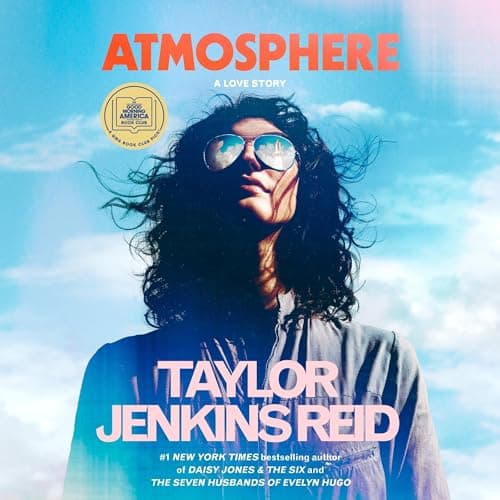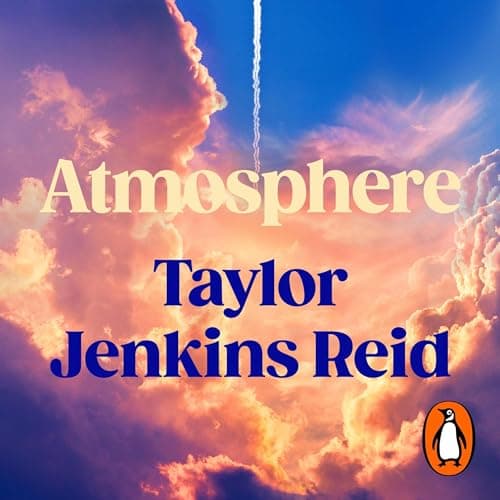

The first hour of Atmosphere found me on my porch just after sundown, sweet tea sweating onto the arm of the wicker chair, the peach trees gone still in that strange Georgia heat before a storm. I had the playback set to 0.85x - naturally - and by the time Joan Goodwin walked into astronaut training at Johnson Space Center, I was already leaning forward like I had somewhere to be. Which is saying something for a widow on her porch with nowhere urgent left to go.
This book understands a thing I have spent my whole life teaching: ambition is never just ambition. It is hunger. It is loneliness. It is desire dressed up in respectable clothes. Joan begins as an astrophysics professor, cerebral and careful, and then Taylor Jenkins Reid places her inside the 1980 shuttle program, among pilots and mission specialists and engineers who all seem to have learned how to hide terror beneath competence. Hank Redmond has that cocky pilot energy you expect. Donna Fitzgerald brings warmth that keeps the whole machine from feeling metallic. Lydia Danes and John Griffin sharpen the stakes because they feel like working adults with jobs that can go wrong in ways the body remembers forever. And Vanessa Ford - Lord, Vanessa. Magnetic is the right word. She enters the novel carrying both invitation and danger.
Houston, with a heartbeat
What I liked most is that Reid does not treat NASA as wallpaper. The training, the hierarchy, the shuttle culture of 1980 through 1984 - it all has weight. You can hear the pressure of a woman entering a world that wants brilliance from her and also wants her to be legible, controlled, convenient. Joan's love story grows inside that pressure cooker, so the romance never feels pasted on. It feels costly. Earned.
And because the book is anchored to mission STS-LR9, there is an undertow from the beginning. You know some terrible change is coming. When the mission scene arrives - especially the moment John Griffin is injured - Reid finally cashes in all that emotional investment. The scene works because she has trained your ear first. You know these people as professionals before you are asked to fear for them as human beings. Some stories need time to breathe. This one uses that breathing room to make the emergency hit harder.
I should say this plainly: if you come for rockets alone, you may get restless. This is not a checklist of launch procedures with a little kissing sprinkled on top. It is a love story and a workplace story and a question about what a life costs when you choose it fully. I kept thinking, oddly enough, of the hunger driving the characters in Fallen Crest Public - though Reid handles that same raw ambition with considerably more restraint and craft. The space material gives the novel lift, yes, but the engine is Joan's interior life - her longing, her awakening, her grief, the way she begins to see her place in the observable universe and then realizes the universe may ask more of her than she planned to give.
Three voices, one gravity
The audio casting is awfully smart. Julia Whelan carries the emotional center with that controlled, intelligent warmth she does so well. She never overplays Joan. She lets thought arrive before feeling spills over, and that restraint matters in a book about highly trained people trying not to come apart. Kristen DiMercurio adds texture and contrast, which helps the ensemble feel inhabited rather than flattened. And Taylor Jenkins Reid reading portions herself gives the whole production a little extra authority - not in a gimmicky way, but in the sense that the author is briefly stepping into the room to set the china exactly where she wants it.
No music. No intrusive sound design. Thank heaven. Just clean audio and narrators who understand the weight of every pause. At 0.85x, the dialogue in the training scenes had room to land, and the more intimate exchanges between Joan and Vanessa gained a quiet voltage. My late husband would have loved this, especially the way Whelan lets silence do part of the acting.
There is one reservation, and it is not small enough to ignore: the ending does feel abrupt. Not emotionally false - let me be clear - but abrupt. After so much careful ascent, the final descent happens quickly. I sat there with the cicadas starting up, thinking, Wait. That's where we're leaving it? Some listeners will admire the sharpness of that choice. Others will want another chapter, maybe two, to let the emotional smoke clear. I am somewhere in the middle. The ending fits the novel's interest in rupture, but it denies a little of the reflective afterglow the book has earned.
If you want constant propulsion, this may test your patience. If you want human feeling handled with a steady hand, you'll be in good company here.
Who Should Listen (And Who Should Skip)
You should pick this up if you like historical fiction that cares about systems and feelings equally, and if you don't mind a slow-burn romance unfolding inside professional ambition. Pick it up too if audio performance matters to you, because this production is polished without feeling slick. Perfect for porch time with sweet tea. Also for a long drive when you can actually pay attention.
Skip it if you mostly listen while distracted. The emotional turns are too fine for that, and the shuttle-program details ask for focus. Skip it too if abrupt endings make you feel cheated no matter how strong the journey was. 'Cause yes - that complaint is real.
What stays with me is not just the danger of space, though the STS-LR9 sequence absolutely lands. It is Joan looking up at a universe she has studied professionally and discovering that knowledge does not protect you from need. Not from love. Not from fear. Not from loss. When Reid slows down enough to let yearning speak, the language turns warm and luminous, and this cast is wise enough not to rush her.
I finished the last chapter after dark, dogwoods just shadows by then, and sat awhile before going inside. That's usually my measure. Whether a book sends me immediately to the sink to wash the glass and carry on - or keeps me in the chair. This one kept me in the chair.