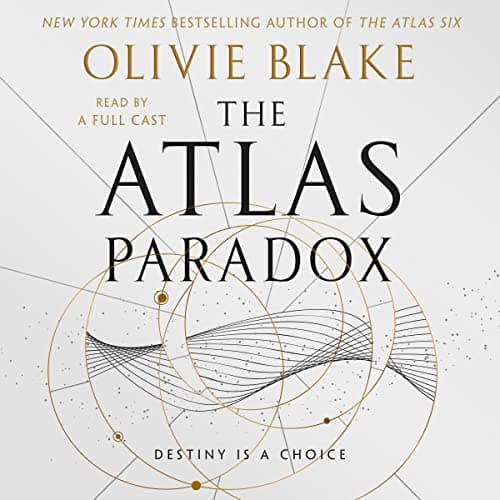

Everyone kept telling me The Atlas Paradox was the book that would make the series click, that the multi-narrator production elevates it into something cinematic and unmissable. I wanted to believe them. I really did. But somewhere around hour 11, standing in the Caltrain vestibule because every seat was taken, I realized I'd been zoning out for twenty minutes and hadn't missed a single plot development. Because there wasn't one.
Let me back up.
Ten Narrators Walk Into a Library
The production ambition here is genuinely impressive. Ten narrators for what's essentially a six-POV story - Macmillan went all in. And for the first few hours, it works beautifully. The cinematic quality is real. Each character gets their own voice actor, so when the POV shifts, you know immediately who you're with. Steve West handling Callum's cold, detached superiority? Chef's kiss. Damian Lynch (Earphones Award winner, for the record) brings this grounded weight to his sections that anchors the whole production.
But here's where it gets messy: the sound editing between narrators is inconsistent enough that transitions can be jarring. Volume levels shift. The ambient tone changes. It's like when you're debugging and you hit a service boundary where the logging format suddenly changes and you have to recalibrate your brain. Except this happens every chapter.
And then there's Parisa's narrator. I'm going to be honest because I think it matters for an 18-hour commitment - the vocal fry and slow pacing on Parisa's chapters made me bump up to 1.75x, and even then I found myself reaching for my phone to skip ahead. Which is a problem, because Parisa is supposed to be one of the most interesting characters. Her sections felt like waiting for a CI pipeline that's stuck on a step you can't skip.
The Sophomore Slump Has a Magic System
Okay, the actual story. The Atlas Six was a setup book - introduce six brilliant, terrible magicians, pit them against each other, end with a gut-punch. The Atlas Paradox is supposed to be the payoff. Two paths, alliances tested, the Society revealed.
What you actually get is a lot of characters thinking about doing things. Thinking about their feelings about doing things. Having conversations about what they might do, in beautiful prose that sounds incredible out loud but moves the plot approximately three inches per hour. The character work is genuinely good - Blake writes interior monologue like she's been reading your therapy notes - but the ratio of introspection to action is roughly 8:1.
The betrayals and backstabbing the blurb promises? They're there. Sort of. But they unfold so slowly and are buried under so many layers of everyone being cleverer-than-thou that when the twists hit, my reaction was less "oh no" and more "finally, something happened." I kept thinking about how The Bobiverse manages to be deeply philosophical AND have things actually occur. Different genre, sure, but the principle stands: you can be smart without being static.
The magic system stuff - the theoretical physics-adjacent worldbuilding about the nature of the archives and what the Society actually does - that's where Blake shines. The science doesn't hold up in any rigorous way, but it's internally consistent enough that you buy it. When the book gets into the mechanics of what these magicians can actually do to reality, I was locked in. Those sections felt like the best kind of hard sci-fi wearing a fantasy costume. Institute does something similar with its genre-blending - and unlike here, the momentum never stalls long enough to make you question the whole enterprise.
The 6AM Commute-Worthiness Report
Here's my core problem: this is not a 6AM book. The multi-narrator format should help with that - new voice, new energy, snap to attention. But the pacing is so languid and the plot threads so intertwined that if you drift for even five minutes, you're lost. I had to rewind more times than I have for any audiobook this year. And the chapter structure makes it genuinely hard to find your place if you need to go back.
At 18+ hours, the ROI on this audiobook is... questionable. There's probably a tight 10-hour story in here that would've been incredible. The character dynamics between Nico and Libby alone could carry a shorter book. But at this length, with this pacing, it's asking a lot.
Perfect for: dedicated listening sessions, long flights. Skip for: commute, background, anything where your attention splits.
Should You Spend a Credit on This?
If you loved The Atlas Six and you're invested in these characters - and I mean really invested, not just "that was fun" invested - you'll probably get enough out of this to justify the listen. The character writing is strong, the production is ambitious even when it stumbles, and the final few hours pick up considerably.
But if you're coming in hoping for the dark academia fantasy equivalent of a page-turner? This is basically a philosophy seminar but for magicians who are too attractive and too sad to get anything done. I finished it in about six commutes plus a weekend session, and I kept going mostly because I'm stubborn and because the narrator for Reina grew on me in a way I didn't expect.
Kevin asked me if it was good and I said "it's... interesting" which we both know is my code for "I have complicated feelings and need to process." He went back to his podcast.