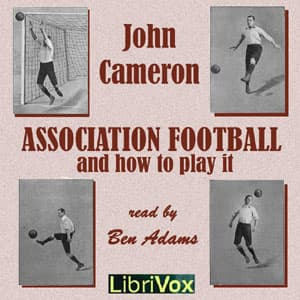

"The game of football is not merely a game of kicking a ball about a field; it is a science."
That line hit me about ten minutes in, and I actually laughed out loud - not because it's funny, but because John Cameron wrote that over a hundred years ago and we're still having the same argument. Every time one of my students tells me soccer is "just running," I want to play them this exact sentence. Cameron, writing in 1908, already knew the beautiful game deserved to be taken seriously as intellectual pursuit. The man was ahead of his time.
A Footballer Who Could Actually Write
Let me be honest about what drew me to this. I don't listen to sports books. I'm an English teacher. My idea of athletic achievement is walking the lakefront with Denise without getting winded. But Cameron's biography is genuinely fascinating - Scottish international, played for Everton and Tottenham, managed Spurs, became a prisoner of war during WWI where he organized football matches among fellow prisoners, then reinvented himself as a journalist. That's not a sports career. That's a novel. If a student turned in a character sketch with that arc, I'd accuse them of being too ambitious.
And here's what surprised me: Cameron can write. Not "well for an athlete" - just well. His descriptions of each position on the pitch read like character studies. The goalkeeper isn't just someone who stops the ball; Cameron gives you his temperament, his required psychology, his relationship to the defenders in front of him. The centre-half gets treated with the kind of detailed analysis I'd expect from a good essay on Hamlet's indecision. Cameron understood that positions are identities, not just locations on grass.
The tactical sections are where the book gets genuinely interesting from a historical perspective. Cameron describes passing combinations and defensive formations that sound almost quaint now, but you can hear the seeds of modern tactical thinking. He's essentially documenting the moment football stopped being a bunch of guys chasing a ball and started becoming a system. A strategy. A science, as he says.
Ben Adams and the LibriVox Question
Let's address the elephant. This is a LibriVox recording - a volunteer narrator reading a public domain text. You know what you're getting: no studio orchestra, no dramatic sound design, no multi-voice cast. Ben Adams reads clearly and with steady pacing, which for a text this old and this instructional is pretty much exactly what's needed. He doesn't try to dramatize Cameron's prose into something it's not. The delivery is straightforward, like a BBC radio presenter reading match analysis - composed, articulate, unadorned.
But I won't pretend it's a professional Audible production. The audio is clean enough, Adams enunciates well, and at just under two hours, nothing overstays its welcome. For a free recording of a 116-year-old football manual, this does its job. I listened to it on a Saturday morning while Denise was at the farmers market, coffee in hand, no distractions. It's that kind of listen - quiet, curious, unhurried.
Who This Is Actually For
Here's where I need to be straight with you. This is not a book for someone looking for the latest tactical analysis of the Premier League. It's not a memoir, despite Cameron's wild life story (which honestly deserves its own full-length biography - someone get on that). It's an Edwardian instructional manual about how association football works, position by position, with some historical context baked in.
So who loves this? History nerds. Football historians specifically. Anyone curious about what the game looked like before television, before FIFA became a global empire, before VAR made us all miserable. If you've ever wondered what football conversation sounded like before podcasts and Twitter, Cameron's prose gives you a window. There's something almost archaeological about it.
My students would absolutely hate this. I kind of love it for that.
It's also barely two hours. You could listen to this on a single long walk. The commitment level is essentially nothing, which makes it easier to recommend as a curiosity than as a must-listen. Think of it as a historical artifact with a microphone attached.
The Annotation Nobody Asked For
I keep coming back to Cameron himself. A man who played at the highest level, managed a top club, survived a war camp, organized sport behind barbed wire to keep men sane, then picked up a pen and made a second career explaining the game he loved. There's something deeply human about that trajectory. This little book - barely a pamphlet, really - is one small piece of a life that deserved more pages.
The prose deserves to be savored, even in its instructional flatness, because you're hearing a voice from 1908 trying to make you understand why football matters. And a century later, we're still trying to do the same thing. Worth pausing the faculty meeting for? Maybe not. But worth a quiet Saturday morning and a cup of coffee? Absolutely.