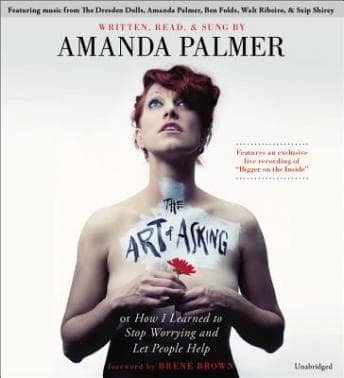

"The art of asking is not about how to get people to give you things. It's about creating the kind of relationship that makes people want to."
That line hit me somewhere around hour 3, squeezed into a window seat on the 6:47 Caltrain, and I actually paused the audiobook. Which I never do. I sat there staring at the fog rolling over the peninsula thinking about how many times I've refused help from Kevin when I'm drowning in on-call tickets at 1AM, insisting I'm fine, I've got it, I don't need anything. Amanda Palmer basically wrote an 11-hour book about why that instinct is broken. And she's... mostly right?
The Vulnerability-as-Architecture Problem
So here's the thing about this book. It's not what I expected. I thought it'd be a business-adjacent manifesto about crowdfunding and monetizing your fanbase - basically another startup book I'd crank to 1.75x and forget by Thursday. Making of a Manager scratched that startup-book itch for me last quarter and did it well, but Palmer is doing something genuinely different here. It's not that. It's way more personal and way less structured than I anticipated.
Palmer bounces between her years as a living statue bride on the streets of Boston (standing on a box in a wedding dress, handing flowers to people who dropped money in her hat), her tumultuous music career, her marriage to Neil Gaiman, and a friend's cancer diagnosis. The through-line is asking - asking for money, asking for help, asking for love, asking to be seen - but the path between those stories is... let's call it organic. Sometimes it feels like a conversation with a brilliant friend who keeps going on tangents. Sometimes those tangents are the best parts. Sometimes they're not.
The strongest sections are when she gets concrete. The mechanics of how she built a couch-surfing network with fans before Kickstarter existed. How her million-dollar crowdfunding campaign actually worked behind the scenes. The internet firestorm when she asked musicians to play for free at her shows. That last one is fascinating because she doesn't fully resolve it - she sits in the discomfort of being both right and wrong simultaneously, and I respect the hell out of that intellectual honesty.
Author-Narrated: The Double-Edged Sword
Palmer narrates this herself, and it's a very specific vibe. Her voice is warm and unhurried - almost like she's telling you all this over wine at 2AM at a party where everyone else has gone home. It's intimate in a way that a professional narrator wouldn't've achieved. You can hear the emotion crack through when she talks about her friend Anthony's illness, and there's this rawness that feels earned, not performed.
But - and this is a real but - there are volume inconsistencies that drove me a little nuts. Some passages are noticeably quieter than others, which is a problem when you're on a train with ambient noise and the person next to you is having a very loud phone conversation about their divorce proceedings. I found myself constantly adjusting volume. Not a dealbreaker, but it knocked a point off the production for me.
The songs between some chapters are a nice touch if you're into Palmer's music. I'm not particularly, so I skipped a couple. They break up the flow in a way that might be lovely for fans but felt like interrupts to me.
Where the Distributed System Breaks Down
Okay, the criticism. Parts of this book needed an editor with a heavier hand. There are stretches in the middle - maybe hours 5 through 7 - where the same ideas circle back without adding new data points. Yes, asking is hard. Yes, we're conditioned to be self-sufficient. Yes, there's a connection between asking and trust. I got it the third time. The ROI on those middle hours is lower than the rest.
Also, Palmer's worldview is very specifically that of a charismatic artist with an enormous platform and a famous husband. She acknowledges privilege a few times, but there's still this gap between "I asked my fans for a million dollars and got it" and "you should ask your landlord for an extension on rent." The book works best as philosophy and memoir. It works less well as practical advice for people who aren't, y'know, Amanda Palmer.
That said? The core argument - that asking for help is an act of trust, not weakness, and that the inability to receive is just as dysfunctional as the inability to give - is something I needed to hear. I literally texted Kevin after finishing it and asked him to handle dinner because I was fried from a deployment. Small thing. Felt huge.
Perfect For: Quiet Commutes. Skip For: Noisy Gyms.
If you're someone who prides yourself on never needing anyone (hi, fellow engineers who debug alone at 2AM rather than paging a teammate), this book will poke at something uncomfortable. It's not a quick listen - 11.5 hours is a commitment, and it meanders - but the emotional payoff is real if you let it in. The volume issues mean you want a relatively quiet environment. Not ideal for the gym or background listening.
I finished this in about 5 commutes at 1.25x (slower than my usual - rushing Palmer feels wrong). It's the kind of book that's better at 85% speed than 175%. Let it breathe.
Now if you'll excuse me, I need to go ask my tech lead for help with a memory leak instead of staring at it alone for another four hours like a stubborn idiot.