
"We are all just one ordinary day away from our lives completely changing."
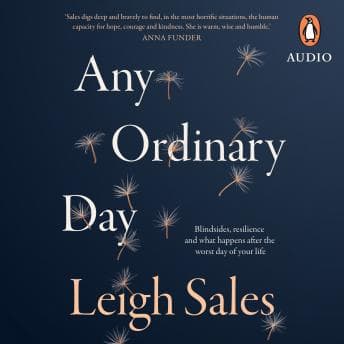
That line hit me somewhere around hour two, and I had to pause my work because my hands were shaking too much to align type on a grid. I was sitting cross-legged on my apartment floor surrounded by color swatches for a client's rebrand, Frida curled on a stack of rejected proofs, and Leigh Sales' voice - steady, warm, unmistakably Australian - just cracked something open in me that I wasn't ready for on a Tuesday afternoon.
The Book That Made Me Call My Mom at 3 PM on a Workday
Here's the thing about Any Ordinary Day: it's not really about the worst days. It's about the morning after. The week after. The year after. Leigh Sales is an Australian journalist who spent her career showing up to interview people on the worst days of their lives - parents who lost children in freak accidents, survivors of the Lindt Cafe siege in Sydney, families ripped apart by natural disasters. And at some point, after her own terrifying health scare, she stopped asking "what happened" and started asking "how did you survive it?"
And the answers she found? Not what I expected. Not what she expected either, honestly. There's a father in this book whose child died in the most senseless, random way, and when Leigh interviews him, he's... funny? Kind? Still breathing and making breakfast and loving his other kids? It broke me in a way that cinematic grief never does. Because it was so real. So ordinary. The grief didn't look like a movie. It looked like a man learning to make school lunches again. That particular kind of quiet devastation - grief that looks like ordinary life continuing anyway - is something I kept thinking about when I later listened to 47 Ronin, which carries its own weight of loss that refuses to be dramatic about itself.
Sales weaves in neuroscience and psychology research about how our brains actually process fear and grief - the amygdala hijacking our rationality, the way we catastrophize the wrong threats while ignoring the real ones. But she does it the way a really smart friend explains something at dinner, not like a textbook. She'll be deep in a survivor's story and then pull back to say "here's why your brain does this" and it never feels clinical. It feels like someone handing you the instruction manual to your own panic.
Leigh Reading Leigh - When the Author IS the Narrator
Okay, so. The narration. This is one of those author-narrated audiobooks where the format genuinely matters. When Leigh talks about interviewing these people, about sitting across from someone whose life imploded - you can hear the journalist in her choosing words carefully, but you can also hear the human underneath who was clearly changed by these conversations. There's a section where she discusses her own medical emergency, and her voice gets quieter. Not performative-quiet. Just... smaller. Like she's back in that moment.
Her Australian accent is warm and grounded, and she reads at this pace that feels like she's thinking through every sentence as she says it - which, at 1.0x speed (my people know I don't touch that speed dial), felt exactly right. This is not a book you rush.
Now, I have to be honest: there are moments where you can hear her swallowing between sentences. It's subtle, but once you notice it, it's hard to un-notice. During the more emotional passages I didn't care at all - I was too busy being wrecked. But during the research-heavy sections where I was already working harder to stay focused, it pulled me out a couple times. Not a dealbreaker, but worth mentioning if you're sensitive to mouth sounds.
Abuela Would Have Clutched Her Rosary and Then Made Me Tea
I ugly-cried twice. Once during the story about the father I mentioned, and once near the end when Leigh circles back to her own life and talks about what all these conversations taught her about letting go of the illusion of control. That second cry was the quiet kind - the one where you just sit there with tears running down your face and your cat stares at you like you've lost it. (Diego literally got up and left the room. Thanks, buddy.)
This book felt like sitting on my abuela's couch in San Antonio while she told me about the hard things that happened to people she knew - not to scare me, but to say: mija, people survive. People are stronger than you think. You are stronger than you think.
At six and a half hours, it's a focused listen. Not long, not short. But it asks you to be present. Don't put this on while you're doing dishes. Give it a Sunday morning. Give it your actual attention.
Who This Is For (and Who Should Skip)
If you're someone who thinks about worst-case scenarios a lot - and let's be real, who doesn't at 2 AM - this book won't fix that, but it'll reframe it in a way that actually helps. If you're grieving something right now, be gentle with yourself, because it will hit hard but it might also be exactly what you need. If you want a deep investigative dive with tons of data and research citations, you might feel like it stays too surface-level. Sales is a journalist, not a researcher, and the book reads like long-form journalism - which I loved, but some people want more academic depth.
The Kind of Book You Press Into Someone's Hands
My heart. MY HEART. This is a rainy Sunday book that somehow made me feel less afraid of the random cruelty of the universe. Not because it promises everything will be fine. But because it shows you - through real people, real grief, real ordinary mornings after - that even when everything isn't fine, you keep going. And that keeping going can look like something beautiful.