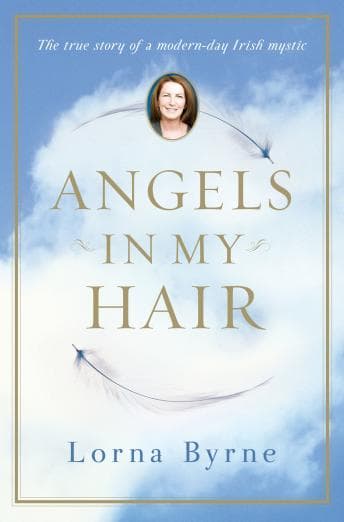

What happens when you approach a mystic's autobiography with the analytical framework of a psychologist? You get a very confused psychologist, that's what.
I started Angels in My Hair on a Saturday night while cooking dal from my mother's recipe — the one she insists I'm doing wrong even though I follow it exactly. The kitchen smelled like cumin and mustard seeds, and Sile Bermingham's soft Irish lilt was filling the room, and I found myself in this strange liminal space between skepticism and genuine curiosity. Which, honestly, might be exactly where Lorna Byrne wants you.
The Psychology of Believing What You Can't See
Here's what grabbed me. Lorna Byrne doesn't present herself as some grand prophet or spiritual authority. She describes growing up in poverty in Ireland, being labeled intellectually disabled by the adults around her, and quietly seeing angels the entire time. The protagonist exhibits classic characteristics of what narrative psychology would call a "hidden knower" — someone whose inner world is rich and complex while the external world dismisses them as simple. And that framework? It's genuinely compelling regardless of whether you believe in angels.
What makes this character — and yes, I'm treating a real person's memoir like a character study, my dissertation committee would be proud — what makes her compelling is the gap between her interior experience and how everyone around her perceives her. She's describing visions of angelic beings in golden light while her teachers think she's slow. That dissonance carries real emotional weight.
But here's where my BS detector started pinging. Byrne's account is remarkably consistent across decades of her life. No periods of doubt. No crisis of faith that doesn't resolve neatly. The research actually shows that even deeply religious mystics throughout history — Teresa of Ávila, Julian of Norwich — describe periods of spiritual dryness, of feeling abandoned. Byrne's narrative is almost too steady. Psychologically, this doesn't quite track for me, and I kept waiting for a moment of genuine rupture that never really came.
The marriage to Joe and his subsequent illness — that should be the rupture. And it does introduce real grief into the narrative. The only memoir I've read that handles grief with comparable emotional honesty — but far less neatly — is When Breath Becomes Air, where the rupture never really resolves and the book is all the more devastating for it. But even here, the angels provide comfort and guidance at exactly the right moments. It's emotionally satisfying in the way a well-structured story is, which made the psychologist in me raise an eyebrow even as the human in me was moved.
Bermingham's Voice Does the Heavy Lifting
Sile Bermingham narrates with this warm, unhurried Irish cadence that turns eleven hours into something that feels like sitting with your grandmother while she tells you family stories you're not sure are entirely true but you don't care because the telling matters. Her emotional delivery is genuinely heartfelt — she reads Byrne's descriptions of angelic encounters with the same matter-of-fact tone as the passages about hanging laundry or struggling to feed her children, and that consistency actually works. It makes the supernatural elements feel domestic, lived-in.
I will say the narration doesn't differentiate much between voices when Byrne quotes conversations with family members or the angels themselves. Everyone sounds more or less like Bermingham, which flattens some of the dialogue-heavy sections. For an 11-hour listen, I would've appreciated more vocal distinction — especially between the human characters and the spiritual beings, since that divide is kind of the whole point of the book.
No production issues. No weird audio artifacts. Just clean, straightforward narration.
This Is a Fascinating Case Study in Audience Self-Selection
I found myself asking: why does this book work for so many people while making others deeply uncomfortable? And I think the answer is that Byrne isn't really writing for skeptics. She's writing for people who already sense something beyond the material world and want permission to trust that sense. The book functions less as evidence and more as companionship.
My therapist would have thoughts about this — about how we seek narratives that validate our existing beliefs, and how that's not necessarily a bad thing. Sometimes the story you need isn't the one that challenges you. Sometimes it's the one that says "yes, the thing you feel is real."
Do I believe Lorna Byrne literally sees angels with wings and golden light walking beside people on the streets of Dublin? The research psychologist in me can't go there. But do I believe she experiences something profound and genuine that has brought comfort to millions of people? Yeah. I actually do.
Who This Is For (and Who Should Jog Right Past It)
If you need empirical evidence or logical argumentation, skip it. You'll spend eleven hours frustrated. If you're open to spiritual memoir as its own genre — where the truth being conveyed isn't necessarily literal but emotional — and if you find comfort in the idea that unseen forces might be looking out for you, this is a genuinely warm listen. Bermingham's narration makes it easy to sink into, especially at bedtime. Not because it's boring. Because it's gentle.
My Clinical Assessment (Don't Tell My Committee)
I went in expecting to pick this apart. I did pick it apart — that's just who I am. But I also finished it, and I also cried a little during the sections about Joe's illness, and I also caught myself looking out the window afterward wondering if there was something standing just outside my peripheral vision. Make of that what you will.