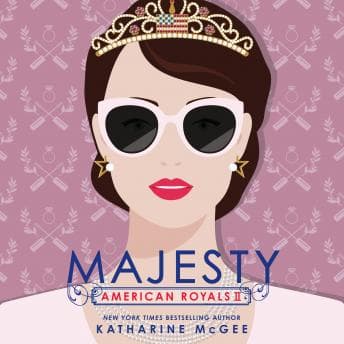

"Power is intoxicating. Like first love, it can leave you breathless."
I was supposed to be debugging my procedural dungeon generation algorithm when that line hit somewhere around the 45-minute mark. And yeah, I closed my laptop. Dr. Patel can wait. The Washington family drama could not.
Look, I'll be honest with you. This isn't my usual wheelhouse. I'm the guy who needs hard magic systems and preferably a map in the front matter. But my D&D group's cleric has been pestering me about this series for months, insisting that palace intrigue scratches the same itch as a good Game of Thrones political subplot. She was... annoyingly correct.
Four POVs Walk Into a Palace
Here's where McGee does something genuinely clever. You've got Beatrice, Sam, Nina, and Daphne - four women orbiting the same throne with completely different gravitational pulls. It's like running a campaign where everyone rolled the same class but took wildly different subclasses. Beatrice is your reluctant paladin who never asked for the crown. Sam's the rogue who'd rather cause chaos than rule. Nina's the commoner bard who got swept into court politics. And Daphne? Daphne is absolutely running a long-con warlock pact with ambition itself.
The four-POV structure does get a bit breathless at times. Just when you're settling into Beatrice's weight-of-the-crown angst, you're yanked into Sam's party princess escapades. It's not bad, exactly - more like channel surfing between four different CW shows that happen to share a universe. Some listeners have called it rushed, and I get that. But honestly? It kept my ADHD brain engaged during a late-night coding session that turned into a "just one more chapter" situation.
Brittany Pressley and the Four-Voice Tightrope
So here's the thing about narrating four distinct female leads who all run in the same social circles: it could go very wrong very fast. Pressley threads this needle with surprising precision. She gives each POV character just enough vocal distinction that you know who's speaking without her resorting to cartoon voices. Beatrice sounds weighted, like she's carrying invisible chains. Sam's got this lighter, more impulsive energy. Nina reads as grounded, real - the outsider perspective you need. And Daphne... there's this subtle edge to Daphne's sections, something calculating underneath the polished surface.
The AudioFile review nailed it when they noted how Pressley "conveys the stress of social expectations as well as the joys of new romance." That's exactly right. When Beatrice is struggling with her new role as America's first queen, you feel that tension in Pressley's delivery. It's not just reading words - she's performing the emotional subtext.
Her voice is genuinely melodic. I listened to about four hours while organizing my board game shelf (yes, I have a system, no, I won't explain it) and the narration never grated. That's a bigger deal than it sounds. Twelve and a half hours is a commitment, and a narrator who annoys you by hour three makes that commitment feel like a prison sentence.
No Magic System, But There ARE Rules
Okay, there's no magic system. But there IS a system, and it's palace politics. Who's in favor, who's out, who's scheming, who's oblivious. McGee builds these social hierarchies with the same care a good fantasy author puts into their worldbuilding. You understand the rules - what happens if a princess dates a commoner, what it means to be photographed at the wrong event, how tabloid coverage can be weaponized.
Daphne's plotline is particularly delicious if you like watching someone play 4D chess while everyone else is playing checkers. She's got secrets that could destroy her, and watching her navigate that is genuinely tense. That kind of high-stakes personal navigation reminded me of Tattooist of Auschwitz, where survival depends on reading power dynamics perfectly. My D&D group would absolutely use her as a template for a political campaign villain. (Taking notes, actually.)
Roll for Initiative (Or Don't)
If you need dragons and sword fights, this isn't your book. But if you've ever gotten invested in the social dynamics of a fantasy court - the marriages, the alliances, the whispered conversations behind closed doors - you'll find that same satisfaction here. It's The Crown meets Crazy Rich Asians, and yeah, that comparison is on the marketing copy, but it's also accurate.
This works great for commutes, chores, or any activity where you want to be entertained but don't need to take notes. I wouldn't recommend it for focused listening during complex work - the multiple POVs mean you'll lose track if you zone out for five minutes.
Skip it if: You actively dislike romance subplots, you need action scenes to stay engaged, or you're allergic to anything that could be described as "guilty pleasure."
The Thesis Can Wait (It Always Does)
Look, I started this at 11 PM thinking I'd listen for an hour while my code compiled. I finished at 2 AM with no regrets and a strong opinion about which Washington sibling I'd want at my D&D table. (Sam. Obviously Sam. She'd play a chaos goblin and I'd allow it.)
Is it Sanderson-level worldbuilding? No. Is it a satisfying, well-narrated twelve hours of palace drama with distinct characters and genuine stakes? Yes. Sometimes you want an epic fantasy that rewires your understanding of narrative. Sometimes you want to watch rich people make terrible romantic decisions while a talented narrator makes it all sound like poetry.
My thesis remains unwritten. The Stormlight Archive remains unfinished. But I regret nothing.