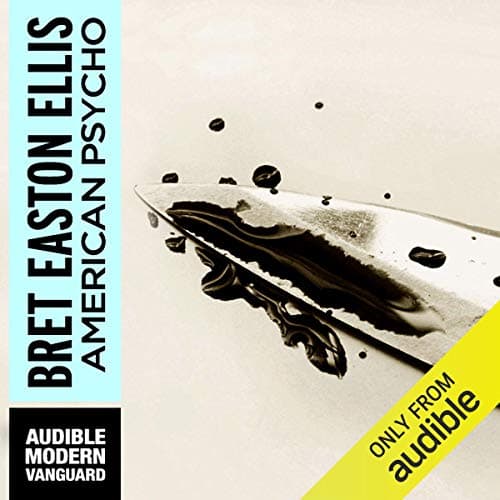

Look, I need to get something off my chest: I did not need to hear a man describe the exact thread count of his Egyptian cotton sheets, the precise brand of every moisturizer in his medicine cabinet, and the specific designer of every single person's outfit at a restaurant — for sixteen and a half hours. And yet here I am, having listened to the entire thing, unable to stop, vaguely disgusted with myself, and absolutely certain that's exactly what Bret Easton Ellis wanted.
American Psycho in audiobook form is a different beast than reading it on the page. When you read the novel, your eyes can skim past the fourth consecutive paragraph about business card fonts or hair care routines. In audio, Pablo Schreiber makes you sit through every excruciating detail, and that's where something fascinating happens — the monotony becomes the horror. The repetitive cataloguing of consumer goods, the obsessive brand-name worship, the hollow status signaling — it all blurs together into a kind of white noise that mirrors Patrick Bateman's interior void. When the violence erupts, it hits differently because you've been lulled into this dead-eyed consumer trance.
Schreiber's performance is the reason this production works as well as it does. His Patrick Bateman is not Christian Bale's Patrick Bateman, and that's a deliberate, intelligent choice. Where Bale went for theatrical mania — the ax swings, the raincoat, the sweat — Schreiber plays it cold. Controlled. Almost boardroom-professional. His Bateman describes unspeakable acts with the same measured, careful cadence he uses to discuss a reservation at Dorsia or the merits of a particular business card stock. The effect is deeply unsettling. There's a chilling atonality to his delivery that gets under your skin precisely because it refuses to sensationalize.
The character differentiation is subtle — slight inflections, minor shifts in register — nothing that would break the spell of being trapped inside Bateman's skull. And you are trapped. That's the point. You're hearing the world through the filter of a man who may or may not be a serial killer, who definitely cannot tell his colleagues apart, and who is slowly losing whatever tenuous grip on reality he ever had. The confusion Bateman experiences in the later chapters — the escalating unreliability, the moments where he seems genuinely bewildered by his own actions — comes through in Schreiber's delivery with real precision.
Now, I completely understand the listeners who find this narration flat or heavy. They're not wrong, exactly — it IS flat and heavy. That's the novel's DNA. Ellis wrote a book that weaponizes tedium, and an audiobook version that somehow made the tedium exciting would be a betrayal of the source material. But knowing why the flatness is there doesn't necessarily make sixteen hours of it easy to endure. If you need emotional warmth, dynamic vocal energy, or a narrator who occasionally sounds like he's having fun, this will test your patience.
The iconic moments land beautifully in audio. The "Hip to be Square" scene — you know the one — plays out with this horrifying cheerfulness that Schreiber nails. Bateman's extended music criticism monologues about Huey Lewis, Whitney Houston, and Phil Collins take on an almost hypnotic quality when performed aloud. They're simultaneously hilarious, pathetic, and terrifying, because you understand that this is a man performing normalcy with the same detached precision he brings to everything else.
As a social satire, this book hasn't lost its edge. The Wall Street culture of the 1980s that Ellis skewers — the vacuity, the interchangeability of people, the elevation of surface over substance — feels almost quaint compared to our current moment, and yet eerily familiar. Bateman is invisible not because he's clever, but because nobody around him is paying attention to anyone. Nobody is real to anyone else. The audiobook format amplifies this loneliness in ways I didn't expect. That particular flavor of isolation — people moving through the same world without ever truly seeing each other — haunted me in a completely different register when I spent time with I Found You, though Ellis would probably find its emotional transparency embarrassing.
A few practical notes: this is absolutely not a background listen. The content is extreme — graphically violent, sexually explicit, and deliberately provocative. You need to be in a mental space where you can engage with deeply disturbing material presented without moral commentary. Ellis doesn't hold your hand. He doesn't tell you how to feel. The bonus Jim Atlas interview at the end provides some welcome context, but the novel itself is a cold, brilliant provocation that demands active participation from the listener.
Who Should Listen (And Who Should Skip): If you appreciate horror that works through sustained psychological dread rather than jump scares, and you have the stomach for extreme content delivered without flinching, this is essential listening. Skip it if you need your narrators animated, your pacing brisk, or if graphic depictions of violence — described in the same tone as a skincare routine — will wreck you rather than fascinate you.
Schreiber's performance elevates already extraordinary material into something that feels genuinely vital in audio form. It's not the definitive Bateman — there probably can't be one — but it's a remarkably effective interpretation that trusts the text and trusts the listener to keep up. I came away from this feeling like I'd spent sixteen hours in the company of genuine madness disguised as meticulous normalcy, which is exactly the experience Ellis designed.









