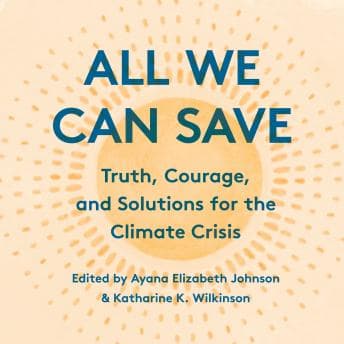

I was debugging a memory leak at 11 PM on a Tuesday when Jane Fonda's voice came through my headphones talking about soil regeneration, and honestly? That cognitive whiplash was exactly what I needed. There's something surreal about staring at stack traces while someone explains how kelp forests could save us. But that's how I consumed most of this 15-hour anthology—in weird pockets of time between deploys, on packed Caltrain cars, during one particularly long wait at the DMV.
Bottom Line: Worth your commute, but not all at once. This is a buffet, not a prix fixe.
Twelve Narrators Walk Into a Climate Crisis
The narrator situation here is wild. You've got Julia Louis-Dreyfus, Janet Mock, Alfre Woodard, Bahni Turpin—basically a murderer's row of voice talent plus the editors themselves. And it works way better than it should. Each narrator brings different energy to their essays, which keeps things from blending into one long lecture.
Alfre Woodard reading about environmental justice? Goosebumps. America Ferrera on Latinx climate activism? Spot on. Production quality is solid—clean audio, smooth transitions between narrators. Some voices are definitely more polished than others (you can tell who's a professional audiobook narrator versus who's an actor doing their first long-form recording), but it never got distracting enough to pull me out.
The poems scattered throughout are a nice palette cleanser. I'm not usually a poetry person—my brain wants bullet points—but hearing them performed broke up the denser policy sections in a way that actually helped retention.
The Essays That Actually Stuck
Here's the thing about anthologies: they're inherently uneven. Some essays hit hard, some feel like they could've been blog posts. The ones that stuck with me were the hyper-specific, practical pieces—Leah Penniman on regenerative farming, Kate Orff on coastal resilience design. These are women who are actually building solutions, not just theorizing about them. The ROI on those chapters was high.
The more theoretical pieces on climate grief and eco-anxiety were... fine? Useful for some listeners, I'm sure. But I found myself zoning out during a few of them, especially around hours 8-10. (Maybe don't listen to this section during your 6 AM commute when you're already half-dead.)
What I appreciated was the diversity of approaches. You've got scientists, lawyers, farmers, activists, poets—and they're not all saying the same thing in different words. Rhiana Gunn-Wright on the Green New Deal policy mechanics is completely different from Tara Houska on Indigenous resistance. The book doesn't pretend there's one solution or one way to engage. That felt honest.
Best Listening Modes (And When to Skip)
I listened to most of this at 1.5x, which worked fine for the essays. The poems I slowed down for—they're meant to breathe. This isn't the kind of audiobook where you need to catch every word to follow a plot. You can zone out for a few minutes, come back, and still get value from whatever section you land in.
If you're looking for a comprehensive climate science primer, this isn't it. It's more about the human side—the emotional, political, community-building aspects of climate work. If you want the hard science, pair this with something like David Wallace-Wells (though fair warning, that one will ruin your week).
My one real criticism: at 15 hours, it's a lot. I finished it over about three weeks of commutes, and that pacing felt right. Trying to binge this would probably lead to burnout and despair—literally the opposite of what the book is going for.
Your Ideal Listener Profile
Queue it up if: You're feeling paralyzed about climate change and want to hear from people actually doing something. You're tired of climate content that's either doom-scrolling fuel or naive optimism. You want women's voices centered in a space historically dominated by dudes in fleece vests.
Skip if: You want a linear narrative or a single author's vision—anthology formats will frustrate you here too. Also skip if you're looking for international perspectives; this is very US-focused, which the editors acknowledge but still felt like a gap.
I came away from this with a reading list, a few new podcasts to check out, and—weirdly—less anxiety than I started with. The book's thesis is basically that despair is a luxury we can't afford, and that there are smart, capable people working on this. That same grounded, action-over-paralysis energy runs through Mindful Athlete: Secrets to Pure Performance—different domain, same refusal to let overwhelm win. Hearing their actual voices made that feel more real than reading it on a page would have.
The Debug Report
Would I listen again? Probably not straight through, but I've already gone back to a few specific essays. That's the nice thing about the anthology format—it's modular. Take what you need, skip what you don't.






![Steve Jobs [unabridged audiobook] audiobook cover](/_next/image?url=https%3A%2F%2Fcovers.audiobooks.com%2Fimages%2Fcovers%2Ffull%2F9788499923406.jpg&w=1920&q=75)