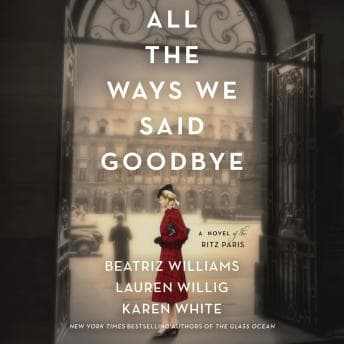

"La Fleur." That name kept pulling me back in every single time Sophie's screaming yanked me out of the story. I'd be sitting in the school pickup line, earbuds in, mentally standing in occupied Paris with Daisy Villon trying to smuggle forged papers past Nazi officers, and then — MAMA I WANT GOLDFISH — and I'd lose the thread for ten minutes. But here's the thing about this book: I always found my way back. Three timelines, three women, one iconic hotel, and somehow my sleep-deprived brain kept all of it straight.
Three Wars, Three Women, One Hotel That Outlasts All of Them
So the structure: you've got Aurelie in 1914, falling for a German officer while her family estate is literally occupied by the enemy. Daisy in 1942, married to a Nazi collaborator but secretly running Resistance missions through the Ritz. And Babs in 1964, a recently widowed Englishwoman trying to figure out who the mysterious "La Fleur" was and why this woman haunted her marriage. Each timeline gets its own narrator, which — thank God — because with three authors writing three different storylines, having three distinct voices in my ears was the only way this was going to work during multitasking.
The 1942 Daisy storyline grabbed me hardest. There's something about a woman living in the Ritz under Nazi occupation, wearing silk and pearls to dinner with German officers while hiding forged identity papers for Jewish refugees, that just gets under your skin. Her grandmother — this brassy American socialite who basically refuses to acknowledge that France has fallen — is the kind of character I want at every dinner party I'll never attend. The tension ratchets up when Daisy gets deeper into the forgery network, and there's a scene where she has to bluff her way through a checkpoint with documents hidden in her daughter's teddy bear that had me gripping my steering wheel in the garage at 9 PM like an absolute lunatic.
Aurelie's WWI storyline is more romantic and sweeping — the forbidden love with Max Von Sternburg has that classic doomed wartime feel. It's the most predictable of the three plotlines but also the most emotionally rich. You know it's going to end badly (it's 1914, nothing ends well), but watching Aurelie choose between loyalty to France and love for this German officer still hits. The betrayal scene genuinely surprised me, and I thought I'd seen it coming from chapter two.
Babs in 1964 is the connective tissue — the mystery hunter, the one peeling back layers. Her storyline is the lightest, almost cozy-mystery adjacent, with a budding romance with lawyer Drew Bowdoin that's sweet without being saccharine. That same quiet emotional pull — where the mystery is almost secondary to the grief underneath it — is what made Newcomer stick with me too. She's the one who ties everything together, and by the time the pieces click into place about who La Fleur really was, I was sitting in my parked car in broad daylight with tears running down my face. Made me cry at school pickup. Worth it though.
Saskia Maarleveld's Accent Game Is No Joke
Three narrators: Helen Sadler handles Aurelie's WWI sections, Nicola Barber takes Babs in the 1960s, and Saskia Maarleveld voices Daisy's wartime Paris. All three are strong, but Maarleveld stood out — her switching between Daisy's controlled Parisian French-accented English and her grandmother's unapologetic American brashness happens so naturally that I stopped noticing the transitions. She carries the most emotionally complex storyline and she earns every moment of it. Barber gives Babs this understated British reserve that cracks at exactly the right moments, and Sadler handles Aurelie's youthful passion without making her sound naive. Having three narrators for three timelines is such a smart choice because my brain automatically knew "oh, this voice means we're in 1942 now" without needing any transition.
At 14 hours, this is longer than my usual comfort zone. But 1.25x brought it down to manageable, and I finished it in about nine days — morning drop-offs, two nap times that actually happened (miracle), and several garage sessions. The pacing is steady rather than fast. The 1964 timeline moves slower than the other two, which makes sense since Babs is investigating rather than surviving a war, but there were a couple of stretches where I wished she'd figure things out a little quicker.
The Big Reveal Earns Its Fourteen Hours
Here's what I didn't expect: the twist. I won't spoil it, but the revelation about La Fleur's true identity — and what really happened between all three family lines — reframes everything you've been listening to. It's the kind of ending that makes you want to immediately relisten to the first few chapters. (I didn't, because Sophie woke up, but the impulse was there.) Satisfying ending — exactly what I needed.
Not groundbreaking, but sometimes you don't need groundbreaking. This is a well-constructed multi-timeline historical novel with genuine heart, solid mystery mechanics, and three love stories that feel distinct from each other. If you loved The Forgotten Room or The Glass Ocean from this same author trio, you know what you're getting. If you haven't read those, this one stands alone perfectly fine.
Perfect for multitasking moms who want something smart but not homework. Car time approved. My book club will love this — if I ever have time for book club again.