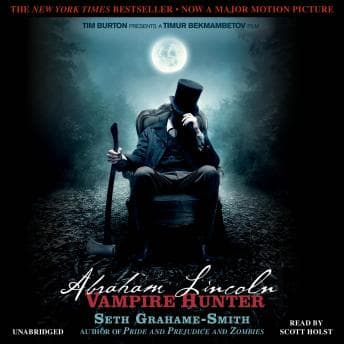

Look, I'll admit it. When I first heard the premise of this book, my immediate reaction was: this is ridiculous. Abraham Lincoln. Vampire hunter. The man who preserved the Union and ended slavery... also killed vampires on the side? My inner academic wanted to be offended.
But here's the thing about Seth Grahame-Smith. He commits. And I mean fully commits. This isn't some winking, ironic mash-up that's embarrassed of its own concept. He writes this thing like he's Doris Kearns Goodwin channeling Bram Stoker, and somehow—against all my better judgment—it works.
The Psychology of a Premise This Absurd
What makes Lincoln compelling here is that Grahame-Smith doesn't just slap vampires onto his biography. He builds them into the emotional architecture of the man's life. Lincoln's mother dies from "milk sickness"—historically accurate—but in this version, it's a vampire attack. Suddenly you have a grief-fueled origin story that actually tracks psychologically. Revenge as a coping mechanism for childhood trauma? I see this pattern in the research all the time. Young Abe channels his loss into purpose, his rage into discipline. Classic sublimation.
The book treats the vampire hunting as Lincoln's shadow self—the violence he couldn't express publicly, the darkness that fueled his public light. I kept asking myself: why does this ridiculous premise feel emotionally coherent? Because Grahame-Smith understands that great characters need internal contradictions. Lincoln the statesman and Lincoln the axe-wielding avenger aren't at odds here. They're two expressions of the same wound.
(Don't tell my students I spent a weekend analyzing vampire fiction. They already think I'm weird.)
Scott Holst's Tightrope Walk
The narration. Scott Holst has an impossible job here. He needs to sound like a serious historical biographer while also selling lines about undead confederates. And mostly? He nails it.
His Lincoln voice works—measured, thoughtful, with that melancholic weight you'd expect. He shifts between the dry academic narrator reading "from the journal" and Lincoln's own perspective without losing you. Clean diction, deliberate pacing. When the action kicks in, he brings energy without going full melodrama.
But—and this is where listener opinions diverge—his character voices can feel a bit theatrical. Some of the regional accents land in cliché territory. I noticed it with a few of the Southern characters especially. Not terrible, just noticeable. Like he's doing impressions rather than inhabiting people.
The bigger issue is the footnotes. Grahame-Smith peppers the text with academic-style footnotes (part of the "serious biography" bit), and in audio form, these interrupt the narrative flow constantly. Just when you're in a tense scene, you get pulled out for a historical aside. On the page, your eye can skip ahead. In audio, you're stuck. It's a structural problem, not Holst's fault, but it drags the pacing in spots.
From Axe-Swinger to President
The book covers Lincoln's entire life, which means it's part coming-of-age revenge tale, part political drama, part horror novel. The early sections—young Abe discovering the truth, training himself, hunting his first vampires—move fast and hit hard. This is a fascinating case study in how genre fiction can illuminate historical figures by giving them fictional stakes (pun intended).
The middle section slows down as Lincoln enters politics. The vampire hunting becomes more sporadic, and the book leans heavier into actual history. Some listeners find this stretch monotone. I actually appreciated the tonal shift—it mirrors Lincoln's own arc from private warrior to public figure. But if you're here purely for the axe-swinging action, you might zone out.
The Civil War section brings everything together. The reveal that slavery and vampirism are connected—that Southern vampires use enslaved people as a food source—is genuinely dark. Psychologically, it gives Lincoln's abolitionism a visceral, personal dimension beyond moral conviction. It's pulpy as hell, but it works.
Who's This For (And Who Should Run)?
Skip this if you want a serious Lincoln biography or if you're sensitive to violence (there's a lot of it, graphically described). Skip it if you hate genre mash-ups on principle. But if you're in the mood for something that asks "what if American history was secretly a horror movie?" and actually delivers on that question? This is your book.
My Clinical Assessment
Would I listen again? Probably not. But I'm glad I listened once. This is a commute book—something to keep you engaged during long drives or boring workouts. It's not deep literature, and it's not trying to be. Jurassic Park operates in that same sweet spot—genre fiction that takes itself seriously enough to earn genuine emotional investment. Smart pulp that respects its premise enough to build a real emotional throughline.
The narration is solid if imperfect, the story is better than it has any right to be, and you'll never look at the Lincoln Memorial the same way again.
(My therapist would have thoughts about why I found the vampire-hunting-as-grief-processing angle so compelling. We're not going there.)